Concerns about Smithsonian's 'radical,' superficial view of U.S. history started long before Trump
The most recent effort centers on House Republicans demanding answers to why the federally funded Smithsonian Institution staged an installation that appeared to have deviated from its original purpose of showing how home designs shape America.
Congressional Republicans have in recent days reignited efforts to rein in what they called the Smithsonian Institution’s “radical view of American history” in its programming – a concern that President Trump has led since his return to office but also dates back to at least the late 1990s.
The most recent effort centers on House Republicans demanding answers from outgoing Smithsonian Secretary Lonnie Bunch about why the federally funded Smithsonian staged an installation at the Cooper Hewitt, Smithsonian Design Museum that appeared to have deviated from its original purpose of showing how home designs shape American life, instead presenting how the U.S. military has deliberately and systematically destroyed homes and neighborhoods.
Internal policy to review proposed exhibitions and identify 'potentially sensitive or controversial' content
The letter sent last week leans into a U.S. Inspector General's report in June on the 2024-25 Making Home – Smithsonian Design Triennial exhibit that concluded the Smithsonian failed to fully implement what is known as Smithsonian Directive 603 – internal policy for reviewing proposed exhibitions to identify “potentially sensitive or controversial” content.
“Cooper Hewitt generally followed the Smithsonian’s content review process,” the 32-page report reads. However, [the Office of the Inspector General] identified opportunities to further strengthen this process.
“The SD 603 Committee’s authority, role, and procedures for reviewing sensitive content have not been formalized. Despite its role in reviewing sensitive exhibit content, the SD 603 Committee is not formally named or structured within SD 603 to define its purpose, responsibilities, and authority. The committee also lacks procedures describing how reviews should be conducted and resources to support the review process.”
The letter to outgoing Smithsonian Secretary Bunch, by the GOP-led House Oversight Delivering on Government Efficiency Subcommittee, said that panel members are "concerned that the Smithsonian has cultivated a scholarly community that supports insinuations that the deliberate destruction of homes to intentionally cause human suffering is intertwined with the military doctrine of the United States."
The letter also states the exhibit was initially proposed to showcase 10 New York City buildings but was instead turned into a "display of homes destroyed by American made munitions in various military engagements against ISIS and other terrorist organizations.”
The exhibit also grew from one room to three floors.
Trump: "A distorted narrative driven by ideology rather than truth"
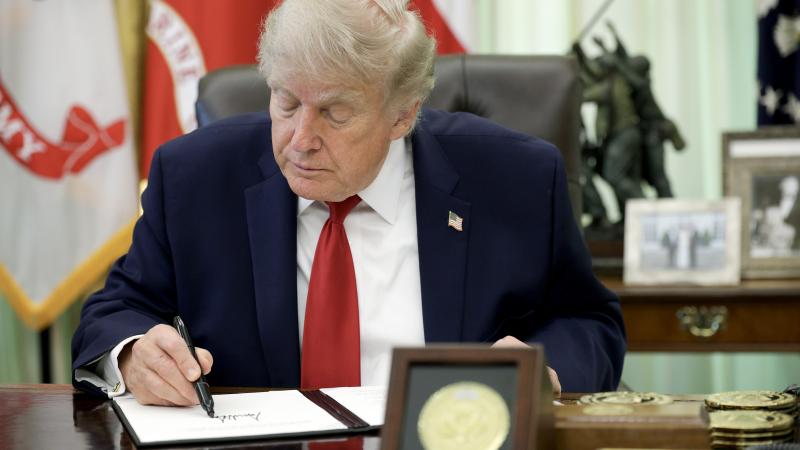
President Trump took aim at the Smithsonian – the world's largest museum, education, and research complex – just weeks after taking office in January 2025.
“Over the past decade, Americans have witnessed a concerted and widespread effort to rewrite our Nation’s history, replacing objective facts with a distorted narrative driven by ideology rather than truth,” he wrote in a March 2025 executive order.
“It is the policy of my Administration to restore Federal sites dedicated to history … to solemn and uplifting public monuments that remind Americans of our extraordinary heritage [and] consistent progress toward becoming a more perfect Union," Trump wrote in the order, in which he specifically takes aim at such sites as the National Historical Park, in Philadelphia, and the National Museum of African American History and Culture, in Washington, D.C.
“To advance this policy, we will restore the Smithsonian Institution to its rightful place as a symbol of inspiration and American greatness.”
In July of this year, the Trump administration issued a 162-page report accusing the Smithsonian of engaging in "extreme political activism" and presenting "a radical view of American history." Along the way, Trump continued to hold Bunch responsible, threatening to fire him.
Bunch led the Smithsonian for roughly seven years, and resigned in early September, amid Trump’s pressure campaign and before his administration said it was preparing a dozen signs for the Smithsonian’s Washington, D.C., museum sites that would warn visitors about the institution in general, and the National Museum of American History in particular, according to National Public Radio.
Culture clash a decades-old problem for Smithsonian
Other Smithsonian flashpoints include a 2021-25 exhibit titled "The Electric Dr. Franklin" that speculated Benjamin Franklin may have shocked slaves in electrical experiments. Critics objected to this phrasing, arguing that it was speculation and lacked direct documentary evidence.
In addition, roughly 23 years earlier, author and culture commentator David Brooks argued in The Weekly Standard that the National Museum of American History “ignores or virtually ignores most of the major events in American history,” pointing to what he considered little on display about the nation’s defining moments — including the Constitutional Convention and the Lewis and Clark Expedition — or such prominent figures as Abraham Lincoln and Martin Luther King Jr.
Bunch, in his Sept. 8 resignation letter, didn’t reference the White House criticism but said, "I have fought for as long as I can.”
The administration's warning about the signs came in a letter from Interior Secretary Doug Burgum to Sens. Lisa Murkowski, of Alaska, and Oregon's Jeff Merkley, the top Republican and Democrat, respectively, on the Senate Appropriations committee, which oversees Smithsonian funding.
"The leadership of the Smithsonian and NMAH have altered the museum's role from accurately and coherently telling America's story to using the museum as a tool to advance personal, radical ideologies,” the letter reads.
The Facts Inside Our Reporter's Notebook
Top Stories



Trending
Just the News Spotlight
Just News, No Noise