Related Articles

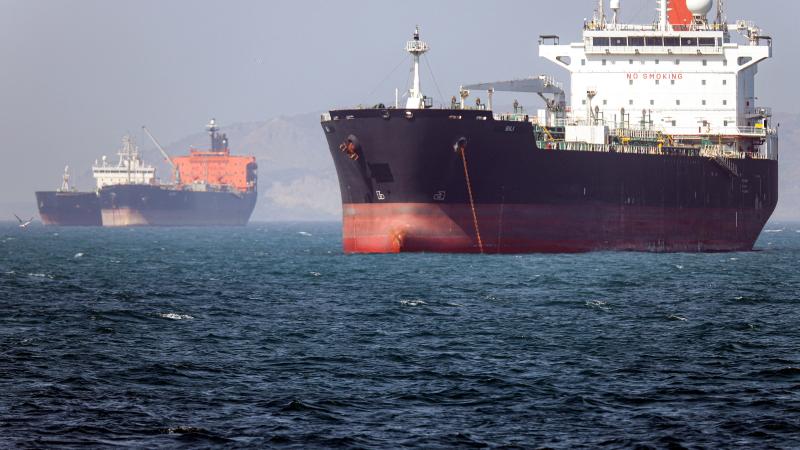
Despite Tehran's insistence that it controls the vital waterway, Middle East energy flows have largely returned to pre-war levels. This comes after Iran's failed attempt at creating economic disaster for the West by attacking oil-laden ships, and instead, at least 16.5 million barrels a day of crude oil left the Middle East last month.
The Iranian regime is remaining publicly defiant in the face of the U.S. blockade of its economy, claiming that it controls the Strait of Hormuz and will not agree to limits on its nuclear program.
However, the facts belie Tehran’s claims. In fact, Middle East oil exports have largely returned to pre-war levels in recent months, showing the regime’s ongoing attacks in the Strait of Hormuz aimed at pressuring its neighbors and the United States are no longer working.
Mohammadreza Naqdi, an advisor to Iran’s Islamic Revolutionary Guard Corps — the powerful paramilitary organization tasked with safeguarding the regime — said on Wednesday that the Strait of Hormuz remains “closed” and the “armed forces of the Islamic Republic of Iran have full control over it.” He vowed that conditions would remain as such “until Iran’s legitimate demands are met.”
Last week, Iranian parliament speaker Mohammad Baqer Qalibaf presented to the United Nations the conditions under which Iran would “reopen” the strait. The conditions echo the Iranian demands contained in the Memorandum of Understanding that the United States and Iran signed this summer, but which broke down after negotiations ended at an impasse and intermittent fighting resumed between the opposing sides.
The Trump administration countered, saying that Iran is losing its grip amid the escalating economic pressure the United States has heaped on Tehran. Secretary of State Marco Rubio said on Wednesday that Iran has “lost complete control” of the strait.
“The Straits of Hormuz are open. There is almost as much oil flowing out now as there was before this conflict began,” Rubio told reporters. “So they’ve lost complete control of the straits and their economy. And [...] not only are they in free fall, now the Iranian economy is about to reach a place that few countries in the world have been in terms of how bad it's going to get.”
President Donald Trump said on Thursday that the United States and Iran “are having productive discussions” and highlighted the tough economic conditions in Iran developing from the U.S. blockade.
“I want to make it clear to everybody that, while Iran is in very bad condition, both economically and militarily, and while the Blockade will remain in full force and effect, with oil flowing in Record Numbers of Barrels through the Hormuz Strait (22 Million Barrels, last night alone, with not one barrel coming from, or going to, Iran!), we will not be attacking Iran at any time prior to the Midterm Elections to be held in the United States on November 3rd,” the president posted to Truth Social.
Fred Fleitz, the chief of staff of the National Security Council during Trump’s first term, told the Just the News that Iran does not actually want a deal, but is seeking relief from the crushing economic blockade.
“They're not planning on making any significant deal there. They want concessions from Trump up front. He's never going to agree to that. If they really wanted to make a sincere deal right now, I think Trump and his people would listen, but they don't. And I think these radicals in this government, the IRGC, they'll burn the country down before they'll give a win to Trump,” Fleitz told the John Solomon Reports podcast.
“I think we have to carry out this economic strangulation strategy, which is more than sanctions. We're not just saying you can't trade with Iran, you can't do banking with Iran. We've stopped them from exporting oil. It's an extraordinary amount of economic pressure,” he added.
Max Meizlish, a research fellow at the Foundation for Defense of Democracies and former Treasury Department sanctions official, told Just the News that Iran’s claims to control the strait are “laughable,” but that the regime’s military has still retained the capability to attack commercial vessels transiting the vital waterway.
“The reality is that Iran neither maintains full control over the Strait of Hormuz, nor is its control entirely gone,” Meizlish told Just the News. “What it controls is its ability to target ships that transit either by way of U.S. escort or otherwise. But even if we discount the fact that oil flows have at least partially returned to pre-war levels, the idea that Iran controls the strait is laughable.”
Meizlish said, however, that the Iranian regime’s own oil exports have not been revived alongside its neighbors due to the crushing U.S. blockade. “The regime hasn’t been able to export any crude by sea since the blockade was reinstated. If Iran controls the strait, why have its oil exports plummeted?”
Last month, at least 16.5 million barrels a day of crude oil left the Middle East Gulf region, matching the pre-war average for the region's producers other than Iran, according to tanker-tracking and satellite analysis by global trade data firm Kpler. That is 10.5 million barrels a day more than the region averaged in March, the first full month after the war shut down the strait, the firm found.
While its neighbors have seen the revival of their oil exports, Iran is missing out on the recovery, Just the News previously reported. The country’s oil exports have hovered near zero since the U.S. imposed a naval blockade of Iranian ports in July after the ceasefire broke down.
The blockade has undercut Iran’s central wartime bet: that choking off the world's most important energy corridor — the Strait of Hormuz — would inflict enough pain on global markets to force Washington and the Gulf states to deal on Iran's terms.