Related Articles
At the same time it is pursuing a greater trading relationship with China, Starmer’s government has been retreating on Chinese national security challenges.
United Kingdom Prime Minister Sir Keir Starmer traveled to China this week to reset icy relations with the communist power, following in the footsteps of Canada, which recently signed its own trade deal.
With Starmer’s trip, the United Kingdom joins a growing train of U.S. allies seeking closer commercial ties with Beijing, which appears primarily geared toward pushing back against President Donald Trump’s trade policies and confrontations over security issues.
Yet, at the same time that it is pursuing a greater trading relationship with China, Starmer’s government has been retreating on Chinese national security challenges, such as caving to a new Chinese embassy close to sensitive data cables and planning to cede a key Indian Ocean island, a move opposed by Washington.
These moves potentially set Britain’s liberal government on a collision course with President Trump, who, while open to a trade deal himself with Beijing, has aggressively pursued reducing Chinese influence and power, principally in the Western Hemisphere and among allies.
Starmer says he believes a middle way is possible. He aims to boost his country’s economic relationship with China and the United States at the same time.
Starmer’s is a more muted strategy than his Canadian counterpart, Prime Minister Mark Carney, who announced last week a new trade deal with Beijing aimed at reducing dependence on the U.S. and delivered sharp criticisms of Trump at the World Economic Forum in Davos. These moves earned Carney a new threat of 100% tariffs on Canada from President Trump.
It remains to be seen if Starmer’s reset with Beijing will elicit a similar reaction from the American president. Chinese President Xi Jinping certainly viewed the British visit as a welcome development after “twists and turns” in the relationship “that did not serve the interests of our countries” in recent years.
Several sticking points in recent years soured the relationship between Beijing and London, many of which stemmed from the growing competition between China and Britain’s closest ally, the United States.
In 2018, at the urging of President Trump during his first term, the U.K. blocked Chinese investment in the country’s 5G network over security concerns. The British government also criticized China for its crackdown against pro-democracy protesters in the former British colony of Hong Kong. A U.K. parliamentary committee also accused China of persistent efforts to steal British intellectual property through industrial espionage in a 2023 report.
Starmer wanted to thaw the chilly relationship, much of which developed under successive Conservative Party governments. Starmer, the leader of the Labour Party, led his party to victory in the 2024 elections, after which it took power for the first time since 2010.
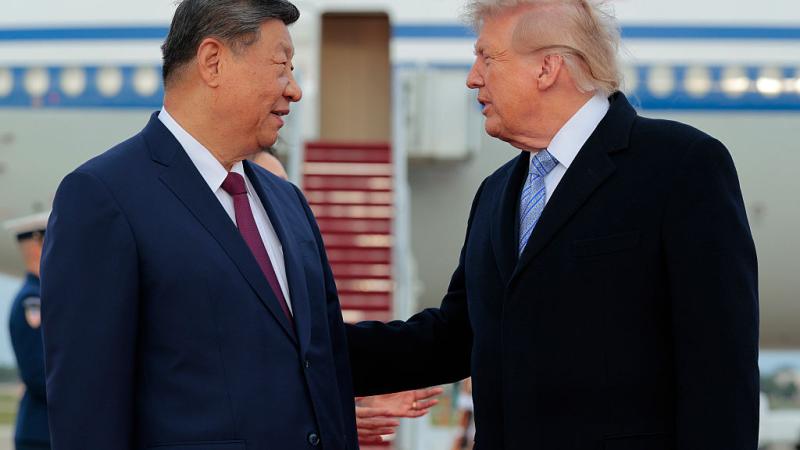
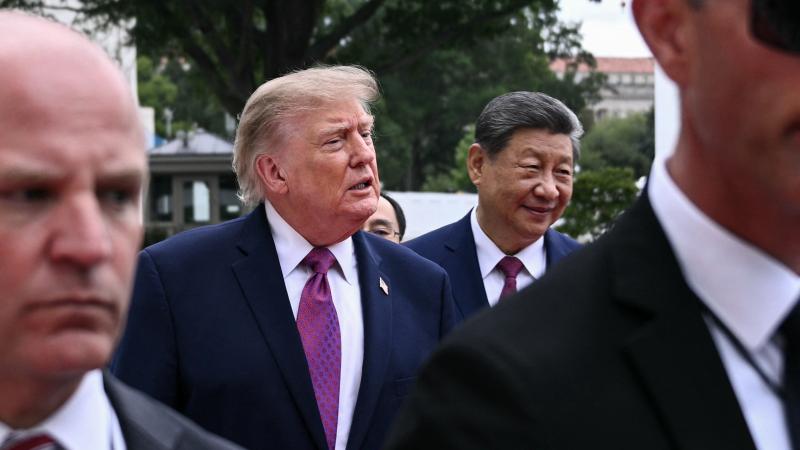
Chinese President Xi Jinping also sees an opportunity to restore commercial ties in the divergence between the United States and its European allies that stems from frustrations with President Trump’s trade policies, unilateral action in the Western Hemisphere, and contentious negotiating style.
“Right now the world is both fluid and turbulent,” Xi said at the meeting with Starmer. “Be it for the sake of world peace and stability or for our two countries’ economies and people’s livelihoods, it is imperative for us to strengthen dialogue and cooperation.”
Starmer said the trip was to “build a more sophisticated relationship” with the Chinese, which he called “a vital player on the world stage.” Unlike Carney, Starmer’s stated justification for seeking a closer relationship with China is focused on restoring close economic ties, not explicitly distancing from the U.S. Indeed, Starmer insists that the U.K. can expand ties and cooperate with both China and the United States at the same time.
While no major trade announcements were made after the meeting, Beijing and London agreed to consult on a “feasibility study” to explore upgrading trade ties. The British government also announced that China would relax visa rules for British citizens traveling to the country and said the two sides discussed whiskey tariffs.
As Just the News previously reported, it may be difficult for countries to scale up economic relationships with China given that the country is currently facing an overcapacity crisis: Its industrial and manufacturing sectors are currently producing far more goods than its domestic economy and trading partners can absorb.
This imbalance has even spurred European countries to consider higher tariffs on China to prevent dumping in their markets and to keep their own industries competitive.
When Canada signed new trade agreements with China last week, U.S. Commerce Secretary Howard Lutnick called the idea that China would be able to increase imports from Canada “the silliest thing I’ve ever seen.”
Though Canada is far more dependent on U.S. trade than the U.K., it is still unlikely that London can significantly boost its own exports to China given the overcapacity crisis, raising questions about how expanding economic ties would benefit Britain.
Starmer’s outreach to China comes at a time when his government appears to be retreating on key national security issues that relate to China.
In May 2025, the British government agreed to transfer sovereignty of an island in the Indian Ocean — Diego Garcia — which is home to an important military base used by both the U.K. and the United States. The country of Mauritius agreed to then lease the military base back to the U.K. and U.S. for at least 99 years.
However, President Trump views this arrangement as unacceptable, calling it a boon for China and Russia. Mauritius has also recently upgraded economic ties with China, raising security concerns for the U.S., which uses Diego Garcia for military operations.
"Shockingly, our 'brilliant' NATO Ally, the United Kingdom, is currently planning to give away the Island of Diego Garcia, the site of a vital U.S. Military Base, to Mauritius, and to do so FOR NO REASON WHATSOEVER,” Trump posted to his Truth Social platform earlier this week. “There is no doubt that China and Russia have noticed this act of total weakness.”
Additionally, Starmer has faced criticism from domestic opposition and experts over his government’s decision to green-light a new Chinese embassy in London despite significant security concerns about the new building’s location. One critic, Sir Richard Dearlove, former head of British foreign intelligence agency MI6, urged the government to reject China’s plans over concerns about the building’s proximity to buried cables that transmit financial and commercial data in London.
"Having a Chinese embassy sitting on top of those cables, which could in extremis be attacked, is a significant problem," he told CBS News last year.
British officials admitted on Tuesday that these concerns could not be totally mitigated, the outlet also reported.