Houthis test Trump by ramping up attacks on Saudi Arabia, developing ballistic missile tech
Iran-backed group steps up attacks on Saudi Arabia and allegedly acquires Chinese parts to produce precision ballistic missiles.
The Iran-backed Houthis have exploited the regional chaos of the U.S.-Iran war and new technology to boost their power – and the threat they pose – to the United States and its partners in the Middle East.
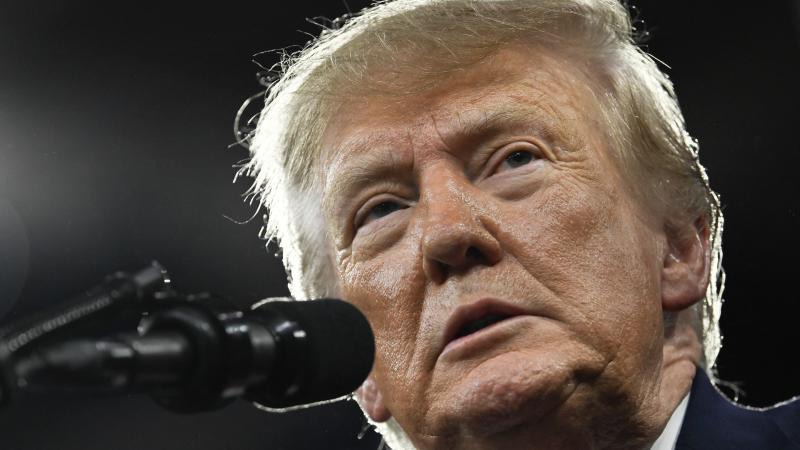
President Trump has warned Yemen’s Houthis as the group steps up attacks on Saudi Arabia amid the Iran war, suggesting they could face dire consequences after the Nov. 3 midterm elections.
The attacks on Saudi oil and civilian infrastructure, including repeated strikes on commercial airports, have continued to roil global oil markets.
The attacks on Saudi Arabia even prompted the U.S. State Department to order on Wednesday all “non-emergency government employees and their family members” to leave the country.
Trump also thinks the Houthis have resumed their attacks at the request of Iran, a longtime backer of the group, to confound his efforts to bring the roughly eight-month-long Middle East war to a close.
“The Houthis are behaving very badly," Trump recently posted to Truth Social. "I thought they learned their lesson a year ago when we bombed the HELL out of them and, at their request, stopped. They’ve been silent for a long time, but now they’ve emerged again, probably at the behest of Iran … in a very nasty way, hitting Saudi Arabia, and purposefully trying to drive up Oil Prices, probably prior to the U.S. Elections – NOT NICE.
“Somebody should explain to them that I’m not running in the Elections, I’ve already won, IN A MASSIVE LANDSLIDE, but I’ll be there after the Elections, and I will never forget."
The Houthis, whose official name is Ansar Allah or Supporters of God, have controlled northwestern Yemen for years amid a civil war that has divided the Arabian country since 2014. The U.S.-designated terrorist group receives backing from Iran, including weapons and funding.
Early in Trump’s second term, the United States bombed the Houthis in retaliation for the group’s attacks on shipping in the Red Sea, which were launched in October 2023 in response to Israel’s war in Gaza.
The attacks first exposed the global markets, U.S. allies, and the United States to the threat the Houthis pose. Now, the group is using the war to boost its own capabilities and attack neighboring Saudi Arabia with devastating effect.
Since the Middle East was plunged into war, the Houthis have been quietly working to develop advanced ballistic missile capabilities that would allow the group to strike even deeper into Israel and Saudi Arabia – or at U.S. military bases in the Middle East. Such an advancement would be a major firepower upgrade for the Iran proxy, which at one time was more focused on Yemen’s internal affairs.
Conflict Armament Research, a group that studies and documents weapons in armed conflicts, recently released a report revealing the Houthis’ attempts to produce advanced medium-range ballistic missiles using Iranian designs and Chinese components.
The effort was discovered after authorities in the Saudi-backed Yemeni government intercepted two shipments last year coming from China. Those shipments contained components needed to construct a homegrown version of Iran’s Kheibar Shekan precision guided missile.
Iran has used the Kheibar Shekan to strike U.S. bases during the conflict, and was likely used in the July attack that killed three U.S. service members in Jordan.
According to the report, the seized cargo included custom-made metal components for the missile’s motor and airframe, along with stabilizing fins and solid-propellant rocket motor parts from the Kheibar Shekan series. Shipping documents traced the parts to an unnamed Chinese precision-metal manufacturer.
If the effort succeeds, the Houthi version would have a range of roughly 2,000 kilometers (about 1,200 miles), putting all of Saudi Arabia and Israel within striking distance.
“The local ambition of the Houthis for manufacturing is beyond what was previously assumed,” Fabian Hinz, senior analyst at Conflict Armament Research, told the Wall Street Journal. Hinz also told the outlet that the group conceals its weapons sites so well that it remains unclear how far production has advanced.
Further, there is evidence that the Houthis attempted to use advanced American Artificial Intelligence capabilities to test such missiles. In a threat report released last month, Anthropic identified “a cell of threat actors” using its signature Claude program to develop three new missiles with advanced capabilities in Yemen.
According to Anthropic, the “cell,” which the company does not explicitly identify with the Houthis, used the AI platform to develop a “guided rocket” with homing guidance capabilities, “a multi-stage ballistic missile” intended to achieve a range of 2,000 km, and “a multi-variant missile” that included a “hypersonic glide vehicle variant,” Just the News previously reported.
Meanwhile, the Houthis have made Saudi airports their primary target. Since early October, ballistic missile and drone strikes on airports in Riyadh, Abha, and Dammam have killed more than 20 people and injured hundreds. The deadliest strike came Oct. 10. At least 12 people were killed, including one American, and more than 300 were injured at Riyadh’s international airport.
On Wednesday, an attack on King Fahd International Airport in Dammam killed a Saudi national and an Indian resident. The Houthis claimed they also targeted Saudi Arabia’s defense ministry in Riyadh and Saudi Aramco facilities in Yanbu. Aramco reportedly ordered staff to evacuate its Dhahran headquarters, which was struck earlier this month.
The Facts Inside Our Reporter's Notebook


Top Stories





Trending
Just the News Spotlight
Just News, No Noise