Xi Jinping carries out record-breaking punishments inside CCP amid purge of generals: Taiwan intel
More evidence comes in pointing to Xi Jinping having purged the ranks of the PLA and CCP. Reports say the Chinese Communist Party disciplined 983,000 party and government officials last year .
China’s strongman leader Xi Jinping carried out a record number of disciplinary actions against Chinese Communist Party members and government officials, a Taiwanese intelligence agency assessed, as Xi conducted a massive purge of People’s Liberation Army leaders ahead of a 2027 deadline to be ready to invade Taiwan.
The Taiwan government’s National Security Bureau reportedly assessed that the CCP had punished nearly one million CCP members and People’s Republic of China officials during 2025, a new report found, which seems to dovetail with Xi’s removal of a host of high-ranking Chinese military brass as he prepares the PLA for war and increases his already iron-like grip on power in the country.
44 generals and admirals, as well as 57 lieutenant generals and vice admirals removed
“The Chinese Communist Party last year disciplined 983,000 party and government officials, a record high during Chinese President Xi Jinping’s tenure, according to a report by the National Security Bureau,” the Taipei Times reported on Tuesday, with the assessment reportedly being sent to Taiwan’s Legislative Yuan — the democratic island nation’s equivalent of the U.S. Congress — ahead of the scheduled committee testimony of Tsai Ming-yen, the director-general of the important Taiwanese intelligence agency.
The Department of War’s annual report on China from December assessed that “China expects to be able to fight and win a war on Taiwan by the end of 2027.”
Xi has carried out a multi-year spree of removing top Chinese military commanders from the highest echelons of the PLA, with the Center for Strategic and International Studies finding that the Chinese leader has removed 44 generals and admirals as well as 57 lieutenant generals and vice admirals since 2022. CSIS added that, of the nearly four dozen PLA leaders who were generals in 2022 or were promoted to three-star roles post-2022, 87 percent of them “were purged or potentially purged” as of February of this year.
“Among those whose titles the CCP revoked last year were eight top researchers, including Liu Cangli, former director of the China Academy of Engineering Physics, the country’s main institution for research, development and testing of nuclear weapons and related technologies,” the Taipei Times said the new intel report also found.
The outlet wrote on Tuesday: “Since the beginning of this year, the CCP has investigated many senior officials, including two high-level CCP officials — Central Military Commission Vice Chairman Zhang Youxia and Liu Zhenli, chief of the commission’s Joint Staff Department — as well as politburo member Ma Xingrui, Chongqing Mayor Hu Henghua, and 17 centrally managed cadres, the NSB said.”
CCP purges might be driven by U.S. military successes
Some assessments have contended that changes within the Chinese military leadership have occurred due to fears about U.S. military superiority demonstrated on the battlefield. The Taiwanese intel assessment from this month reportedly found that “the removals” of top Chinese generals and admirals “might have been linked to the CCP’s sale of military equipment to countries such as Venezuela that have performed poorly in conflict scenarios in the past few years.”
Miles Yu, the director of the China Center at the Hudson Institute, also wrote in late March that the waves of Xi-led purges inside the PLA might be being driven by recent impressive performances by the U.S. military.
“The modern trajectory of China’s weapons development cannot be understood without recognizing a recurring pattern: Every major leap in the People’s Liberation Army has been triggered by decisive demonstrations of U.S. military superiority,” Yu wrote in the Washington Times. “From the Persian Gulf War to more recent confrontations involving Iran and Venezuela, American battlefield dominance has repeatedly exposed systemic weaknesses in China’s military-industrial complex, forcing cycles of hurried modernization, internal crisis, and political purges.”
Yu argued that “at its core, the CCP has long defined the United States as its principal adversary” and that the CCP’s “strategic mission has consistently centered on overcoming and ultimately displacing American power.”
“Yet rather than pursuing steady, innovation-driven development, China’s military modernization has largely been shock-driven,” Yu added.
Xi uses purges to solidify his grip on power
Many independent assessments have argued that the military purges are at least partly motivated by Xi’s desire to maintain and expand his power atop China.
“Since coming to power in 2012, Xi Jinping has repeatedly purged senior military leaders to root out corruption—which Xi sees as an impediment to his ambitious military modernization agenda—and to remove political obstacles,” the CSIS China Power Project wrote in February.
“In his first five years, Xi purged two former vice chairmen of the powerful Central Military Commission, Guo Boxiong and Xu Caihou, as well as two sitting CMC members, Fang Fenghui and Zhang Yang,” the report added.
CSIS added: “Around 2023, Xi initiated a second major round of purges—this time far bolder and more extensive than before. Over the past few years, Xi purged six members of the CMC including: former ministers of defense Wei Fenghe and Li Shangfu, CMC vice chairman He Weidong, Director of the CMC Political Work Department Miao Hua, Chief of the Joint Staff Department Liu Zhenli, and finally senior vice chairman of the CMC Zhang Youxia. Their removal has decimated the PLA’s high command, leaving only one sitting general on the CMC, Zhang Shengmin, who was promoted to vice chairman in late 2025.”
The D.C. think tank found that “these purges have touched virtually every part of the PLA, spanning the CMC, key functional departments under the CMC, the PLA’s four services and four support forces, the five theater commands, military academies, and the People’s Armed Police.”
The Jamestown Foundation wrote in January that Chinese authorities had announced that month that they were investigating CMC Vice Chairman Zhang Youxia and Chief of Staff of the CMC Joint Staff Department Liu Zhenli, and that “official statements point to disagreements with Xi Jinping over PLA development and training, and even instances of open resistance to his directives, as the cause of the generals’ downfall.”
The foundation assessed that “Zhang Youxia’s timeline for PLA joint operations training did not align with Xi Jinping’s 2027 deadline for the PLA to be capable of invading Taiwan.”
“January 2026 marked the start of the final annual training cycle before 2027. The divide between Zhang Youxia and Xi Jinping no longer centered on debate or planning and instead shifted to execution and direct noncompliance,” the foundation added. “This problem was clearly visible across the PLA, and it posed a serious threat to Xi’s authority.”
Retired U.S. Navy Captain James Fanell wrote in January that Xi’s removal of Zhang was particularly striking.
“A princeling, the son of a prominent and influential PLA general and comrade of Mao Zedong, Zhang is also a veteran and national hero for his participation in the PLA’s last combat operations against Vietnam in 1979,” the retired captain wrote. “Even more intriguing are the rumors that he was a confidant and supporter of Xi Jinping, indicating that Xi is willing to purge even close friends and national heroes.”
The Office of the Director of National Intelligence assessed in March 2025 that Xi’s purges were likely motivated both by anti-corruption efforts and by Xi’s desire to solidify power.
“Corruption is an endemic feature of and challenge for China, enabled by a political system with power highly centralized in the hands of the CCP, a CCP-centric concept of the rule of law, a lack of independent checks on public officials, and limited transparency,” the ODNI wrote. “Xi’s anti-corruption campaign more deeply reflects a party-directed securitization, or a targeting of political indiscipline and ideological impurity, particularly at the highest levels of government, in an effort to preserve the CCP’s domestic control and legitimacy.”
Purges come as CCP wants to be ready to invade Taiwan next year
Bringing the independent and democratic island nation of Taiwan under the thumb of mainland China appears to be a major motivator in many of Xi’s actions.
The U.S. Department of War assessed late last year that “the PLA continues to make steady progress toward its 2027 goals, whereby the PLA must be able to achieve ‘strategic decisive victory’ over Taiwan, ‘strategic counterbalance’ against the United States in the nuclear and other strategic domains, and ‘strategic deterrence and control’ against other regional countries.”
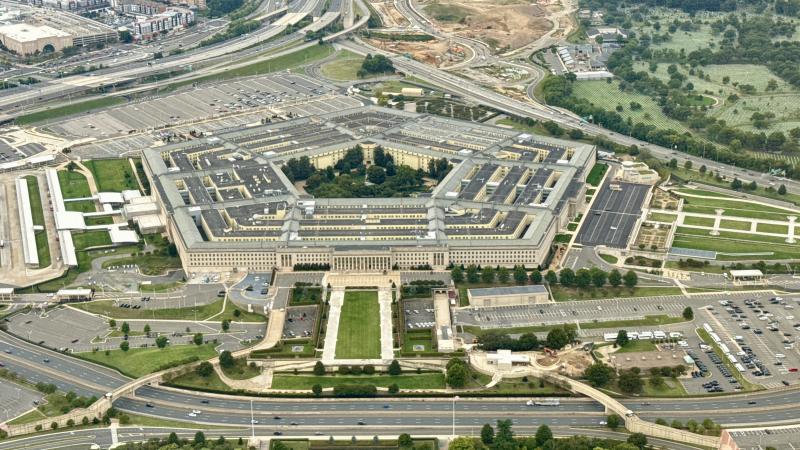
The Pentagon noted that “Beijing has detained or suspended multiple members of its Central Military Commission, China’s highest-level military decision-making body” and that “investigations into these corrupt leaders indicate Beijing is pursuing a zero-tolerance approach to corruption and is willing to purge the military of perceived disloyalty regardless of the disruptive impact on the PLA.”
The 2025 Pentagon report, which called out the CCP’s ambitions to “displace” the U.S. on the global stage in part through the growth and modernization of the Chinese military, also noted that “the PLA measures its concepts and capabilities against the ‘strong enemy’ of the United States” and that “China’s top military strategy focuses squarely on overcoming the United States through a whole-of-nation mobilization effort” that Beijing had dubbed “national total war.”
The Mercator Institute for China Studies — based in Germany — said in February that Xi’s military purges were “likely good news for Taiwan” in the short term, because “with the CMC empty and chains of command disrupted, risky military action seems unlikely.”
“In the long run, however, a new generation of PLA leaders deemed more loyal and trustworthy will likely increase the risk of conflict,” the institute added. “It seems clear that, despite the current PLA disarray, Xi Jinping remains firmly in control of the levers of power and intent on seeing this clean-up campaign through, regardless of who must fall.”
Sukjoon Yoon, a retired South Korean Navy captain and an advisor to the South Korean defense ministry, argued in March that “Xi’s vision” — including “prioritizing political loyalty over operational competence and centralized control over mission command” — are “inevitably in tension with President Xi’s attempts to transform the PLA into a world-class military.”
“Xi’s attempt to square the circle will depend on the appointment of senior officers to replace those recently purged, and this is expected after the annual plenary session of the CCP, in the autumn,” the South Korean Navy veteran added. “The way in which they seek to demonstrate their loyalty may have momentous consequences: for Taiwan, for the Korean Peninsula, and for the wider world.”
An article for the National Defense University’s Institute for National Strategic Studies suggested in March that the purges were at least in part about readying the PLA to invade Taiwan.
“The absence of credible information from Beijing has allowed many theories about the causes of these dismissals to circulate, which often center on factional politics or power consolidation,” the NDU analysis said. “An examination biographical records, however, yields more support for the view that most purges are intended to clean up corruption-prone parts of the PLA in support of Xi Jinping’s broad agenda of readying the military for combat by its 2027 centennial. The massive scale of the purges, however, has probably set that agenda back as key positions are vacant or filled by less experienced officers.”
CCP justifies Xi’s military purges: “The pace of self-revolution will never stop”
The CCP and the PLA have justified Xi’s widespread purges of the top ranks of the Chinese military as a matter of loyalty and necessity.
“All officers and soldiers of the armed forces must resolutely support the decision of the Party Central Committee, consciously maintain a high degree of consistency with the Party Central Committee with Comrade Xi Jinping at its core in thought, politics, and action, resolutely obey the command of the Party Central Committee, the Central Military Commission, and Chairman Xi, and ensure the high degree of unity, purity, and consolidation of the armed forces,” the PLA’s daily propaganda outlet wrote in January.
The PLA argued that Zhang Youxia and Liu Zhenli “seriously betrayed the trust and expectations” of the CCP and the PLA, “seriously fostered political and corruption problems that undermined the Party's absolute leadership over the military and threatened the Party's ruling foundation,” and “severely impacted the political and ideological foundation for unity and progress among all officers and soldiers.”
The PLA’s Central Military Commission also proclaimed in February that “the pace of self-revolution will never stop, and the process of striving for strength is unstoppable.
“Resolutely investigating and punishing corrupt officials like Zhang Youxia and Liu Zhenli removes obstacles and stumbling blocks hindering the development of our cause,” the PLA argued.
“Our army is a people's army under the absolute leadership of the Party," the Central Military Commission said. The Commission continued, saying "On the new journey of the new era, President Xi Jinping's leadership in building a strong military, and the scientific guidance of Xi Jinping 'Thought on Strengthening the Military', have always been the source of strength, direction, and future for the cause of building a strong military.”
The Facts Inside Our Reporter's Notebook

Top Stories


Trending
Just the News Spotlight
Just News, No Noise