Related Articles

Back to the future? Democrats about to take Congress are promising to restore food stamp funding, and a new report alleges the last big increase was shaped by advocacy groups and has already cost taxpayers $105 billion. None of them address waste or fraud, and seem to make funding the barometer of the program's success.
Democrats have vowed to reverse Medicaid and food stamp cuts, including a Medicaid work requirement that congressional scorekeepers estimated would save $317 billion. With Trump still in the White House, that sets up a showdown between him and Congress when Democrats take power in January.
Democrats' food stamp pledge will need President Donald Trump's cooperation, since they lack the votes to override a veto. A new report from a non-profit, 501(c)(3) public charity, also claims that the last time Democrats held power, they expanded the Supplemental Nutrition Assistance Program (SNAP) with the help of advocacy groups. SNAP is colloquially known as "food stamps."
The report, published Tuesday by the Foundation for Government Accountability (FGA), says that officials in former President Joe Biden's administration worked with outside advocacy groups to deliver the largest permanent food stamp increase in the program's history, reopening a process that Government Accounting Office (GAO) auditors found in 2022 that an earlier Biden-sponsored update lacked "key project management and quality assurance practices."
The Biden administration's 2021 update of the Thrifty Food Plan, the U.S. Department of Agriculture (USDA) formula used to calculate SNAP benefits, left the average SNAP benefit about 35% higher in 2025 than it would otherwise have been and has already cost taxpayers an additional $105 billion in just five years, according to FGA calculations. The report said that the Biden-era hike contributed to "higher grocery prices, inflation, and higher enrollment" in SNAP.
The paper was published as Democrats prepare to take control of Congress in January with pledges to reverse the Medicaid cuts and restore SNAP funding. Trump's 2025 law, the One Big Beautiful Bill Act, limited future Thrifty Food Plan increases to the rate of inflation, widened food stamp work requirements, and created a national Medicaid work requirement.
The Congressional Budget Office (CBO) estimated that between fiscal years 2025 and 2034, the Trump law would save $317 billion through the Medicaid work requirement, and the law's nutrition provisions would save almost $187 billion.
Biden's Thrifty Food Plan update has come under scrutiny before. In 2022, the Government Accountability Office (GAO) released a report that found the USDA failed to develop a way to measure the project's success, didn't come up with a plan to ensure quality throughout the process, and didn't assign a dedicated project manager to make sure key practices were followed.
The FGA report builds on what the GAO found, and states that emails show the Biden administration worked with activist groups to put the Thrifty Food Plan into action.
FGA said its account rests on emails the USDA released under the Freedom of Information Act. It has not published them, and Just the News has not independently reviewed them.
FGA's review of emails found that Stacy Dean, the USDA's Deputy Undersecretary for Food, Nutrition, and Consumer Services under Biden, had at least 120 email exchanges with the Center on Budget and Policy Priorities (CBPP), a progressive think tank, where she had been vice president for food assistance policy, in roughly 16 months. Just one day before the USDA announced the plan, Dean told The New York Times that it underwent a "scientific, analytical process" and was not about "approving a benefit increase."
CBPP claims to be "a nonpartisan research and policy institute" dedicated to equality of resources people need to "thrive and share in the nation’s prosperity." At the same time, that same website opens with several items attacking Trump and Republican policies on the issue.
In one instance, CBPP says on their website that "Too many low-income families are going without the help they need to afford food since the harmful 2025 Republican reconciliation law made unprecedented cuts to SNAP. Already, 5.5 million people, including an estimated 2 million children, have lost SNAP benefits since the law was enacted."
The CBPP Board of Directors includes several alumni from the Carter, Clinton and Obama administrations, having held positions in at least one organization sponsored by George Soros' Open Society Institute. Other directors have more centrist work histories, including work at The Committee for a Responsible Federal Budget and at the Congressional Budget Office during the term of G.W. Bush.
Neither Dean nor CBPP responded to Just the News' inquiries.
FGA also said the emails showed the process included other advocacy groups, including the Food Research and Action Center (FRAC), a 501(c)3 charity that has opposed food stamp workfare projects as early as 1978, according to a GAO review. FGA said emails also showed the USDA asked advocacy groups to find food stamp recipients who would tell a panel that benefits were too low.
FRAC is described by InfluenceWatch as a "left of center" group that supports the Universal School Meals Act that was co-sponsored by left-wing U.S. Representatives including "squad members" Alexandria Ocasio-Cortez, D-N.Y., and Rashida Tlaib, D-Mich. FRAC did not respond to a Just the News inquiry.
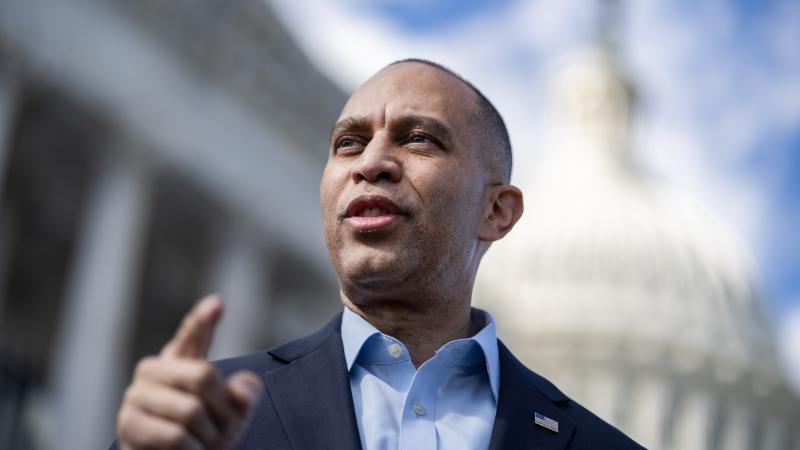
After the Nov. 3 election, House Minority Leader Hakeem Jeffries, D-N.Y., wrote in a letter to colleagues announcing his candidacy for House speaker that Democrats would "restore SNAP funding." Should Jeffries succeed in his bid to become Speaker of the House, he will not preside over a veto-proof majority in Congress, for which a two-thirds vote of the members present and voting (with a quorum of 218) is needed.
According to the Congressional Research Service, assuming all 435 seats are filled, that comes out to 290 votes, and the Associated Press reports that the Democratic Party bloc stands at only 257 seats after the 2026 midterms.