Supreme Court hands Trump a win in bid to prevent ineligible voters voting in midterm elections
The Supreme Court has cleared the way for parts of the administration’s election security executive order to proceed. Despite this procedural win, a second nationwide injunction still blocks the USPS from enforcing new mail-in ballot rules.
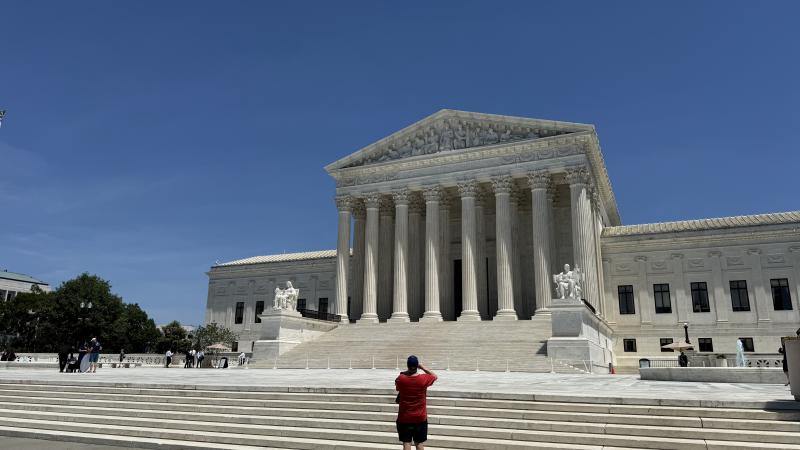
The Supreme Court on Monday opened the door for President Donald Trump’s executive order aimed at securing the upcoming midterm elections from ineligible voters and implementing verification standards for mail-in ballots.
The high court halted a lower court ruling that was blocking the president’s March 31 executive order establishing a whole-of-government approach to prevent noncitizens from registering to vote or voting in federal elections. A coalition of 23 Democratic states and Washington, D.C., sued the administration in Massachusetts to block the order.
The lower court’s ruling by District Court Judge Indira Talwani in June specifically blocked parts of the executive order directing federal prosecutors to focus on prosecuting any state and local officials who facilitate ineligible voting and instructing the U.S. Postal Service to establish verification standards for mail-in ballots, including a unique barcode.
While the Supreme Court’s August 24 decision lifts the injunction in California v. Trump, the lawsuit brought by a coalition of 23 states and D.C., the administration still faces a separate nationwide legal barrier.
A second, active preliminary injunction issued by Judge Talwani in August in League of Women Voters of Massachusetts v. Trump continues to block the Postal Service from implementing the changes mandated by the executive order for the upcoming election.
So, while the Supreme Court has cleared the path for the administration to proceed with certain aspects of the order, significant legal hurdles remain regarding the Postal Service's implementation before the November midterm elections.
The executive order directed the Department of Homeland Security to create a nationwide list of adult U.S. citizens and the USPS to obtain lists of registered voters. The USPS, an independent agency of the executive branch, would then be required to send mail-in ballots only to individuals on both of those lists.
The Supreme Court’s conservative justices determined, however, that the District Court “lacked jurisdiction to enter the judgment” and that the stay on the executive order does harm to the government’s legitimate functions of rulemaking and executive prosecutorial discretion, according to the high court’s per curiam opinion published Monday.
The ruling allows the Trump administration to proceed with its two-pronged effort, through the Postal Service, to ensure that no non-eligible voters cast votes in the upcoming midterms and, through the Justice Department, that those who facilitate such alleged illegal voting will be pursued by prosecutors.
Since early absentee voting in many states is just weeks away, the Trump administration would have to move quickly to implement the order’s provisions, which could still face further legal challenges.
As the midterms approach, President Trump has aimed to ensure that no ineligible voters cast votes. In recent months, emerging evidence shows that potentially hundreds of thousands of noncitizens are registered to vote across the country and some have voted in recent elections.
In July, the president declassified a Homeland Security Department assessment that found over a quarter million illegal aliens were registered to vote in four states – California, Nevada, New Jersey and Pennsylvania – based on a review of commercially available voter registration data.
The documents were released during the president’s election integrity speech in which he also revealed that China had obtained 220 million American voter registration files.
The agency reviewed voter registrations as part of an administration priority to address concerns about illegal voting in the U.S. using the SAVE system, a controversial citizenship database that includes Social Security numbers.
The administration is offering the centralized records to states to identify noncitizens on voter rolls across the country. The four states opted not to utilize the SAVE system, prompting the agency to conduct a separate review using publicly available voter records.
In the preceding month, the Trump Justice Department had secured about two dozen noncitizen voting arrests, prosecutions or convictions in the last few months alone, with about another 90 more cases under investigation, officials told Just the News in July.
After the president’s declassification, New Jersey Democrat Gov. Mikie Sherill announced that her state’s motor vehicle registration system had accidentally registered 6,600 noncitizens to vote. She said that at least 400 of those individuals had, in fact, cast votes in recent elections.
The software vendor for the New Jersey Motor Vehicle Commission, IDEMIA, issued a statement disputing those claims, saying it was the responsibility of the state government to verify eligibility to vote, Just the News first reported last month.
Then, just last week, the U.S. Census Bureau determined that 24,000 noncitizens likely voted in the 2020 general election spread across all 50 states.
California had the highest number of noncitizens voting, with 4,300 votes, followed by Texas, with 2,500. Of the 24,000 noncitizen voters who cast ballots in 2020, 3,800 were from Mexico and 950 were from Canada. Nearly 7,000 had no country reported, according to the analysis.
The Postal Service recently unveiled a rule establishing new mail-in ballot requirements in part forbidding itself from sending such ballots in any state that refuses to comply with the executive order and establishes new verification requirements, like a unique voter barcode on ballot envelopes.
Though the court opened the door for the rule to be implemented, the measures are still subject to additional legal challenges because the Supreme Court did not rule on the merits of any argument against its implementation, only that the challenge was premature.
The clock is ticking because North Carolina, the first state to send out military and overseas absentee ballots, will begin to do so on Sept. 4.
The Facts Inside Our Reporter's Notebook
Links
- still faces a separate nationwide legal barrier
- create a nationwide list of adult U.S. citizens
- the high courtâs per curiam opinion
- found more than a quarter million illegal aliens
- secured about two dozen noncitizen voting arrests
- Just the News first reported
- that 24,000 noncitizens likely voted
- unveiled a rule establishing new mail-in ballot requirements
- clock is ticking
Top Stories


Trending
Just the News Spotlight
Just News, No Noise