Blue state gerrymanderers in legal crosshairs for violating civil rights, must comply, Dhillon says
If congressional maps are redrawn in blue states to comply with the legal precedent established in Louisiana v. Callais, Republicans will likely pick up multiple seats in areas previously represented by Democrats. Ass't. A.G. Harmeet Dhillon predicts considerable legal brawling.
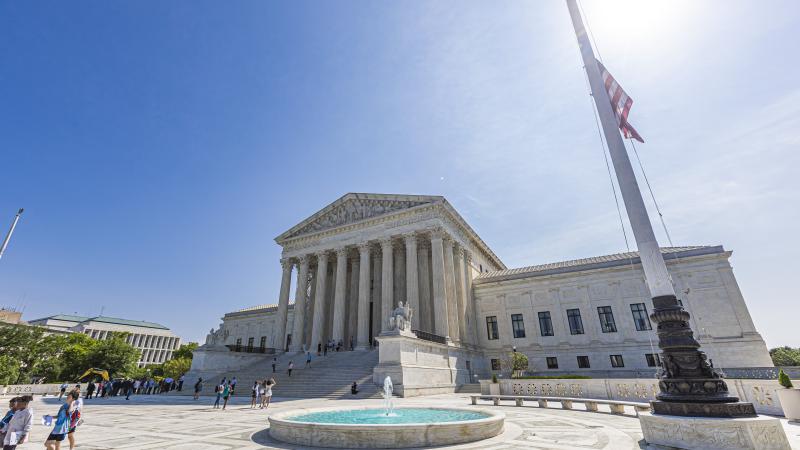
Following the Supreme Court's decision striking down Louisiana’s congressional map as an unconstitutional racial gerrymander, other states that have used race as a predominant factor in gerrymandering are now under the microscope of the Department of Justice (DOJ) and will possibly be vulnerable to lawsuits and future redistricting mandates before the midterm elections in November.
"This is the law of the land now, and eventually every jurisdiction in the United States is going to have to comply with race-free line-drawing," Assistant Attorney General for the Civil Rights Division Harmeet K. Dhillon told Just The News.
The nation's highest court ruled 6-3 in Louisiana v. Callais that the state was not required under the Voting Rights Act to create a second majority-Black district and that compliance with the law could not justify the race-based drawing of lines, a decision that is expected to make it harder for other states to draw similar majority-minority districts in future redistricting.
Dhillon signaled that the DOJ already anticipates legal action: "Some states have race in their constitutions as a requirement in districting. That's now illegal, so the field is ripe for legal challenges, not just by the Department of Justice, but by private plaintiffs, candidates and others."
Ten states currently use race as a basis for districting
Ten states have enacted their own Voting Rights Acts (often called state VRAs or SVRAs) that explicitly prohibit racial vote dilution and allow (or effectively require) race to be considered in determining whether minority groups (defined as protected classes based on race, color, or language minority status) have been denied a fair opportunity to elect candidates of their choice.
The states which have enacted these SVRAs and are therefore subject to legal action following Callais are California (enacted in 2002 and amended in 2015), Colorado (2025), Connecticut (2023), Illinois (2011), Maryland (2026), Minnesota (2024), New York (2022, amended in 2024), Oregon (2019), Virginia (2021, amended in 2026), and Washington. (2018, amended in 2023 and 2026).
These states' laws parallel or expand on Section 2 of the federal Voting Rights Act of 1965 and typically prohibit election practices, systems, or districting that result in, or are intended to cause, vote dilution for protected classes. The practice therefore inherently uses race as a predominant factor in determining districts.
The state laws variously require or consider evidence of racially polarized voting (where minority voters and the majority vote differently) plus other factors like a history of discrimination, unequal access to the political process, or effects of discrimination in areas such as education, employment or health.
The Voting Rights Act of 1965 and its effects
The Voting Rights Act of 1965, signed by President Lyndon B. Johnson, was a landmark civil rights law designed to overcome state and local barriers that prevented African Americans from exercising their right to vote under the 15th Amendment.
Sparked by attacks on marchers in Selma, Alabama, the act banned literacy tests and other discriminatory Jim Crow-era practices, and required federal pre-clearance for voting changes in jurisdictions with histories of discrimination. It dramatically increased Black voter registration and turnout.
Congress renewed and expanded the law in 1970, 1975, 1982, and 2006. The Supreme Court’s 2013 Shelby County v. Holder decision invalidated the pre-clearance coverage formula, shifting enforcement dynamics while core protections remain.
History of gerrymandering
Gerrymandering, the practice of drawing electoral district lines for partisan advantage, dates to the early days of the U.S. republic but earned its name in 1812. Massachusetts Gov. Elbridge Gerry, a Democratic-Republican, signed a redistricting plan that favored his party. Contemporaneous political cartoons depicted one oddly shaped district as a salamander, dubbing it the “Gerry-mander.”
The tactic — packing opponents into few districts or spreading them thinly — persisted through the 19th century, intensifying after Congress required single-member districts in 1842. Courts later addressed one-person, one-vote standards and racial gerrymandering, but the Supreme Court ruled in 2019 that partisan claims are political questions beyond federal review.
The Facts Inside Our Reporter's Notebook
Links
- striking down Louisianaâs congressional map
- Louisiana v. Callais
- Voting Rights Acts
- California
- Colorado
- Connecticut
- Illinois
- Maryland
- Minnesota
- New York
- Oregon
- Virginia
- Washington
- Section 2 of the federal Voting Rights Act of 1965
- Voting Rights Act of 1965
- marchers in Selma, Alabama
- early days of the U.S. republic
- Elbridge Gerry
Top Stories



Trending
Just the News Spotlight
Just News, No Noise