Rubio says regional peace not possible if Iranian proxies launch rockets, engage in terrorism
The Secretary of State also said that neither the U.S. nor its regional partners would agree to a toll regime for the Strait of Hormuz.
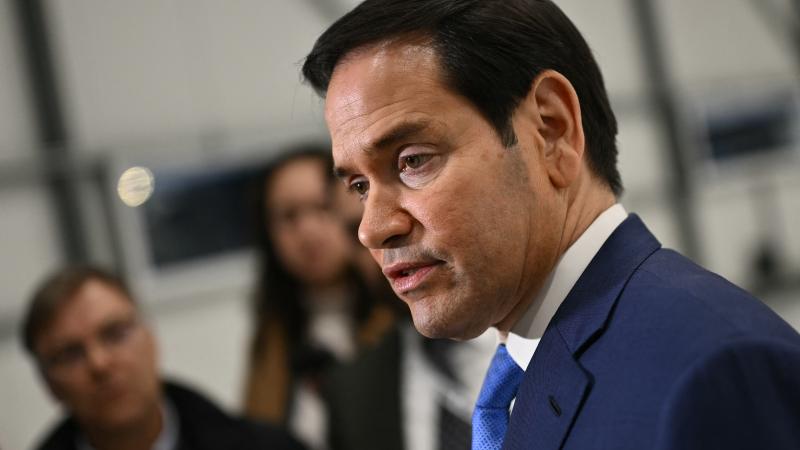
United States Secretary of State Marco Rubio said on Tuesday that peace in the Middle East is “not possible” if Iranian proxy groups continue to launch missiles and engage in terrorism.
“A careful reading of the MOU will see that when you talk about, for example, a complete end of hostilities in the entire region, well, that’s not possible, you can't have the end of hostilities and conflicts in the region as long as Iranian proxies are launching missiles and drones from Iraq and are participating in terrorism like Hamas did and like Hezbollah did,” Rubio told reporters after he touched down in the United Arab Emirates.
Rubio said that the actions of Iran’s proxy will groups will be dealt “at the appropriate time in these negotiations” with Iran.
Rubio’s comments come after confusion about whether the agreement signed with Iran would adequately deal with the regime’s funding of proxy groups that frequently engage in terrorism abroad, including launching attacks on Israel, Saudi Arabia, and U.S.-based in Iraq and Kuwait during the war.
Vice President JD Vance, who led a U.S. delegation to Switzerland over the weekend to engage in direct talks with Tehran, delivered sharp warnings that Israel’s continued strikes against Hezbollah, an Iranian proxy in neighboring Lebanon, were endangering a larger peace agreement.
Though Vance said that the U.S. also expects Hezbollah not to fire rockets and drones at the Israelis, critics suggested that the vice president was being tougher on Israel for defending itself.
For example, Vance said “we could have a better and more peaceful situation if Israel responds in the context of a conversation that’s ongoing” when considering how to reply to Hezbollah attacks against its soldiers.
The secretary’s visit to the UAE, a close partner of the United States, is the first stop on his tour of the Arabian Gulf region to engage with U.S. allies who faced the brunt of Iranian missile and drone strikes during the U.S.-Iran war. He will also visit Bahrain and Kuwait.
Rubio also clarified that the United States, nor countries in the region, would agree to allow Iran to charge tolls for commercial passage through the Strait of Hormuz.
Earlier on Tuesday, Iran and Oman issued a joint statement saying that they are planning to jointly manage commercial shipping traffic passing through the Strait of Hormuz. The countries said that these “services” would have “costs associated,” indicating a call for some kind of toll.
The Facts Inside Our Reporter's Notebook
Top Stories




Trending
Just the News Spotlight
Just News, No Noise