Trump stands in public with the families of murder victims as Newsom spares 548 killers' lives
If it's all about optics, Gavin Newsom may have played the wrong card, by giving the president a ready-made stage to stand beside grieving families, put names and faces to the 548 sentences Newsom erased, and recast a fight over state policy as a choice between killers and their victims.
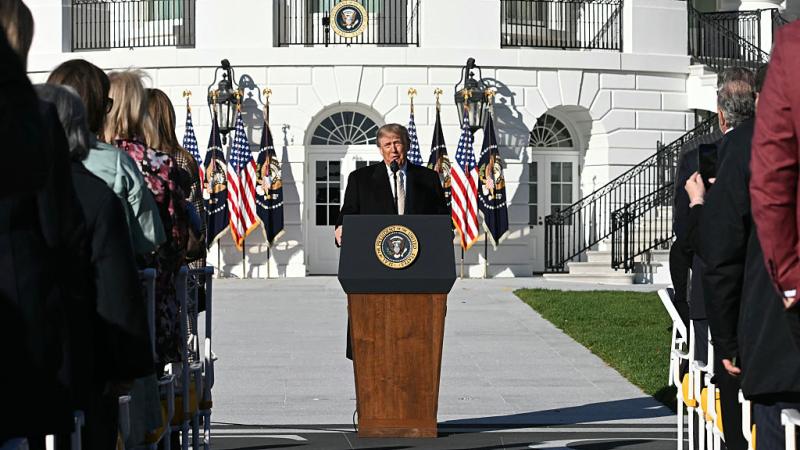
Two days after the midterms, California Governor Gavin Newsom used one signature to clear out the largest death row in the Western Hemisphere. On Monday, President Donald Trump stood in the Justice Department's Great Hall with the families left behind and vowed that Washington wouldn't let it stand.
Trump called Newsom's move "one of the most shocking acts of injustice our country has ever seen." Turning to the murder victims' families seated before him, he said that after juries delivered their verdicts and death sentences were handed down, Newsom "came along and stole away the only closure those families might ever have." Those families, Trump said, will "never, ever be the same."
According to ABC's San Francisco news outlet, Newsom has not released convicted killers from prison; rather, he proposed commuting 548 death row sentences to life in prison without the possibility of parole. The television station also quoted Marc Klaas, the father of Polly Klass, who was murdered by Richard Allen Davis. Davis was convicted of the killing in 1996.
"Thirty years ago, when Richard Allen Davis was sentenced to death, I was told by the prosecutor, 'See, you can trust the system. The system works for you. If you work within the system.' Today, 30 years later, I'm finding out that that's not the truth," Klaas reportedly said to the ABC-owned and operated station.
California hasn't executed anyone since 2006
Newsom's order covers the 548 people under death sentence in California, though 382 cases need the state Supreme Court's approval for the commutation of the death sentences because those inmates have more than one felony conviction.
The governor had already halted executions with a 2019 moratorium, but that order left the sentences themselves in place. California hasn't executed anyone since 2006, even though voters rejected abolition in both 2012 and 2016.
The White House built Monday's event around those voters and victims. Officials from the DEA, the U.S. Marshals Service, the ATF and the Bureau of Prisons joined the gathering and some victims' families attended, so their stories could be highlighted.
The administration also circulated a list of 20 notorious convicted killers, including child murderers and serial killers, who it says benefit from Newsom's decision. In a statement before the speech, the White House said Newsom "must stop playing politics with public safety."
Using clearly understandable optics to stake his position with his base, the approach is a familiar one for Trump. Before the second 2016 presidential debate, he held a press event with women who had accused Bill Clinton of misconduct and then seated them in the audience. On the campaign trail he regularly featured "Angel Families," whose relatives were killed by immigrants in the country illegally.
The families left behind and DAs across California now have to notify them
More than two dozen relatives of murder victims have petitioned the court to block the commutations, arguing the governor didn't give victims the legal notice they were owed. Marc Klaas called the decision a "knife in the back."
The White House has put individual cases at the center of its argument. It pointed to Bob Williams, who raped and murdered a Bakersfield woman in her home in 1994, and Marcus Wesson, who killed nine members of his own family in Fresno in 2004. Serial killers Randy Kraft, convicted of 16 murders, and Charles Ng, convicted of killing 11 people including two baby boys, are also among those whose sentences were commuted.
Local prosecutors now have to deliver the news. Kern County District Attorney Cynthia Zimmer said she was sure Newsom "didn't know the names of the defendants or even the names of the victims," and that DAs across California now have to notify grieving families.
A new directive
The Trump administration has spent two years moving in the opposite direction. An Inauguration Day order directed the attorney general to pursue the death penalty for the most severe crimes and to encourage state prosecutors to do the same.
The department has since authorized seeking death sentences against 44 defendants, added firing squads as a permitted method of execution and reinstated the pentobarbital protocol, according to an Associated Press report.
Trump closed his remarks by raising the stakes. He announced a presidential directive ordering the Justice Department to seek the death penalty for child murderers, as well as for rapists and human traffickers who kill their victims. The directive also tells the attorney general to expedite federal executions. "Capital punishment will be swift and certain," Trump said.
He also urged Congress to pass a new bill sponsored by Rep. Brandon Gill, R-Texas, called the "Just Punishment for Murder Act." It would codify parts of the directive and his order on killers of police officers, and it would extend the policy to immigrants in the country illegally who commit murder. The text of the bill has not yet been published as of yesterday.
United States Attorney General Todd Blanche told the audience the department has sought the death penalty 49 times since Trump's January 2025 executive order, compared with once under the previous administration.
How far can the feds reach?
States normally carry out the death penalty, and the federal government can seek execution only for a limited set of crimes. The DOJ's proposed Death Penalty Act would speed up executions and limit federal courts' power to review state sentences.
For now, California's own high court is the real gatekeeper. About 70% of condemned inmates meet the multiple-felony condition that requires the justices' sign-off. As for the victims' families, some will have to face the challenge of knowing that their loved one's killer is not on death row, and whether, even if merely symbolic, they feel that justice has been served.
Amanda Head is White House Correspondent for Just the News. You can follow her here.
The Facts Inside Our Reporter's Notebook
Links
- largest death row in the Western Hemisphere
- 548 people
- According to ABC's San Francisco news outlet
- Polly Klass
- rejected abolition
- petitioned the court
- Bob Williams, who raped and murdered a Bakersfield woman in her home in 1994
- Inauguration Day order
- 44 defendants
- nearly doubled
- presidential directive
- new bill
- text of the bill has not yet been published
- 49 times
- Death Penalty Act
- here



Top Stories

Trending
Just News, No Noise