Related Articles


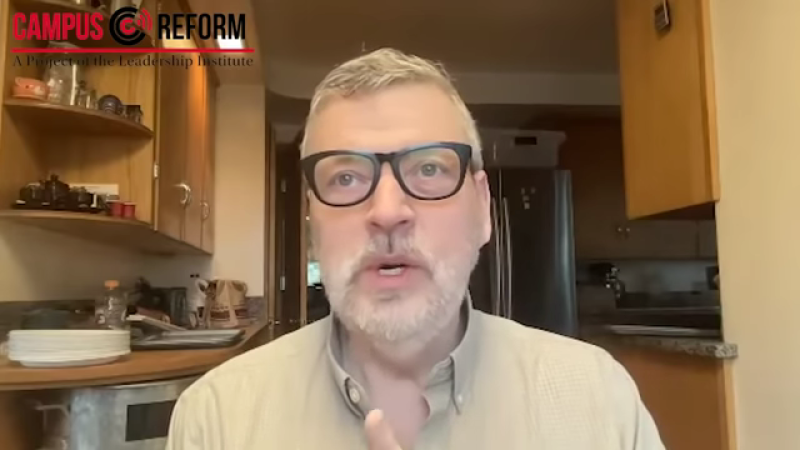
Arizona Supreme Court must affirm that victims of forced training can sue, restoring decades of state precedent on "implied private right of action" that is broader than federal case law, professor says.
Nearly five years after then-Arizona GOP Gov. Doug Ducey signed legislation prohibiting public entities from requiring employees to "engage in orientation, training or therapy that presents any form of blame or judgment on the basis of race, ethnicity or sex," the Grand Canyon State's courts can't agree on how it may be enforced.
Arizona State University professor Owen Anderson is petitioning the state's highest court to confirm Section 41-1494 gives public employees an "implied private right of action" to stop such coercion, which in his case was ASU training on how to "critique whiteness."
While the law's "only express mechanism to ensure compliance" is an annual report to the governor and legislative leaders, Maricopa County Superior Judge Melissa Iyer Julian agreed with Anderson, citing a 38-year-old Arizona Supreme Court precedent known as Transamerica that sets forth criteria for determining implied private right of action.
Skipping oral argument to overturn Julian, the Arizona Court of Appeals "astonishingly" construed lawmakers' silence on enforcement as confirmation that individuals cannot sue, without even mentioning Transamerica and while contradicting "decades" of its own decisions, Anderson's lawyers said.
"That’s wrong—a law is essentially meaningless if it can’t be enforced" by the "specific class of people" for whom it's designed, said the Goldwater Institute, named after the late Arizona senator Barry Goldwater and founded the same year as Transamerica.
The Arizona Board of Regents, the defendant, didn't even try to dispute that "Inclusive Communities" training violates state law by forcing employees to agree that "it’s okay to judge people on their race, ethnicity, religion, and sex," Anderson said. It's not a "left or right issue" whether employees can hold their organizations accountable for violating the law.
Goldwater didn't file a federal lawsuit alleging First Amendment violations "because ASU's DEI training mandate violates Arizona law," a spokesperson told Just the News when asked why the firm didn't hedge its bets with a federal companion.
The firm's summary of the case says the Arizona Constitution offers "broader protections for free speech" than the U.S. Constitution's First Amendment, making ASU's threat of punishment for employees who don't give the "correct" answers on the Inclusive Communities quiz even more egregious.
The feared preemption of stronger state constitutional protections by the federal Constitution was a key element of litigation by a fired teacher in Virginia who went to state, not federal, court to argue the Old Dominion gave him the right to refrain from addressing students by their preferred pronouns even if the First Amendment didn't.
The Virginia Supreme Court reinstated Peter Vlaming's lawsuit, emphasizing Virginia resisted ratifying the U.S. Constitution because of the perceived weakness of its religious protections, and ruled its own constitution wasn't bound by a U.S. Supreme Court precedent narrowing religious protections. Vlaming's school district gave him a hefty settlement in 2024.
'Binary thinking' attributed to 'colonization'
Inclusive Communities is not a close call on compliance with the law, which prohibits training that holds individuals "responsible for the actions committed by other members" of their race, ethnicity or sex, says they should "feel psychological distress" based on their demographics, or deems "meritocracy … inherently racist or sexist," the original lawsuit says.
Goldwater said it obtained the "slides and video transcript" from a training in 2023, which ASU requires faculty to complete every two years, through a public records request.
"Anderson viewed, but did not complete the mandatory training nor the required quiz that followed," the case summary notes.
The training's concepts and statements included that "racism takes the form of innocuous questions or comments … heterosexuality is privileged and goes unquestioned" and that "white supremacy was written into the foundational documents" of America, Goldwater said.
"Binary thinking" is attributed to "colonization" in another portion of the training. Like the Biden administration's never-finished Title IX rulemaking that conflated sex and gender identity, the training also describes written forms that limit sex options to "male and female" as examples of "homophobia and anti-gay bias."
The correct answers on the quiz are also listed. "Dominant identities are often interrogated in society and by individuals" is false, while land acknowledgments — recently in the news because of singer Billie Eilish's Grammys speech — hold "organizations, and their people, accountable to those with whom they share space."
ASU did not answer queries Thursday for its defense of Inclusive Communities training under Arizona law.
Lets government agencies disregard the law 'with impunity'
The appeals ruling illustrates the challenge faced by lawmakers in carefully crafting statutes so that they not only survive legal challenges but also don't give judges leeway to expand their reach or neuter their effect by reading into silence or adopting novel definitions.
The U.S. Supreme Court's 2020 precedent Bostock, for example, found terminating an employee based on gender identity — in that case, a male who presented as a woman after getting hired — is sex discrimination under Title VII because it "requires an employer to intentionally treat individual employees differently because of their sex."
Litigants and courts have repeatedly extrapolated that narrow holding to Title IX — ignoring explicit instructions from SCOTUS — arguing that it is sex discrimination to exclude students from the opposite sex's intimate facilities if they identify as the opposite sex.
"If allowed to stand, the decision will leave Arizonans without meaningful redress when their statutory rights are violated, and let government agencies disregard Section 41-1494 with impunity, free from any realistic prospect of enforcement," Goldwater's petition says.
Instead of applying the 1988 precedent, which tasks lower courts with recognizing implied rights of action if the "statute’s context, language, subject matter, effects, consequences, and overall spirit and purpose support it," the appeals court cherrypicked a precedent that turned on statutory "ambiguity," a separate concept from "implication," the petition says.
It also neglected a 1974 ruling that authorized consumer fraud lawsuits "because the language the Legislature used made it clear that that was the Act’s intent" and "widespread economic losses" from deceptive trade practices would "remain uncompensable" without an implied private right of action, the petition says.
Harking back to Goldwater's description of Arizona free speech protections relative to the First Amendment, the petition says Arizona law "more broadly implies" private causes of action than federal case law does.
Legislative silence is the start, not the end, of judicial analysis, the petition says, quoting another Arizona Supreme Court precedent. "That inquiry is about who can sue—not about what the statutory text means."
Goldwater also wants the high court to review Judge Julian's dismissal of its other client, Ladd Gustafson, who claims "taxpayer standing" to challenge the ASU training based on the law's prohibition on spending public money on such training.
He is "plainly injured" because ASU requires employees to undergo training every two years, but Julian answered the wrong legal question, finding "he could not show that a judgment in his favor would affect public expenditures," the petition says.