Related Articles
University of South Florida claims event organizers can silence others' expression in outdoor areas of campus without violating First Amendment or state law designating such places "traditional public forums."
When an anti-abortion activist held a sign depicting a fetus in utero with the caption "What about her body and her rights?" to the side of a University of South Florida weekly open-air market, campus police didn't just order him into a so-called free speech zone, as did Tucson, Ariz. police when an evangelist showed up to a nonsectarian Christmas street festival.
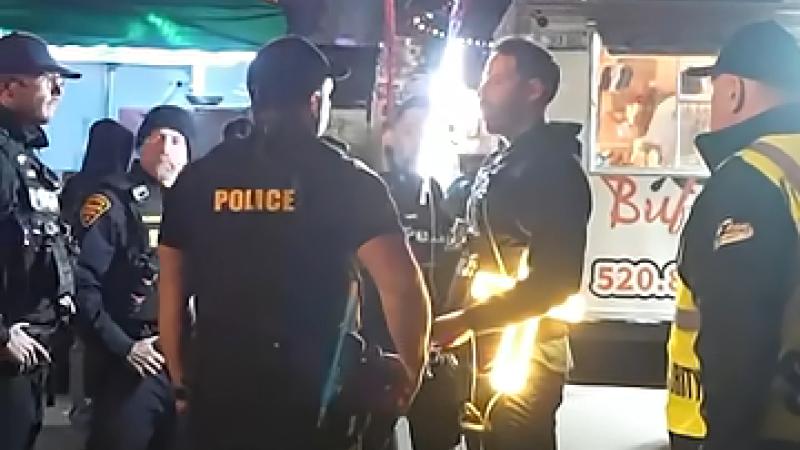
USF police arrested and jailed Tyler Newton for 14 hours on Sept. 23 at the behest of campus officials for standing with his sign and sharing his "abolitionist" views with passers-by, a new First Amendment lawsuit claims.
Describing Newton as a "disabled veteran who is medically retired" from the Army and has "committed himself to public advocacy and speech," the lawsuit says the taxpayer-funded university also banned Newton from campus for a year, preventing him from visiting his brother, a student, and he can't challenge the no-trespass order as a non-student.
The complaint is bound to get heightened attention because it was filed by the Center for American Liberty, founded and led by Assistant Attorney General for Civil Rights Harmeet Dhillon before her confirmation.
Dhillon's group apparently got involved quickly, since Newton posted a GiveSendGo fundraiser to cover his legal defense by Sept. 29 and had raised $875 as of Oct. 6 before hiding it. (The fundraiser still shows up in search results for his name and activism.)
Newton had also asked for donations in August so he could buy "recording equipment" to document his anti-abortion activism, having just returned to Florida with his wife and child, and it came in handy for his visit to USF last month.
Event organizers have 'choice' to veto First Amendment rights in public spaces
Because of Newton's 46 minutes of continuous tripod footage documenting his interactions with students and campus officials and his arrest, plus the lawsuit's hard documentation of his arrest and no-trespass order, the litigation likely won't require a jury to resolve factual issues.
The video captures Marshall Student Center Director Matt Marshall, who oversees the weekly Bull Market in the MSC plaza, telling Newton that event organizers don't want his "activity taking place during their event" and "they have that choice." Marshall is a defendant along with President Moez Limayem, USF Police Chief Chris Daniels and USF trustees.
Marshall cited a USF public space policy that suspends First Amendment rights in otherwise public areas during any "reserved activity" such as events and tabling, despite the fact that the Bull Market is visibly well behind Newton's spot on the edge of a walking path.
Tucson police used the same justification to threaten arrest against evangelist David Hoffman last December – that the Winterhaven Festival of Lights organizers had the right to exclude proselytizing on public streets because of their city permit.
"This case is not about whether anyone agrees with Tyler's views on abortion," Center for American Liberty CEO Mark Trammell said. "The First Amendment means very little if public officials can have someone arrested simply because others would rather not hear his message."
The lawsuit also alleges USF is violating an eight-year-old state law that renders "outdoor areas of public universities that are generally open to members of the campus community" as "traditional public forums for everyone," preventing viewpoint-based regulation of expression.
USF Senior Director of Media Relations Althea Johnson declined to answer questions about the litigation, including how campus policy comports with the 2018 Campus Free Expression Act. USF's practice is "not to comment on pending litigation," she wrote in an email.
Newton didn't get the temporary restraining order he had sought by Oct. 13 to let him engage in activism at the next two Bull Market events, Oct. 14 and 21. (Dhillon's firm filed the lawsuit Oct. 9 but didn't publicize it until Thursday, and its online press release is still password-protected as of Thursday night.)
U.S. District Judge Mary Scriven, nominated by President George W. Bush, ruled hours after the complaint and motion for TRO that "the 'recurring' nature" of the event means USF should first get "the opportunity to be heard and present defenses." She scheduled a two-hour evidentiary hearing for Oct. 21, during the first half of that day's Bull Market.
'These people think that we're dumb'
The lawsuit challenges USF policies that give event organizers the power to exclude individuals such as Newton from "stand[ing] peacefully in outdoor areas of a public university campus" and speaking their "conscience," claiming they violate the First and Fourteenth Amendments and state law and present "an ongoing and credible threat" to Newton's rights.
Newton's female partner informs him that an official told her, "We can't be here because the area's reserved" at the start of the 46-minute video. "Reserved for?" he responds incredulously. "These people think that we're dumb."
The next 20 minutes document Newton's style of activism, familiar to anyone who has encountered activists raising money for progressive organizations such as the ACLU on the street: asking passers-by for their thoughts and seeing who bites.
"Any opinions on abortion?" he asks a young woman four minutes in while leaning on his fetus sign, prompting a 16-minute talk that gradually heats up. "You're disgusting," she says while walking away, apparently noticing the recording equipment for the first time, and demands that he not post their conversation, at which point USF's Marshall shows up.
Newton and his partners – the female and another male appear on video – are crossing the "boundaries" of the Bull Market's reservation, Marshall says, citing USF's time, place and manner restrictions and offering to take them to a new location for the same activism.
"Your activity is interfering with this reservation" and the space is a "limited public forum," Marshall says, meaning USF can limit certain types of speech, and leaves three minutes later to get police, who arrive at the 30-minute mark.
"Right now this area is reserved," an officer tells Newton, who responds, "It's a traditional public forum." Marshall shows up again when the officer promises to arrest Newton for "resisting without violence" if he doesn't turn over his identification.
The Bull Market event organizers "said they do not want this activity taking place within" their reservation, Marshall says, repeatedly insisting state law and the U.S. Constitution don't override the veto power USF gives event organizers over First Amendment rights.
Newton tells Marshall and an officer that his associates were previously arrested at the Texas Alamo for the same activity, but "all charges were dropped, and now we're suing," referring to an arrest in August of members of Abolitionists Rising.
Their lawyer, CJ Grisham, told the Christian Post that Texas Department of Public Safety Officers weren't enforcing state or local law but rather "rules propagated by the Alamo Trust, the private organization that manages the Alamo property on behalf of the state of Texas." Newton also mentioned the Alamo Trust as the instigator of the arrests.
Newton's lawsuit doesn't mention Abolitionists Rising but simply describes him as an "abortion abolitionist," a category "distinct from the mainstream pro-life movement in that they call for the immediate and complete end of abortion." He has appeared in recent posts by the Florida Abolitionists Society.
"I'm not infringing on anybody's reserved spot. I'm not blocking traffic," Newton tells police, still engaging passers-by as officers stand around. "My lawyer has gone over all of this," he says when an officer again demanded Newton's identification, then arrested him for refusing and for trespassing.
"I'm a disabled veteran. I'm hurting badly," Newton tells an officer after several minutes with his hands tightly cuffed behind his back, prompting the officer to loosen the cuffs. His lawyers said the criminal charges were dismissed Oct. 9, the day the suit was filed.