Related Articles

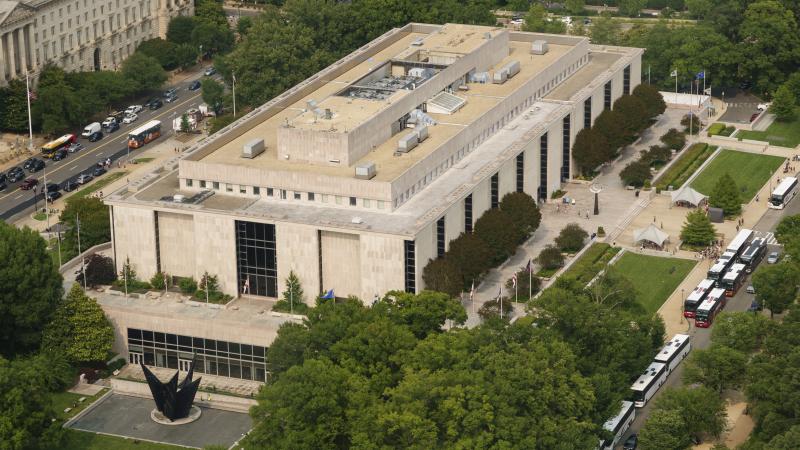
Former Attorneys General Bill Barr, Michael Mukasey, Jeff Sessions, and John Ashcroft sent a letter to Federal Judicial Center Director Judge Robin Rosenberg criticizing the chapter in the fourth edition of the Reference Manual on Scientific Evidence.
Four former U.S. attorneys general are urging the Federal Judicial Center to distance itself from a climate science chapter included in a reference guide used by federal judges.
Former Attorneys General Bill Barr, Michael Mukasey, Jeff Sessions, and John Ashcroft sent a letter to Federal Judicial Center Director Judge Robin Rosenberg criticizing the chapter in the fourth edition of the Reference Manual on Scientific Evidence. The guide helps judges evaluate complicated scientific testimony in court cases.
The attorneys general argue the chapter could influence courts in climate litigation.
“While we appreciate that the FJC removed this chapter from the version hosted on its website, to the best of our knowledge, it is still being published as a joint venture with the FJC by the National Academies of Sciences, Engineering, and Medicine, with the FJC's imprimatur still affixed on the National Academies' website,” they wrote. “Furthermore, other highly problematic references to contested issues, climate change litigation, remain in the FJC document.”
The Federal Judicial Center makes the Reference Manual on Scientific Evidence in cooperation with the National Academies of Sciences, Engineering, and Medicine. It is meant to help judges understand scientific disputes and evaluate expert testimony.
The former attorneys general say the publication historically avoided taking sides in policy or legal debates.
“Historically, the Reference Manual has purposely avoided being a vehicle for one-sided, biased advocacy. Not so the Fourth Edition,” they wrote.
Their letter criticizes the authors of the climate chapter, Jessica Wentz and Radley Horton, arguing that their work relates closely to climate litigation.
“This newest version, for the first time, included a chapter on ‘climate science’ authored by climate-litigation activists Jessica Wentz and Radley Horton," the attorneys general wrote.
The attorneys general argue the chapter relies heavily on a law review article co-written with an attorney representing plaintiffs in climate lawsuits.
“Indeed, a large part of the chapter is based upon a single article for which the lead author is acting as contingency plaintiff’s counsel in a number of cases, and his role in the litigations is nowhere disclosed,” they wrote.
They also say the chapter treats disputed legal concepts tied to climate litigation as settled science.
“This new chapter endorses custom-made-for-litigation studies on contested legal concepts like event and source attribution, presenting them as accepted science. In other words, it’s designed to tip the scale in litigation," they wrote.
The attorneys general said the issue could undermine confidence in the courts.
“It is unacceptable that a branch of the federal judiciary has taken what is essentially an advisory position on litigation adverse to a party and that appears designed to influence judges in their role as gatekeeper of scientific evidence,” they wrote.
Meanwhile, a coalition of 24 state attorneys general led by Montana Attorney General Austin Knudsen wants federal agencies to investigate organizations involved in producing the manual and reconsider federal grants tied to the project.
“Taxpayer dollars should not be used to fund efforts that impartially influence judges. Given multiple opportunities, NASEM and NSF still refuse to take responsibility for publishing a biased climate science manual violating their public commitments and legal obligations,” Knudsen said, The Center Square reported. “The organizations producing these manuals and pushing their climate agendas on judges must be investigated, and all funding to them should stop.”
The Federal Judicial Center has removed the climate chapter from the version of the manual hosted on its website. However, the National Academies continues to distribute a version containing the chapter.