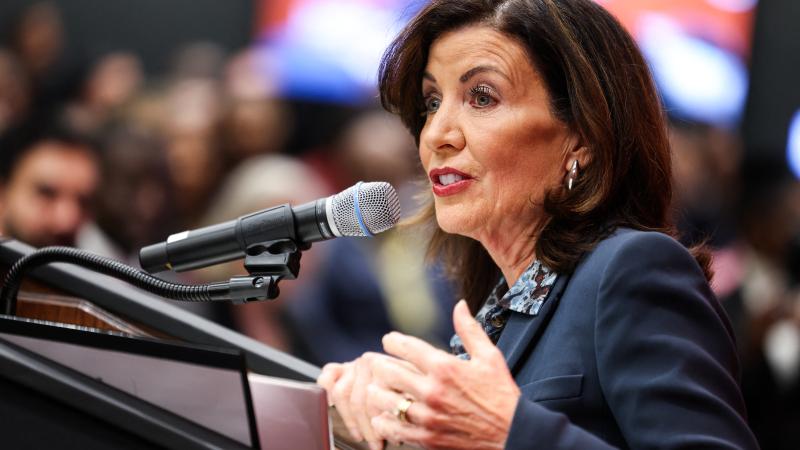
'No Kings' stronghold seeks to nullify voters who banned males from girls' sports
Seattle mayor endorses school board's vote to authorize legal action against I-638, passed by 35 of 39 Washington counties, following ACLU lawsuit that claims it requires an "intrusive sex-verification regime."
The Washington Supreme Court has repeatedly invalidated voter initiatives in the post-Soviet era, often relating to taxing and spending limits, and it has a reputation with conservatives and business groups as an activist court beholden to unions and Democrats, perhaps best illustrated in 2015 by declaring charter schools unconstitutional.
The city of Seattle, its educational establishment and progressive activists are counting on that history to quash an initiative to limit girls' sports to females, which passed by more than 10 percentage points in last week's midterm elections, despite the U.S. Supreme Court upholding near-identical laws in Idaho and West Virginia.
Mayor Katie Wilson, who says she has a "sewer socialist mentality," came out in support of the Seattle Public Schools Board of Directors' authorization of legal action against Initiative 638, deeming it sex discrimination because the law doesn't affect boys' athletics.
The Washington ACLU has already sued to block the Dec. 3 certification of the law on behalf of the Washington Education Association, Seattle nonprofit TransFamilies and pseudonymous parents of children in Seattle Public Schools, ages 11 to 17: two males who compete or are "registered" in girls' sports, one secretly, and four females who compete on girls' teams.
The Washington Interscholastic Activities Association's policy was the first in the nation to allow sex-based competition by gender identity alone, without requiring mitigating steps by male athletes such as testosterone suppression, which research suggests marginally reduces male athletic advantage over females. TransFamilies helped write it.
"For nearly two decades, Washington schools and the Washington Interscholastic Activities Association have relied on policies designed to ensure all students can participate fully in school life," Wilson said. She supports the board's "commitment to creating inclusive learning environments where every student has the opportunity to reach their full potential."
Beyond the initiative's "scrutiny, verification, and potential invasions of privacy not imposed on boys," the board is concerned about "potential legal, operational, financial, and administrative burdens for public schools," according to its resolution.
The litigants will face off against the Washington Attorney General's office, which told the Washington State Standard its role is to ensure every law, whether passed by the Legislature or initiative, "is defended regardless of our personal views about the policy."
That doesn't guarantee a robust defense. State Attorney General Nick Brown, a Democrat, wrote the ballot summary for a parents' rights initiative he opposed, by the same group that sponsored I-638, that received 65,000 fewer votes and ultimately failed, perhaps because of how vaguely Brown wrote it.
Seattle city leadership is concerned about "the measure’s impact on student privacy, safety, dignity, and equitable access to educational opportunities," Wilson said, claiming transgender athletes cannot "participate fully in school life" or "reach their full potential" if males are limited to competition in boys' athletics, a requirement backed by 35 of 39 counties.
District could 'burn millions on a quixotic challenge' that backfires
Only Seattle's King County, two small coastal counties and a Canadian border county rejected the initiative, the latter by just 116 votes out of nearly 114,000, according to unofficial results from the Washington Secretary of State.
King County's southern neighbor Pierce County, which includes Tacoma, approved the initiative 60-40%, higher than the statewide tally.
Suburban Tacoma's Puyallup School District is where a secretly male wrestler was captured on video allegedly sexually assaulting Kallie Keeler on the mat during a match, the subject of an emergency SCOTUS petition by Keeler and her mother to compel authorities to tell them before matches if Keeler is paired with a male or automatically withdraw her.
Suburban Portland's Clark County, at the bottom of the state, approved the initiative by the same margin as Pierce. That was the site of the "Camas Courage" protest last month in support of female cross-country athletes from multiple schools who forfeited a race against Camas High School male runner Logan Mihailoff, who switched to girls' competition mid-season.
While the ACLU litigation is silent about which sports the parents' children play, the secretly male 17-year-old Seattleite could not be Keeler's opponent from the Dec. 5, 2025 match because the ages and school districts don't match.
The board's authorization of legal action raises the possibility it will "burn millions on a quixotic challenge that could establish even more negative precedent for blue states on the issue," George Washington University law professor Jonathan Turley said, noting the high court unanimously slapped down civil rights challenges to the Idaho and West Virginia laws.
That's what happened when SCOTUS agreed to review an appeals court's ruling against Idaho's law in favor of transgender runner Lindsay Hecox, whose ACLU lawyers unsuccessfully tried to withdraw the challenge. The high court upheld Tennessee's ban on so-called gender-affirming care for minors after Hecox's district and appellate wins.
Supreme Court Justice Brett Kavanaugh wrote that the U.S. Constitution and Title IX "do not require an overhaul of women’s and girls’ sports throughout America," citing both the threat to "competitive fairness" from males in girls' sports and the "significant safety risks" to girls.
The litigants "want boys in girls’ sports at all costs, and they are willing to undermine democracy to get them there," I-638 sponsor Let's Go Washington Executive Director Darren Littell told the Standard. "Girls’ leagues should never have become the all-purpose leagues that these organizations want them to be."
Outkick sports columnist Matt Calkins, who left the Seattle Times this summer after 11 years due to its alleged censorship of gender-critical perspectives in his columns, contrasted the litigation to overturn an initiative with Seattle's role in the "No Kings" movement, "where tens of thousands rallied against a president they accused of disregarding the will of the people."
Women's sports advocate Amy Sousa confronted the Seattle school board at the Monday meeting at which it authorized legal action, "told them the vast majority of counties in Washington voted 'yes' on I-638 and yelled, 'King County doesn't get a veto!'" Calkins reported.
'Asking a doctor to check an additional box' is not 'intrusive'
Like opponents of other girls-only sports laws, the ACLU litigants lean heavily on the vigorously contested claim that I-638 imposes an "intrusive sex-verification regime."
No such process is laid out in the initiative's wording, which notes that state law and school district policies already require students to "undergo a routine physical examination prior to participation in interscholastic sports, which includes documentation of the student's sex assigned at birth." (The phrase "assigned at birth" is ideological, not scientific.)
Would-be participants in girls' sports would have to provide this documentation, "signed by the student's personal health care provider," verifying the student's female sex based on one of three options: "reproductive anatomy, genetic makeup, or normal endogenously produced testosterone levels."
"The Initiative will lead to widespread confusion and inconsistency in the administration of youth athletics statewide," because "its many undefined terms will be interpreted differently from district to district, and provider to provider," disproportionately harming "all girls, including transgender girls," the ACLU lawsuit in King County Superior Court says.
It also claims that "existing medical eligibility forms generally do not require verification of a student's sex based on the criteria specified in the Initiative," meaning "girls whose existing forms lack that verification will need to obtain additional documentation to satisfy the Initiative's new requirements."
Families of girls will face "financial and logistical burdens" that boys don't face to play sports, such as scheduling "hurried mid-season medical appointments – and possibly blood tests or genetic tests – in order to continue playing a fall or winter sport," the suit says.
It faults the initiative for not defining a "normal" level of testosterone "or what age groups different tests may apply to," claiming that circulating testosterone levels before puberty "do not significantly differ" between males and females. Intersex children "would be foreclosed from playing girls’ sports" under the initiative, the suit claims.
"If asking a doctor to check an additional box requires legislative oversight, new funding structures and layers of bureaucracy, maybe Olympia needs some streamlining," a spokesperson for Let's Go Washington told KING5, referring to the state capital.
The Facts Inside Our Reporter's Notebook
Links
- activist court beholden to unions and Democrats
- declaring charter schools unconstitutional in 2015
- initiative to limit girls' sports to females
- U.S. Supreme Court upholding near-identical laws
- "sewer socialist mentality,"
- authorization of legal action against Initiative 638
- Washington ACLU has already sued to block the Dec. 3 certification
- policy was the first in the nation
- research suggests marginally reduces male athletic advantage
- TransFamilies helped write it
- Washington State Standard
- Wilson said
- unofficial results from the Washington Secretary of State
- secretly male wrestler was captured on video
- emergency SCOTUS petition
- "Camas Courage" protest
- Keeler's opponent from the Dec. 5, 2025 match
- Jonathan Turley said
- ACLU lawyers unsuccessfully tried to withdraw
- Outkick sports columnist Matt Calkins
- alleged censorship of gender-critical perspectives
- initiative's wording
- KING5

Top Stories

Trending
Just the News Spotlight
Just News, No Noise