U.S. citizen takes helm of Mexico’s fiercest cartel, exposing ugly truth on birthright citizenship
The new cartel boss Juan Carlos Valencia González possession of dual citizenship presents challenges for U.S. intelligence surveillance, which led the Mexican government to his predecessor.
A California-born U.S. citizen whose mother is a Mexican national and is reportedly part of a drug and money laundering cartel herself, has now taken the helm of Mexico’s most dangerous cartel as the Supreme Court is set to consider a Trump administration challenge to the very birthright policy that granted him that citizenship.
Multiple reports indicate that the 41-year-old Juan Carlos Valencia González, a dual U.S. and Mexican citizen, took charge of the notorious "Jalisco New Generation" cartel (CJNG) in the aftermath of a Mexican special forces raid that took out the cartel’s former boss, El Mencho, last month.
The raid was the most direct action Mexican authorities have taken against the cartels in coordination with the United States, which, under President Donald Trump, ramped up pressure on the drug trafficking organizations after naming them designated foreign terrorist organizations.
U.S. intelligence helped locate past cartel kingpin in Mexico
As a result, the American administration has increased surveillance of the cartels and, at times, has threatened to take direct military action if Mexico didn’t step up. It was reportedly U.S. intelligence that provided Mexico with the location of El Mencho, precipitating the successful operation.
CJNG was shepherded to prominence by that former leader, Ruben Nemesio Oseguera Cervantes, known as “El Mencho,” and grew into Mexico’s most powerful and well-equipped cartel. Based in Mexico’s coastal Jalisco state, the cartel’s network operates a global drug trafficking empire spanning from China to North Africa and has for years smuggled drugs into the United States.
But now, with El Mencho dead, and his biological son in an American prison for life, the cartel has turned to Valencia González, his stepson, to assume leadership of the sprawling enterprise. Valencia González’s American citizenship is likely to complicate the U.S. government’s efforts to gather intelligence but could also stand in the way of any future military strikes against him as head of CJNG.
"Exploiting U.S. birthright citizenship" author says
The ascension of a U.S. citizen to head of the designated terrorist organization also comes at the same time that the Supreme Court is considering a Trump administration challenge to U.S. birthright citizenship under the Fourteenth Amendment, which, under the current interpretation, grants citizenship to most children born in the country–just like Valencia González.
“This is another example of adversaries exploiting the U.S. birthright citizenship for their benefit, to the detriment of America,” investigative journalist and author Peter Schweizer told Just the News. Last month, Schweizer’s new book, The Invisible Coup, outlined the ways in which China in particular exploits the standard by encouraging birth tourism.
Schweizer pointed to the similar example of infamous drug lord Joaquín “El Chapo” Guzmán of the Sinaloa cartel. El Chapo’s wife, Emma Coronel, traveled to Los Angeles to give birth in the United States in 2011. Though she was already a U.S. citizen, giving birth in the country would ensure that she wouldn’t have to apply for citizenship for her children later, which would require her to provide their father’s name.
“A US citizen who has a baby in another country must apply for citizenship for the child through the consulate, which would have been complicated by being married to the most famous criminal in North America,” Schweizer wrote in his book. “It was easier [for her], as a US citizen, to travel freely to the United States, give birth here, and leave the father’s name blank on the birth certificate.”
Mark Morgan, the former acting commissioner of U.S. Customs and Border Protection, said the ascension of a birthright American citizen to the head of a Mexican cartel lens Creedence to the Trump administration's effort to end the concept.
"It's something we don't talk enough about ... just simply because you're born here does not mean that you fully assimilated, and does not mean your allegiance is to this country," he said. "So it's a righteous issue for the Trump administration to push back on."
SCOTUS to hear arguments in Trump v. Barbara
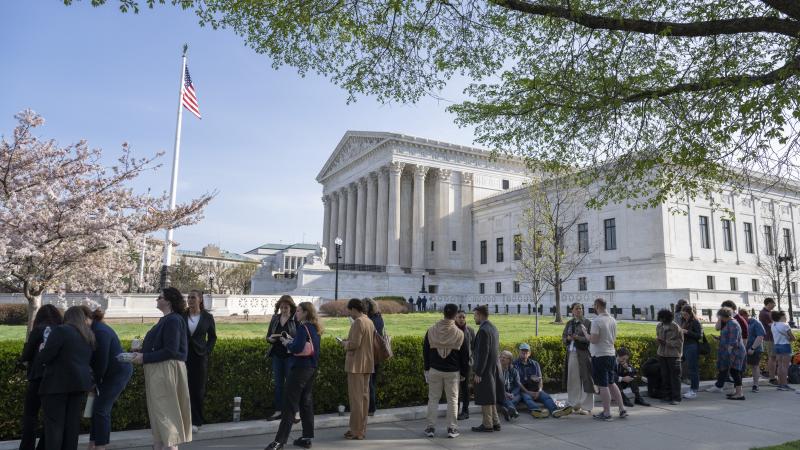
The U.S. Supreme Court is currently considering a challenge to the Trump administration’s efforts to end birthright citizenship. The court will hear oral arguments in the case, Trump v. Barbara, on April 1.
The president issued an executive order intended to prevent babies born in the United States from automatically receiving U.S. citizenship if their parents are in the country illegally or only temporarily. However, the order was challenged and never went into effect.
The challengers argue that the order contradicts the Fourteenth Amendment’s citizenship clause, which provides that “[a]ll persons born or naturalized in the United States, and subject to the jurisdiction thereof, are citizens of the United States and of the State wherein they reside.”
The Trump administration argues that the amendment’s framers only intended for the clause, which was added to the Constitution in 1868, to grant citizenship to former slaves and their children.
How Valencia González came to U.S. citizenship: a family's tale
Valencia González was born in Santa Ana, California to Rosalinda González Valencia, reportedly a drug kingpin in her own right and known as La Jefa, Spanish for “the boss” for her association with the “Cuinis” gang which later allied with the Jalisco New Generation Cartel.
Though details of La Jefa’s early life are murky, she was born in Mexico in the 1960s where her family grew avocados in a plantation field. Later, she and several of her 18 siblings eventually moved to the United States, possibly illegally. The Department of Homeland Security did not respond to inquiries about La Jefa’s immigration status.
It was there that she gave birth to Valencia González, whose father was Armando Valencia Cornelio, head of the Milenio Cartel, for whom several of her siblings worked. Valencia Cornelio was arrested by Mexican authorities in 2003 but the public record is vague on his fate. He was designated by the United States under the Kingpin Act as a significant foreign narcotics trafficker in 2004.
At some point, La Jefa and Valencia Cornelio separated, and she returned to Mexico. She married El Mencho in 1996, uniting her clan with the growing CJNG and putting Valencia González into the cartel’s line of succession.
Emerging as a globe-spanning drug trafficking empire
CJNG rose to power in Jalisco following a dispute with El Chapo’s Sinaloa cartel. The U.S. Department of State has described CJNG as a “transnational organization with a presence in nearly every part of Mexico” that traffics fentanyl, engages in extortion, smuggles migrants, steals oil and minerals, and trades in weaponry.
Since building its globe-spanning drug trafficking empire, the group has also increasingly employed military grade weaponry like drones, improvised explosive devices, and rocket-propelled grenade launchers, posing a novel problem for Mexican authorities and the United States, Just the News previously reported.
Recent battles between CJNG and rival cartel cells have terrorized villages, some within just a few hundred miles of the U.S. border. The use of drones in particular has made them more dangerous, which they use to drop explosives on their enemies, both Mexican police and rivals.
Surveillance requires approval from the U.S. Attorney General and the Foreign Intelligence Surveillance Court
Juan Carlos Valencia González’s U.S. citizenship creates hurdles for American intelligence agencies that did not exist when targeting his predecessor, El Mencho. Under U.S. law, surveillance and data collection on American citizens abroad are subject to stricter regulations.
While high-resolution CIA drone surveillance was instrumental in the operation that eliminated El Mencho, using similar methods against a U.S. citizen requires additional steps, including seeking approval from the U.S. Attorney General and convincing the Foreign Intelligence Surveillance Court that Valencia González is acting as an “agent of a foreign power,” The Wall Street Journal reported. President Trump’s designation of CJNC as a foreign terrorist organization could smooth this process, however.
Previously, the Obama administration cited the 2001 congressional authorization for the use of force against terrorist groups deemed responsible for the 9/11 attacks to justify the strike. Currently, no such authorization exists for the use of force against Mexican cartels.
Mexican authorities have been reluctant to take President Trump up on his offer of U.S. military assets to strike against the cartels, and a future strike against Valencia González would certainly spark constitutional questions. The Constitution recognizes a right to a “speedy and public trial.” Advocacy groups have also argued that the extrajudicial killing of American citizens abroad is in violation of the Fifth Amendment right to due process.
When President Barack Obama ordered a drone strike against Anwar al-Awlaki, a U.S.-born cleric who assumed leadership of Yemen’s al-Qaeda branch, the administration justified the strike as an act of self-defense against a terrorist organization.
The Facts Inside Our Reporter's Notebook
Links
- now taken the helm
- most powerful and well-equipped
- El Mencho dead
- his biological son in an American prison
- The Invisible Coup
- by encouraging birth tourism
- traveled to Los Angeles to give birth
- requiring her to provide
- considering a challenge
- challengers argue
- Fourteenth Amendment’s citizenship clause
- Rosalinda González Valencia
- known as La Jefa
- arrested by Mexican authorities
- designated by the United States
- Department of State
- increasingly employed military grade weaponry
- designation of CJNC as a foreign terrorist organization
- cited the 2001 congressional authorization
- have also argued
- justified the strike

Top Stories

Trending
Just the News Spotlight
Just News, No Noise