From proving ground to payday, Trump’s Michigan trip shows auto industry shifting into high gear
Under Trump’s trade policies, companies such as General Motors (GM) are shifting production of certain vehicles stateside.
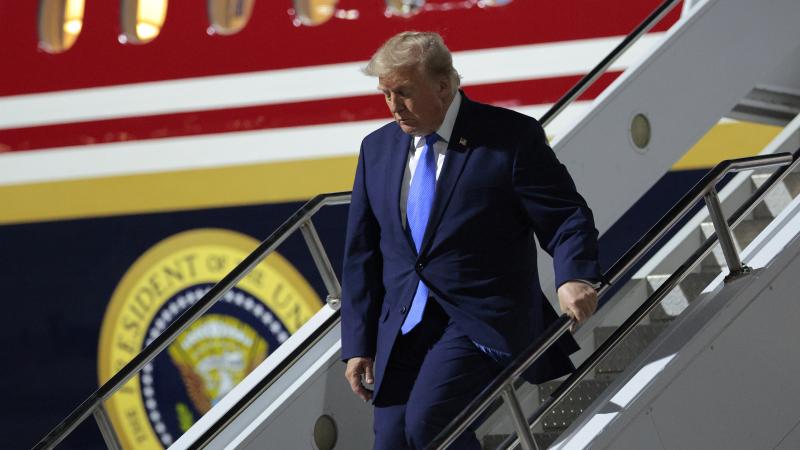
President Donald Trump traveled Monday to General Motors' Milford Proving Ground facility in Michigan, touting his second administration's strides made in the auto industry, one of the nation's most important industries that suffered under previous policies.
"For decades, the autoworkers and manufacturers of this great state were sold out and betrayed by globalist politicians and corrupt special interests who let other countries steal your jobs, pillage your factories and pillage the crown jewels of America from Detroit and all over our country," Trump said at the facility.
Tariffs shift American production into drive
Under Trump’s trade policies, including Section 232 auto and parts tariffs and broader forced-labor measures, companies such as General Motors (GM) are shifting production of certain vehicles stateside.
"It’s amazing what tariffs are doing for GM," the president also said.
GM announced the plan in June 2025 as part of a $4 billion U.S. investment to expand domestic manufacturing in response to tariffs.
Current gas-powered Chevrolet Blazer production at the Ramos Arizpe plant in Mexico is scheduled to end around September 30. The refreshed 2028 Blazer will begin production in the second quarter of 2027 at their Spring Hill plant in Tennessee.
For the Equinox, GM is adding gas-powered production at its Fairfax Assembly plant in Kansas starting in mid-2027 to boost U.S. output and meet strong demand, while some Mexican production continues for other markets.
"We're building more auto factories and more plants than at any time in the history of our country," Trump also said Monday.
Other manufacturers have announced multi-billion-dollar U.S. investments and factory expansions, with White House officials citing over $20 billion in Michigan business investments and more than 1,600 related jobs as evidence of the “America First” approach working.
Sales surge keeps factories humming
Domestic sales of key U.S. vehicles, particularly pickups and SUVs, have remained robust, helping keep American factories busy and supporting jobs.
General Motors raised its full-year 2026 profit forecast for the second time this year after strong second-quarter results, citing solid customer demand in North America for its lineup of pickups and SUVs along with improved margins.
Trump and White House officials have highlighted that the Working Families Tax Cuts protected roughly 170,000 manufacturing jobs in Michigan, part of a broader national impact that sustained nearly six million American jobs and preserved significant economic output and wages across all 50 states.
Less red tape, more affordable rides
Regulatory resets under the Trump administration have restored greater flexibility for automakers by easing strict fuel-economy and emissions requirements that previously constrained product choices and raised costs.
In December 2025, the administration reset Corporate Average Fuel Economy (CAFE) standards to levels that can be met with conventional gasoline and diesel vehicles, projecting savings of roughly $1,000 on the average new car and $109 billion for American families over five years.
In February, the EPA took what it called the single largest deregulatory action in U.S. history by rescinding the Obama-era Endangerment Finding, and eliminating federal greenhouse-gas emission standards for light-, medium-, and heavy-duty vehicles, with claimed taxpayer savings exceeding $1.3 trillion.
Additional steps included ending California’s EV mandates through a congressional joint resolution in June 2025 and setting civil penalties for CAFE violations to zero in the Working Families Tax Cuts Act, giving companies more room to produce the trucks, SUVs, and hybrids that match actual consumer demand while investing in domestic capacity.
Further accelerating the growth
The administration may expand or extend existing offsets that reward higher U.S. or USMCA (US-Mexico-Canada Agreement) content in vehicles and tighten rules during the upcoming USMCA review to require more parts and final assembly in America to avoid duties. This would directly reward companies that fully reshore supply chains.
Other potential moves involve accelerating permitting and infrastructure for reliable, affordable domestic energy sources such as natural gas and nuclear targeted at auto plants and suppliers to lower operating costs and boost competitiveness against overseas facilities.
Another measure to further grow the industry would be to broaden auto-loan interest deductibility or create additional tax credits tied exclusively to high-U.S.-content vehicles while offering targeted support for auto-parts suppliers to relocate or expand domestically, generating a stronger multiplier effect across the industry ecosystem.
Amanda Head is White House Correspondent for Just The News. You can follow her here.
The Facts Inside Our Reporter's Notebook
Links
- General Motors' Milford Proving Ground
- Section 232
- $4 billion U.S. investment
- scheduled
- boost U.S. output
- remained robust
- raised its full-year 2026 profit forecast
- highlighted
- reset Corporate Average Fuel Economy
- rescinding the Obama-era Endangerment Finding
- ending Californiaâs EV mandates
- existing offsets
- here


Top Stories





Trending
Just the News Spotlight
Just News, No Noise