State of Union: A president with big ideas confronts an opposition addicted to pandering protests
Trump enjoyed a joint session audience dominated by Republicans, as many Democrats boycotted and declined to attend.
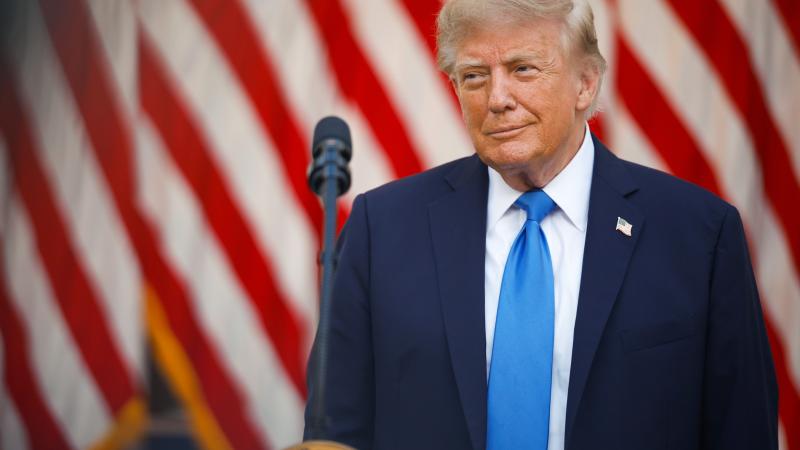
President Donald Trump on Tuesday night delivered his second term's first State of the Union address from the United States Capitol, presenting ideas to a nation that's heard nothing but protest, pandering and platitudes from his political foes for the first 13 months of his term.
In one of the epic speeches of his career, Trump weaved nearly two hours, cataloging his first-year successes alongside a celebration of everyday Americans’ extraordinary achievements and heroism.
On the other side of the aisle, the response appeared to be less ideas-driven and characteristically more oppose-everything-Trump.
Trump laid out a massive new agenda that included new federal matching payments for Americans' 401(k) retirement accounts and a path to a balanced budget and an income tax-free federal system while delivering a powerful and personal repudiation of what he sees as the insanity of Democratic ideas like sanctuary cities.
“You should be ashamed of yourself,” the president declared in one jibe at Rep. Ilhan Omar, D-Minn., one of the Democratic congressional lawmakers who did attend.
Democrats were reportedly instructed by minority leader Hakeem Jeffries, D-N.Y., that they could either attend in silent defiance or boycott the historic address. Dozens chose to no-show.
Trump touted his aggressive law and order successes, particularly on illegal immigration, including mass criminal deportations, border enforcement, and near-zero illegal crossings, restoring order at the southern U.S. border after chaos there during the Biden administration.
Attributing America's current condition overrun by illegal immigrants to former President Joe Biden, Trump has consistently insisted that illegal immigration is out of control. It seems some Democrats agree and are ready to admit it.
Wisconsin Democratic Governor Tony Evers effectively admitted that illegal immigration keeps his state afloat.
In a January 2026 interview with WBAY News, Evers expressed concern about potential ICE (Immigration and Customs Enforcement) actions targeting farm workers amid increased enforcement in the Midwest.
“I can probably say in my sleep, our state will be destroyed economically if suddenly we decide anybody undocumented is going home or has to leave Wisconsin," he said.
Evers referenced a University of Wisconsin-Madison survey indicating that around 70% of labor on Wisconsin dairy farms is performed by people living in the country illegally.
In yet another instance of reality colliding with hypocrisy, New York City's new mayor, Democratic Socialist Zohran Mamdani, has faced criticism for mandating two forms of ID, copies of ID documents, a Social Security card, and photos for residents to participate in paid emergency snow shoveling during a blizzard, bucking the liberal ideology that requiring IDs is racist.
This policy contrasts sharply with the broader Democratic argument that voter ID laws are discriminatory, as they ostensibly suppress voting among minorities and low-income individuals who lack easy access to such documentation.
More recently, California Democratic Gov. Gavin Newsom, a potential 2028 presidential candidate, raised eyebrows during a book tour event in Atlanta when he told a predominantly black audience and Mayor Andre Dickens that he was "like you," citing his low SAT score of 960 and struggles with dyslexia and reading speeches.
Newsom's team dismissed the backlash as "MAGA-manufactured outrage," insisting the remarks were about his personal challenges and not racially motivated.
Prior to tonight's address, dozens of Democratic lawmakers announced they would boycott the event, opting instead for counter-programming events or to express protest against his policies through absence.
Trump also announced that Vice President JD Vance would lead a new "war on fraud" initiative, stating it could help balance the budget, and emphasized plans to make health care more affordable through direct payments to health savings accounts.
The president laid out his successes in the foreign policy arena, ending numerous wars and brokering deals between nations which have been in conflict for decades in some cases.
Mindful of the economy's impact on the midterm elections in November, Trump highlighted his administration's economic achievements, declaring that after just one year in his second term, the U.S. has undergone a stunning transformation with inflation plummeting to its lowest level in more than five years, incomes rising fast and the economy roaring stronger than ever before.
He touted massive investment inflows, stating that his administration has secured commitments for more than $18 trillion pouring into the country from around the globe, alongside record-breaking stock market milestones like the Dow Jones surpassing 50,000 points years ahead of schedule, crediting tariffs and deregulation as key drivers of this resurgence.
Trump emphasized job creation and energy dominance, saying more Americans are working today than at any time in history, American oil production has increased by over 600,000 barrels a day, and natural gas output has reached all-time highs thanks to his "drill, baby, drill" policies, all contributing to what he described as America's golden age and a future of even greater prosperity.
The speech, which became the longest in U.S. history at over 100 minutes, also celebrated the upcoming 250th anniversary of American independence and promised that Iran would never acquire a nuclear weapon.
The special guests at the address included a mix invited by the president, first lady Melania Trump, House Speaker Mike Johnson, R-La., and other Republican lawmakers.
Trump's invitees include Erika Kirk (widow of Turning Point USA founder Charlie Kirk); Saige Blair (a Virginia teen central to a parental rights case involving school gender transition issues without parental consent); the gold-medal-winning U.S. men's Olympic hockey team; Evalea and Gary Beckstrom, parents of slain National Guard member Sarah Beckstrom; and a 99-year-old (approaching 100) World War II veteran, George "Buddy" Taggart.
The State of the Union address originates from Article II, Section 3 of the U.S. Constitution, which requires the president to periodically inform Congress about the condition of the nation and recommend measures. George Washington delivered the first in-person annual message in 1790, but Thomas Jefferson switched to written messages in 1801 (viewed as less monarchical), a practice that lasted until Woodrow Wilson revived spoken addresses in 1913. The name "State of the Union" was popularized by Franklin D. Roosevelt in the 1930s–1940s and became official in 1947.
It has since evolved into a major televised event where the president outlines his priorities and policy agenda before a joint session of Congress.
The Facts Inside Our Reporter's Notebook
Top Stories


Trending
Just the News Spotlight
Just News, No Noise