Related Articles
Ossoff refuted claims about the Biden administration’s contributions to current energy prices. He blamed the Trump administration’s tariff policies and the U.S. military conflict in Iran for high gas prices.
(The Center Square) - Candidates for U.S. Senate in Georgia debated over healthcare policy, gas prices and tariffs on Thursday night in a hotly contested race with national attention.
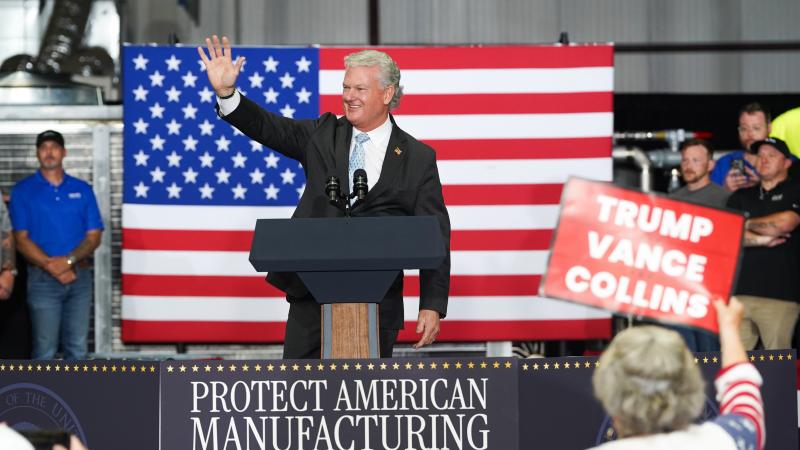
Sen. Jon Ossoff, D-Ga. and Rep. Mike Collins, R-Ga., sharply disagreed over how to address rising healthcare costs, gas prices and the Trump administration's tariff policies during the debate, which was hosted by Gray Media and Atlanta News First.
Collins said high gas prices are a result of economic and environmental policies under Joe Biden’s administration. He called for the United States to build up its strategic oil reserves and increase energy independence.
“We have got to continue to get back to energy independence,” Collins said. “The first thing that the Biden administration and my opponent and the Democrats did was kill the Keystone pipeline. That alone would have helped keep these energy costs down.”
Ossoff refuted claims about the Biden administration’s contributions to current energy prices. He blamed the Trump administration’s tariff policies and the U.S. military conflict in Iran for high gas prices.
“We’re going to repeal the tariffs and we’re going to end this disastrous war in Iran,” Ossoff said. “Our economy has been strangled by Donald Trump and Mike Collins’ economic record.”
In Georgia, gas prices have dropped by 33 cents per gallon since Gov. Brian Kemp pushed forward a fuel tax suspension last week. Average gas prices in Georgia are $3.84 and diesel prices are $5.78 per gallon, according to AAA.
With the fuel tax suspension, Georgians are paying less for gas than any other state in the region.
Ossoff also blamed tariffs for rising costs across the board. He criticized Collins for failing to vote against the president’s tariff authority as a member of the U.S. House.
The incumbent Democrat also pointed to his campaign’s support for Georgia farmers who were negatively impacted by the tariff policies. Ossoff said he would work to negotiate with foreign countries that impose unequal duties on products from the United States to increase fairness in the international marketplace.
“When Georgia pecan growers came to me, they told me that India had a 100% tariff on Georgia pecans,” Ossoff said, referencing a policy dispute from 2023. “I got to work and got the Indians to cut that tariff by 70%.”
Collins said the administration’s tariffs are an attempt to give the United States a more favorable position in the global economy.
“We have bowed down to the rest of this world and took it from companies or countries charging us tariffs over and over again,” Collins said. “We shouldn't be doing that. We should set it up to where we have the advantage.”
The candidates also sparred over healthcare policy and lowering costs for Georgia residents. Ossoff blamed Medicaid restrictions brought by the “One Big Beautiful Bill” for cutting Medicaid benefits across the country and shutting down a labor and delivery unit in St. Mary’s Sacred Heart Hospital in Lavonia.
The hospital shut down its unit in October 2025, partially citing Medicaid cuts. However, the hospital also cited staffing shortages and changing demographics prior to the bill’s passage that informed the decision.
“The Congressional Budget Office warned us that if they pass this bill, health insurance premiums would skyrocket, that if they pass this bill, rural hospitals would have to close down services,” Ossoff said.
Collins touted his vote in favor of the “One Big Beautiful Bill” and its inclusion of a $50 billion rural hospital fund. The Republican congressman blamed the Affordable Care Act for rising healthcare premiums and burdensome hospital mandates that drove prices up.
“Our premiums have gone through the roof and the coverage has gone through the floor,” Collins said.
Ossoff called for Medicaid expansion in Georgia and praised Democratic gubernatorial candidate Keisha Lance Bottoms. He blamed rising ACA costs on Republicans in Congress allowing subsidies to expire in the program.
“He still refuses tonight to explain why he voted to double your health insurance premiums and I think that's disqualifying for a candidate for U.S. Senate,” Ossoff said.
Collins touted price transparency in drug manufacturing and praised TrumpRx, a federal government database for prescription drugs. He said price transparency, rather than federal subsidies, would lower healthcare costs.
“The only people that get subsidized are our insurance companies and they make more money off of you and me while our insurance coverage goes down,” Collins said.
Ossoff and Collins also engaged in personal disputes throughout the debate. The incumbent Democrat called Collins a “bigot,” citing his son-in-law’s connections to the group Patriot Front and antisemitic comments.
“Imagine running for the U.S. Senate while neo-Nazi propaganda is disseminated to an audience of millions from your home,” Ossoff said. “Mike Collins is a bigot and it's disqualifying for a candidate for the U.S. Senate.”
Collins defended his family against claims from Ossoff but did not deny his son-in-law's associations. He attacked Ossoff for his support of Michigan Democratic Senate candidate Abdul El-Sayed and endorsement from online streamer Hasan Piker, “who has faced criticism for comments suggesting America deserved the Sept. 11 attacks."
“He doesn't denounce anybody or anything or condemn them because he's part of them,” Collins said.
Early voting in Georgia begins on Oct. 13. Polls are open from 7 a.m. to 7 p.m. on Election Day. For more information, visit the Georgia Secretary of State’s office at georgia.gov. For results on Election Day, visit thecentersquare.com/georgia.