Related Articles
During his visit to Dublin, Canadian Prime Minister Carney says the "new world order will be built out of Europe," signaling move away from U.S. ahead of the G7 summit
Canadian Prime Minister Mark Carney said that the “new world order will be built starting with Europe,” signaling a pivot away from the U.S. ahead of the (Group of Seven) G7 Summit that began Monday in France.
He made the remarks Saturday at a joint news conference with Ireland’s leader Taoiseach Micheál Martin during his six-day trip to Europe.
"Canada is the most European of non-European countries. We are transforming our cooperation with Europe,” Carney said.
He also said in a later address at Trinity College, in Dublin, that the “strands” of the order could be “woven in” at the G7 Summit this week and that Canada and Europe were a “force for good – because we safeguard the values of human rights, dignity, and pluralism that our people hold dear.”
Earlier in January, Carney made similar remarks during a speech at the World Economic Forum in Davos, Switzerland. He said that the “old world order” was not coming back, calling for middle powers to band together against great powers. His comments have also been interpreted as a critique of President Donald Trump’s foreign and economic policies.
At Trinity College, Carney also said that middle-power countries should not compete for favor with America. He said that Canada and the European Union had a combined population more than twice the United States, with a comparable economy and collective defense budget double that of China’s.
“In a world of great power rivalry, middle powers have a choice – to compete for favor or to combine to create a third path with impact," Carney said.
The statement comes as Carney also noted that the U.S. was not interested in making fundamental changes to the USMCA free trade agreement with Canada and Mexico.
"The U.S. has been clear. They don't want to change the fundamental architecture," Carney said, saying that this was because the White House would have to go through Congress to do so, which they wanted to avoid.
The consequences of the fractured North American trade relationship have spilled over into Washington.
Following a January trade deal between Ottawa and Beijing that reduced Canada's 100% tariffs on Chinese EVs to 6.1%, Michigan Democratic Sen. Elissa Slotkin introduced legislation last month to explicitly ban Chinese-made connected vehicles from crossing the U.S.-Canada border.
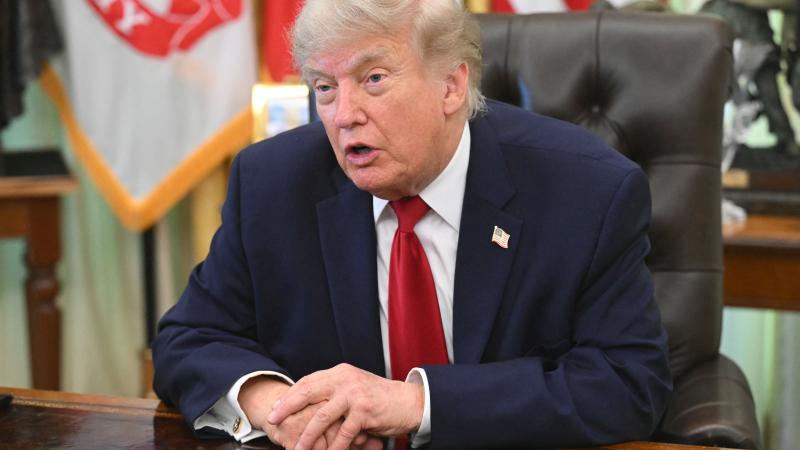
July 1 is the deadline for the renewal of the U.S.-Mexico-Canada Agreement. However, Trump has said last week that he may not renew the deal, saying that the U.S. does not need anything that Canada has.
Meanwhile, Carney has set a goal to double Canada’s non-U.S. exports in the next decade.
In February, Canada also became the first non-European member to join the EU’s defense procurement initiative, the SAFE mechanism, allowing Canadian defense companies access to a $174 billion EU loan program.
This comes while the Trump administration seeks to reduce American military presence in Europe, with a shift away from the role the U.S. has played since WW2. Trump has repeatedly criticized NATO’s European members for not spending enough on defense.
Carney also said that Canada has established 56 partnerships on critical minerals in more than 10 countries, most of them being in Europe.
This echoes his earlier comments at the European Political Community Summit in Armenia in May, in which he argued that the international order would be rebuilt from Europe, with a broader push into Canadian defense, critical minerals, energy, digital infrastructure, space, semiconductors, payment systems, vaccines and clean technology.
Ahead of the G7 summit, Carney visited French President Emmanuel Macron on Friday and Irish Taoiseach Micheál Martin on Saturday. He has also met with the Irish President, the President of the European Council, and the President of the European Commission to discuss expanding the Canada-EU partnership.
"Prime Minister Carney has spoken with great clarity and conviction about Canada's desire to deepen its engagement with Europe. Ireland warmly and unreservedly welcomes that ambition, and we will do what we can to strengthen relations between the European Union and Canada during our forthcoming presidency," Martin said.
At the G7 summit, Carney announced that a Canadian company had become the first to land a contract under the SAFE mechanism, securing more than $7 million to supply tactical radios made in Canada to Poland’s military.
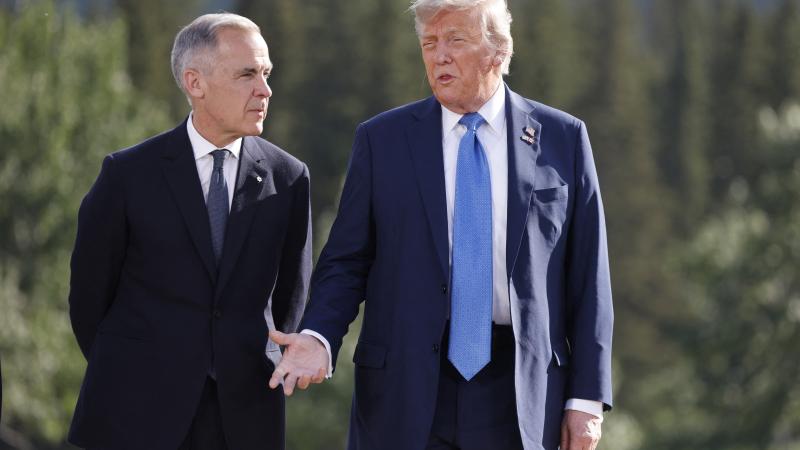
According to a senior U.S. administration official, Trump is not scheduled to hold bilateral talks with Carney at the G7 summit, as reported by PBS News.