Related Articles
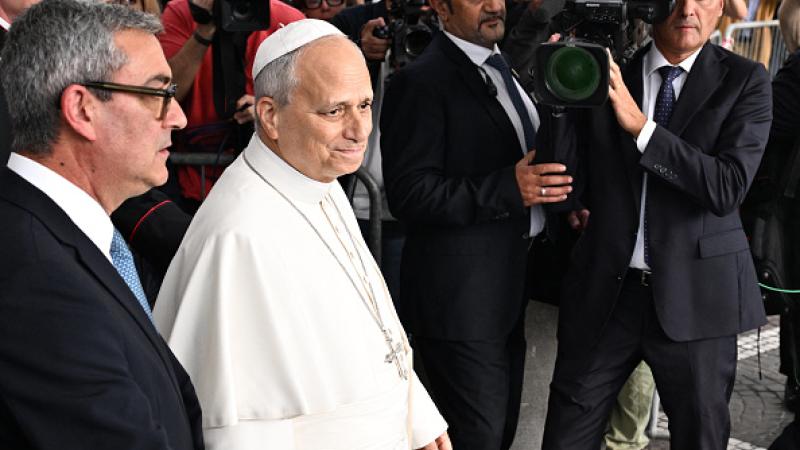
Leo was elected amid widespread speculation on whether the leader of the world’s 1.2 billion Catholics would follow in the progressive footsteps of predecessor Pope Francis or return to a more traditional Catholic doctrine.
In an age of instant judgments and ideological scorecards, questioning where Pope Leo XIV lands on the liberal-conservative spectrum may be a misrepresentation of both the man and the moment.
Leo, the former Cardinal Robert Prevost of Chicago, was elected pope seven months ago amid widespread speculation over whether the leader of the world’s 1.2 billion Catholics would follow in the progressive footsteps of predecessor Pope Francis, or return to a more traditional Catholic doctrine.
To some, the pontiff’s statements seem to suggest openness and reform; to others, they might suggest continuity packaged in a new language.
“Interpretations of Pope Leo at this point end up being a kind of Rorschach Test,” Rome-based author, theologian and commentator Thomas Williams told Just the News. “People label him the way they want to label him.”
It is not that the pontiff has been silent, or that he has avoided substance. In his first months, the 70-year-old Leo has spoken regularly – always cautiously, sometimes bluntly – about Church priorities.
He has discussed prickly issues such as political polarization, cultural fragmentation and the moral costs of power in remarks treated by some U.S. media as a critique of the U.S. under President Donald Trump.
The pope has also cast the international debate over mass migration as a moral one, emphasizing dignity and attention to human suffering.
In addition, he has repeatedly urged global leaders to push for peace in war-torn parts of the world including Gaza, Ukraine and parts of Africa, and he has blasted economic inequality and consumerism as “systems that discard the vulnerable.”
But Leo has also talked about the limits of papal personality, in contrast to the often personality-driven tenure of Pope Francis. And he has stopped short of any reversals of Church doctrine and has stayed away from culture-war talking points.
“We have to remember that the pope spent many years as a missionary, and he still has that mindset,” Andrea Gagliarducci, a leading Vatican analyst, told Just the News. “A missionary doesn’t care about ideology; he cares about getting the job done in a pragmatic way. I think that’s the way Leo is approaching the papacy.”
According to London-based Alistair Sear, a retired church historian, the first seven months of Leo’s papacy may be too little time to be able to draw conclusions about a papacy.
“We have to remember that in the Vatican, things move very slowly,” Sear said in an interview. “Change isn’t measured in weeks or months but in years and decades. Francis was an exception. At least in that way, Leo’s papacy can be seen as a return to the normal pace of change.”
Gagliarducci broadly agreed, but said it will always be difficult to compare Leo to his predecessors because he is from a different period in Church history.
He pointed out that Leo was ordained as a priest in 1982, 17 years after the close of the Second Vatican Council, which dramatically reshaped the way the Church related to the modern world. Commonly known as Vatican II, the council’s reforms still divide Catholics.
“Leo is the first pope to come of age entirely after Vatican II,” Gagliarducci said. “For the generation of priests ordained in the 1980s, those debates were entirely historical. They didn’t matter as much as they used to, which is very different from the experience of Leo’s predecessors.”