Related Articles
Backed by a $1,000 government seed deposit and billions in private philanthropy, the new tax-deferred accounts aim to give American newborns a massive financial head start
“Trump Accounts” officially launched on Monday following a July 4 opening, drawing positive feedback from economists who project the program will provide significant financial benefits for American children nationwide.
The accounts come as part of Trump’s new tax law, the One Big Beautiful Bill, and are essentially tax-deferred investments for newborn American citizens born between January 1, 2025, and December 31, 2028. As of today, more than six million people have signed up for the accounts.
The program includes an automatic seed deposit of $1,000 from the Treasury Department into each account, which is invested into low-cost, diversified US stock index funds, such as mutual funds or exchange-traded funds (ETFs).
Parents or employers can make private contributions of up to $5,000 annually, with employers able to contribute up to $2,500 tax-free as part of the $5,000 cap.
Trump accounts could grow to $5,000 by age 18 if no further contributions are made from the initial $1,000. If an additional $5,000 is contributed each year, TrumpAccounts.gov projects that funds can grow to $271,000 by age 18.
The accounts operate as custodial-style traditional IRAs, owned by the child but administered by a parent or guardian. Parents are able to open an account by filing IRS Form 4547 or through the online portal TrumpAccounts.gov, while families can track growth through the Trump Accounts app.
Once the child turns 18, the Trump Account converts into a traditional IRA, with the young adult able to access funds penalty-free for qualified expenses such as education and first-time home purchases.
In an interview with Just the News, Michael Busler, an economist and public policy analyst and Professor of Finance at Stockton University, called the Trump Accounts “absolutely marvelous” as it would not cost taxpayers “anything” due to investments by Michael Dell and others.
Dell Computers founder Michael Dell, with his wife Susan, have pledged $6.25 billion for “Trump Accounts” for children 10 and under, specifically targeting children born before January 2025 and living in zip codes with a median income of $150,000 or less.
SpaceX also announced Monday that it would donate shares to more than two million Trump Accounts. Goldman Sachs and Morgan Stanley are matching the government’s initial deposit, while philanthropists in several states are giving additional gifts to qualifying families.
Busler said that the Trump accounts offer children an opportunity to further financial literacy, and options for where they could use funds once they turned 18 – including to pay off college debt, as capital to start a business, or even to fund a gap year.
“These kids, who are very tech-savvy with cell phones typically by the time they're eight or nine years old, will be able to go on their account and watch their money grow,” said Busler, and said children could choose to save allowances in their accounts rather than spend them.
“You get some birthday money or Christmas money. Instead of just going out and spending it, you put it into this account, and you can just watch this account grow," he said.
Some economists have cited limitations to the Trump Accounts. John Berlau, Senior Fellow and Director of Finance Policy at the Competitive Enterprise Institute, argued that “the investment choices need to be broadened” to include private company stocks, private equity, and cryptocurrency, since the accounts are limited to index funds.
“They need to broaden the investment choices and let parents and their financial advisors decide and take the risk, but also reap the benefits,” Berlau said in an interview with Just the News.
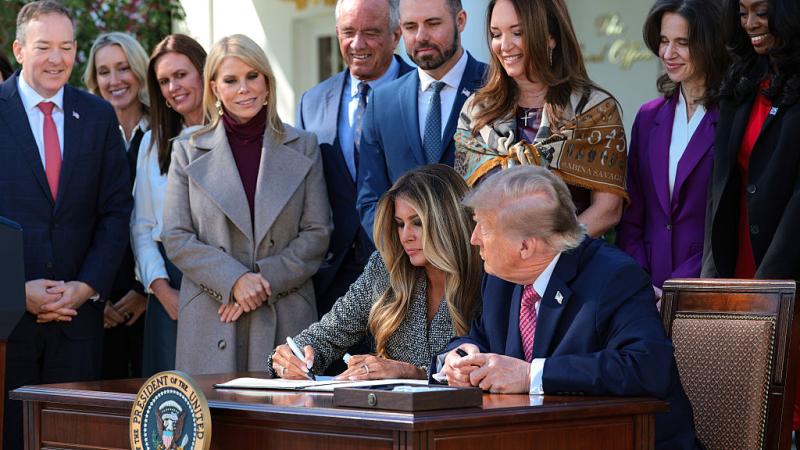
However, Berlau noted that Trump had indicated the accounts could eventually include Bitcoin, saying, "Something could happen," in the Oval Office where he rang the opening bell for the New York Stock Exchange and the Nasdaq to mark the program's launch ceremony.
Adam Frank, Head of Wealth Planning and Advice at J.P. Morgan Wealth Management, said that other investment accounts could be more viable, such as the 529 college savings plan, which can be accessed before age 18, withdrawn tax-free, and where up to $35,000 can be rolled over to a Roth IRA.
Withdrawals from the Trump Accounts before the retirement age of 59 ½ are subject to income taxes and a 10% penalty, with exceptions for qualified purposes such as higher education.
Meanwhile, Busler said there were other alternatives families could invest in, but investing in index funds also meant it carried less risk. He also said that the Trump Accounts benefited all families, regardless of income levels.
“Remember, this is money that's given to them, and the only restriction is you have to invest it in an index fund,” he said. “If you're the lowest of the low incomes or the highest of the highs, you're still getting a newborn child and an influx of capital.”
Busler further touted the Trump Accounts for teaching children about the "system that took us… from the birth of a nation to the largest, most prosperous economy in the world in about 150 years,” namely capitalism, noting "talk" by several candidates in recent local and congressional races about replacing capitalism with socialism.
“Capitalism is a good thing — not perfect — but it is a good thing,” said Busler. "And it will show children at a young age that capitalism does work…and forget about all this socialism that they've been talking about, which will be a disaster for the country," he said.