Appeals court gave Trump narrow window to seek SCOTUS intervention on ballroom; He moved quickly
Unless the justices intervene, the injunction is set to halt construction on August 21.
The Trump administration’s emergency appeal Friday to the Supreme Court to intervene in its White House ballroom case sets up a high-stakes fight over presidential power, congressional control of federal property, and the limits of national-security claims.
The administration is asking the justices to lift a lower-court order that has halted above-ground construction on the project.
In filing the emergency application, Solicitor General D. John Sauer seeks a stay of an injunction issued by the U.S. Court of Appeals for the D.C. Circuit.
Earlier this month, a divided appeals court panel, in a 2–1 ruling, upheld a district court order requiring the administration to obtain explicit congressional authorization before continuing work on the project.
The panel gave the government a narrow window to seek Supreme Court intervention, and the administration moved quickly. Unless the justices intervene, the injunction is set to halt construction on August 21.
The case has quickly emerged as a closely watched test of executive authority, raising questions about who controls federal property, how far national-security justifications can extend, and how courts should respond when a controversial construction project is already well underway.
From Demolition to Lawsuit
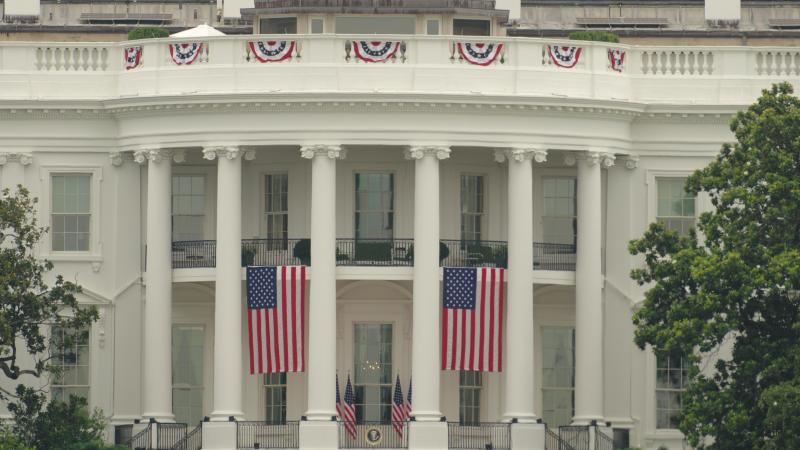
The dispute traces back to October 2025, when the administration demolished the White House’s East Wing to make way for a roughly 90,000-square-foot ballroom and underground complex.
The completed structure is expected to accommodate about 1,000 guests and incorporate hardened security features, including a bunker, missile-resistant construction, drone defenses and other fortifications.
The White House has described the project as both a classically styled architectural addition and a necessary modernization of presidential protection and continuity-of-government infrastructure.
Estimates of the project’s cost have ranged from roughly $400 million to substantially higher figures cited by contractors, with the bulk of the funding coming from private donors rather than a congressional appropriation.
That funding structure, along with the scale of the demolition, prompted the National Trust for Historic Preservation to sue. The organization argued that alterations of this magnitude to the White House and its grounds require congressional authorization under the Constitution and federal property and preservation laws.
In March 2026, Senior U.S. District Judge Richard Leon, a George W. Bush appointee, granted a preliminary injunction blocking most above-ground work. He later allowed underground security construction and other measures strictly tied to protecting the site to continue, but he rejected the administration’s broader argument that the entire ballroom was inseparable from national-security needs.
The D.C. Circuit affirmed the core ruling on Aug. 7, in the 2–1 decision.
The majority – Judges Patricia Millett, an Obama appointee, and Bradley Garcia, a Biden appointee – held that “whether or not a massive ballroom should be constructed is for Congress to decide and is not a matter for Executive self-help.” The court also emphasized that the president is a temporary occupant of the White House, not its owner.
Judge Neomi Rao, a Trump appointee, dissented, arguing that the National Trust lacked standing and that the courts had exceeded their proper role.
President Trump reacted to the ruling on Truth Social, calling the decision “horrendous, politically motivated, and unlawful,” and a “National Security threat to our Nation.”
He also vowed an immediate appeal to the Supreme Court.
The administration has continued to portray the ballroom as an integral component of presidential security.
Sauer’s filing struck a similar tone, describing the injunction as “extraordinary” and warning that halting construction would disrupt the addition of an integrated military complex essential to protecting the president, his family and executive-branch personnel.
The filing also emphasized the project’s advanced state. Construction is reportedly about 65% complete, with crews working long hours. The administration argues that further delay would be particularly disruptive and costly given how far the project has progressed.
The Legal Questions at the Core of the Case
Several distinct but overlapping issues are likely to shape the Supreme Court’s handling of the dispute, whether the justices rule narrowly on the emergency application or ultimately consider the merits.
Congressional Control Over Federal Property
The U.S. Constitution’s Property Clause (Article IV, Section 3, Clause 2) provides that “Congress shall have Power to dispose of and make all needful Rules and Regulations respecting ... property belonging to the United States.” The lower courts have treated the White House grounds as subject to that congressional authority.
The lower courts found no statute clearly authorizing the president to unilaterally demolish and rebuild major portions of the Executive residence. The administration, however, points to historical practice, the president’s responsibility for day-to-day White House operations, and the project’s reliance on private funds as grounds for broader executive authority.
The D.C. Circuit majority rejected that view, emphasizing the unprecedented nature of the project. No prior president, the majority noted, had unilaterally demolished a major, congressionally funded portion of the White House and replaced it with a privately financed structure.
At the core, the dispute asks whether the president’s control over the White House as the seat of the Executive Branch includes the power to make permanent changes to the property without Congress’s approval.
Whether the National Trust Has Standing to Sue
Judge Rao’s dissent focused heavily on standing, as she concluded that the National Trust lacks standing to stop construction at the White House.
The National Trust does not own the White House grounds, which are part of President’s Park, and the administration argues that the organization has not identified the kind of concrete, particularized injury required to invoke federal jurisdiction.
That issue could provide the Supreme Court with a way to resolve the case without reaching the broader separation-of-powers questions. A ruling that the National Trust lacks standing would allow the project to proceed while leaving unresolved the scope of presidential authority over major changes to federal property.
How Much Weight Should National-Security Claims Receive?
The administration has increasingly characterized the ballroom as part of a hardened security complex rather than merely an event space. It points to threats against the president, the protective value of the building’s mass and height, and drone- and bullet-resistant design features.
The lower courts allowed underground bunker construction and other security-related work to continue but declined to extend that rationale to the entire above-ground structure. The judges also pointed to inconsistencies in the administration’s descriptions of the project over time.
The Supreme Court could therefore confront a difficult question: How much deference should courts give executive-branch assertions of national-security necessity when those assertions are used to justify permanent changes to federal property? And where a project is designed as an integrated whole, can a court meaningfully distinguish genuine security infrastructure from features that primarily serve other purposes?
Does Private Funding Change the Constitutional Calculus?
The ballroom is being financed through $400 million in private donations, and the administration argues that this distinguishes the project from ordinary federal construction subject to congressional appropriations.
The lower courts rejected that argument, reasoning that private financing does not eliminate a separate requirement of congressional authorization for major changes to federally controlled property.
The Supreme Court’s treatment of that issue could have consequences beyond the White House. A broad ruling for the administration could give future presidents greater latitude to pursue privately financed projects on federal property without going through the traditional appropriations process.
What Happens When Construction Is Nearly Complete?
The government also argues that the project’s advanced stage weighs heavily against continued enforcement of the injunction. With construction reportedly about 65% complete, the administration says the practical consequences of stopping work now would be substantial – and that courts may ultimately be unable to restore the status quo even if the project is later deemed unlawful.
The National Trust, by contrast, argued that the injunction is precisely what prevents the administration from creating an irreversible fact on the ground. Allowing construction to continue simply because it has progressed far enough, the challengers contend, could undermine judicial review by making any eventual remedy effectively impossible.
That tension between preserving the status quo and recognizing the realities of a project already well underway may be especially important to the justices as they consider emergency relief.
What Comes Next
Chief Justice John Roberts has called for a response by noon Tuesday. The high court could grant an administrative stay while further briefing proceeds, deny relief and allow the injunction to remain in effect, or agree to take up the underlying case for full review.
Whatever the court decides, the case is already emerging as a significant marker in the ongoing battle over the boundaries of presidential power – and, ultimately, who has authority to control decisions concerning the White House itself.
The Facts Inside Our Reporter's Notebook

Top Stories



Trending
Just the News Spotlight
Just News, No Noise