Europe’s climate policies offer no relief for gas prices, as oil-rich U.S. is somewhat shielded
North America produces almost all the oil it needs to supply itself, but Europe mostly passed on investments in oil and gas development. Now, as petroleum supplies from the Middle East get cut off, the flaw in green policies is becoming apparent.
West Texas Intermediate oil prices, the U.S. benchmark, took a dip down to around $87 per barrel last week as President Donald Trump spoke of productive meetings with the leadership of Iran.
Then on Monday, the president claimed these discussions were ongoing, but he followed the statement up with threats to resume attacks on key petroleum, electricity and water infrastructure facilities.
“If the Hormuz Strait is not immediately ‘Open for Business,’ we will conclude our lovely ‘stay’ in Iran by blowing up and completely obliterating all of their Electric Generating Plants, Oil Wells and Kharg Island (and possibly all desalinization plants!), which we have purposefully not yet ‘touched,’” the president stated in a post on Truth Social.
In addition to his statement on social media, Trump also told the Financial Times that the U.S. may try to take over Iran’s oil industry like it did with Venezuela’s.
The markets are again betting that supplies of oil through the Strait of Hormuz, through which 20% of the world’s petroleum flows, aren’t going to start flowing again soon. The price of crude oil was up over $100 per barrel on Monday.
Patrick De Haan, head of petroleum analysis for GasBuddy, estimates that Americans have spent approximately $8 billion more on gasoline since the conflict in Iran began.
While North America is feeling the impacts of the global oil squeeze, it doesn’t compare to what’s happening in Europe, where gas prices are more than double what they are in the U.S. in some countries. After over a decade in a war against fossil fuels, Europe doesn’t produce anywhere close to the oil it needs.
Pain at the pump
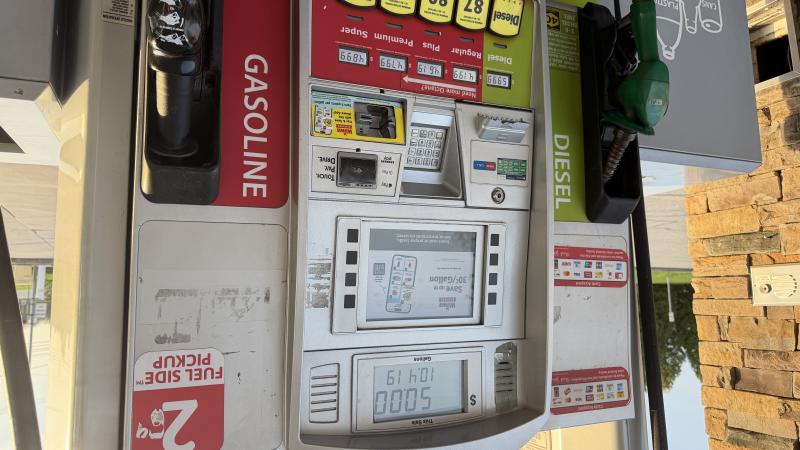
Due to the massive amounts of energy produced in North America, the U.S. will be shielded from the worst of the impacts — but not entirely. Average national gas prices were nearing $4 per gallon on Monday, having jumped $1 per gallon in a single month, according to AAA.
“We really produce all the oil we use between the U.S., Canada and Mexico. So that's not an issue. We're going to continue to have high gas prices, though, and there's just no place for the price to go but up,” David Blackmon, author of the “Energy Additions” Substack and an analyst with more than 40 years of experience in the oil and gas industry, told Just the News.
De Haan forecasted gas prices will push past the $4 per gallon mark, and diesel prices could reach up to $6 per gallon. If the situation doesn’t improve, he explained in an article on X, U.S. gas prices could hit record highs.
“The situation remains highly volatile and unpredictable, but upward pressure on fuel prices is likely to persist as long as global oil supplies are constrained by the continued disruption in the Strait,” De Haan wrote.
According to the Energy Information Administration, U.S. inventories rose by nearly 7 million barrels, and they’re nearly 0.1% over the seasonal average. In March, the Trump administration had authorized a massive release of oil, in coordination with a global release of stockpiles, from the Strategic Petroleum Reserve. As of last week, the SPR hadn’t yet been tapped for those supplies.
Inventories of gasoline fell by 2.6 million barrels but remained 3% above the five-year seasonal average.
Gas prices likely to rise
Blackmon said that no one knows how high this trend in high gas prices will go or for how long, but we haven’t likely reached the ceiling. If the conflict in Iran doesn’t come to a close, the impact will be mitigated as consumers drive less and companies find ways to cut back.
“I don't think anyone knows where the maximum might be before you have so much demand destruction that the market balances itself,” Blackmon said.
While the impact will be muted in the U.S., in European markets, the situation is going to be painful.
Europe adopted an aggressive pursuit of net-zero emissions and greatly restricted development of its oil and gas. Russian President Vladimir Putin fanned the flames of the activist opposition to hydraulic fracturing, a technology that has made the U.S. the largest producer of oil and gas in the world.
Seven European countries have banned fracking. Since 2010, energy expert Robert Bryce reported on his Substack, European oil production fell by 2.5 exajoules. There are approximately 172 million barrels of oil in an exajoule.
Brent Crude oil prices, the European benchmark, were over $113 per barrel on Monday, and European drivers were paying $9 or $10 per gallon for gas.
Similarly, California pursued a European-style energy policy. Drivers in the Golden State were paying $5.87 on Monday. Nevada and Arizona, which get much of their gasoline supplies from California, were paying over $4.50 per gallon.
While it may seem like Europe is lying in the bed it made for itself, as a global commodity, the impact of Europe’s war on fossil fuels impacts us here in the U.S. The world is now fighting over a slimmer supply than it would have been if Europe had done more drilling.
“Despite all of the narratives and the rhetoric about renewables and an energy transition, our reality remains that we have a global oil-based economy. And we haven't invested enough in new oil reserves for a decade now because of those narratives. This is having cascading impacts all over the world, and it will continue,” Blackmon said.
Kevin Killough is the energy reporter for Just The News. You can follow him on X for more coverage.
The Facts Inside Our Reporter's Notebook
Links
- president stated in a post on Truth Social
- Trump also told the Financial Times
- over $100 per barrel
- estimates
- according to AAA
- Energy Additions
- he explained in an article on X
- Energy Information Administration
- authorized a massive release of oil
- the SPR
- fanned the flames of the activist opposition
- Seven European countries
- Robert Bryce reported on his Substack
- $9 or $10 per gallon for gas
- European-style energy policy
- $5.87 on Monday
- follow him on X
Top Stories



Trending
Just the News Spotlight
Just News, No Noise