Hungary's Orban, Trump's close European ally, faces toughest reelection bid in more than a decade
Orbán has repeatedly forced the European Union to change its plans. Now, despite U.S. support, he's likely to be ousted from office.
Hungarian Prime Minister Viktor Orbán, among President Donald Trump's closest European allies, is facing his toughest reelection bid in more than a decade – putting at risk what is arguably Trump's most reliable bulwark against what he considers the European Union's longtime efforts to "do damage to the U.S."
Hungarians will go to the polls April 12, and polls show Orbán’s Fidesz (Hungarian Civic Union) party running further behind than at any other time since Orbán’s current tenure, which began in 2010. The election leader right now is the Tisza (Respect and Freedom) party, founded in 2024.
Tisza is led by Péter Magyar, also a member of the European Parliament. If Tisza gains a majority in the April 12 vote, Magyar will replace Orbán as prime minister.
Most recent polls show Tisza – a centrist, pro-European Union coalition – topping 50% of the vote in a crowded five-party field, with Fidesz a distant second with roughly 35%. A year ago, the two parties were running neck and neck.
“This is the first election in more than a decade where Orbán’s defeat is a plausible outcome, not just a theoretical one, given the scale of the opposition’s lead and the erosion of his support in key constituencies,” the geopolitical risk and research consultancy Eurasia Group reported.
The 62-year-old Orbán, the man once dubbed “Trump before Trump," served as Hungarian prime minister from 1998 to 2002, and then reelected in 2010, and has been in power since then.
To be sure, Orbán has spent roughly the past 15 years as the European Union’s most reliable dissenter: blocking, delaying and restructuring decisions backed by almost all the leaders in the 27-nation bloc. And Trump, together with those at the highest reaches of his administration, are working to help keep him in power.
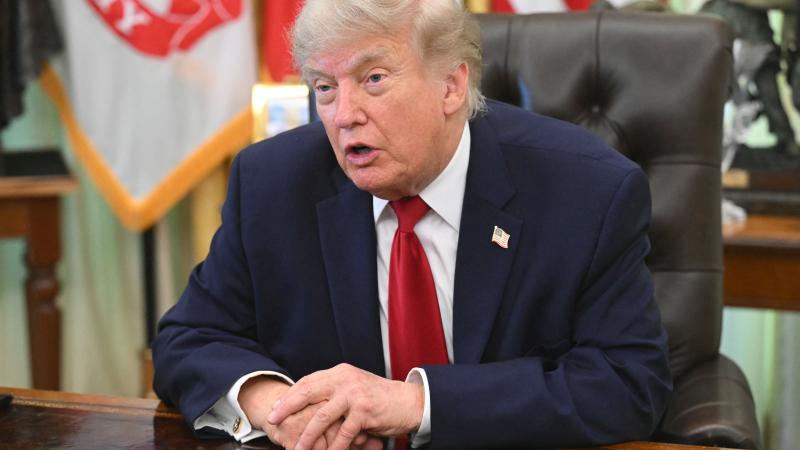
Trump last week formally endorsed Orbán, calling him “a strong and powerful leader ... a true friend, fighter, and winner.”
Last month, Secretary of State Marco Rubio made a trip to Budapest, during which he held a televised press conference in which he praised Orbán and said his reelection was the best option for the country. And Vice President JD Vance has announced plans to visit Hungary on April 7 and 8, in another high-profile show of support, just days before Hungarians go to the polls.
Even with the election approaching, Orbán, who also has close ties to Russian leader Vladimir Putin, has not stopped antagonizing European Union allies.
His latest move was to veto Brussels’ finalization of a plan to provide Ukraine with $105 billion in funding for its war against Russia, a plan that had been approved by all EU member states – including Hungary – last year. Hungary’s lone opposing vote this month was enough to prevent the money from being released.
But the EU aid package may just be delayed, not rejected. European leaders are now banking on the idea that Magyar will be victorious in April and that he will not oppose the funding plan.
An unnamed EU diplomat was quoted by media as calling the Ukraine vote “the straw that broke the camel’s back,” adding that “the hope to talk reason into Orbán is gone.”
Trump made the comment about the EU trying to "screw the U.S." during the early days of his second term, specifically referring to trade imbalances and further arguing the group was created as an opposition to America.
"It was formed to really do damage to the United States and trade," he said in February 2025. "They're screwing us on trade. ... The European Union has been very bad to us."
Trump has further argued that the North Atlantic Treaty Organization, in which 30 of the 32 member-states are European, has similarly taken advantage of the U.S., or at least until recently, by members not paying their fair share for military defense. And his recent gambit to annex or buy all or part of Greenland, an autonomous territory of Denmark, an EU and NATO member, is also considered another sign, in addition to higher European tariffs, of Trump's stance on Europe.
Meanwhile, Orbán has benefited from close ties with Trump.
Polls have shown that Hungarians have a higher opinion of the U.S. than any other country in Europe.
According to Pew Research, 78% of Hungarians believe U.S. democracy works “very well” or “somewhat well,” compared to just 48% who held the same views in Italy, 36% in France, and 31% in Germany. The same poll showed that 60% of Hungarians had a “favorable” view of the U.S., compared to 47%, 36% and 33% in Italy, France, and Germany, respectively.
The Facts Inside Our Reporter's Notebook
Links
- Trump before Trump
- Most recent polls
- Orbánâs defeat is a plausible outcome
- According to Pew Research
- Péter Magyar
- If Tisza gains a majority in the April 12 vote
- a strong and powerful leader
- Marco Rubio visited Budapest last month
- JD Vance has announced plans to visit Hungary
- a plan to provide Ukraine with $105 billion in funding
- the straw that broke the camelâs back


Top Stories




Trending
Just the News Spotlight
Just News, No Noise