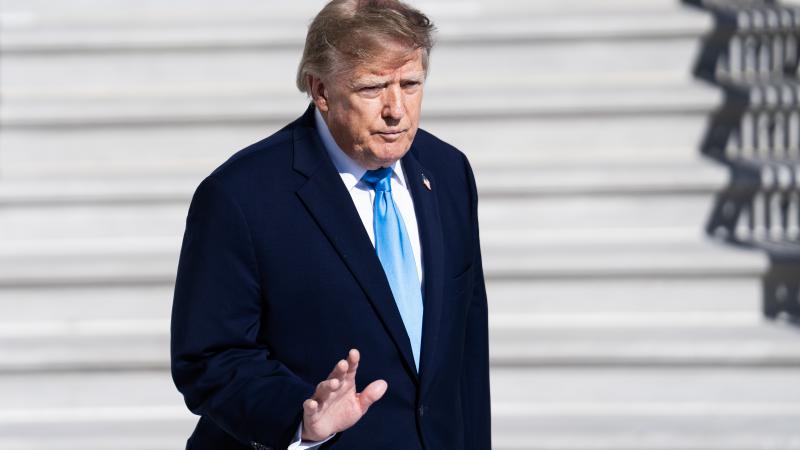
U.S. has increasingly come to dictate European policy more than the countries
New Hampshire Democrat Sen. Jeanne Shaheen acknowledged Friday at the start of the Munich Security Conference that Europeans "clearly" have been rattled by Trump's talk of the U.S. taking control of Greenland
Across Europe, politics in the U.S. has the capacity to dominate news cycles, shaping market expectations, security planning and diplomatic policymaking in a way domestic debates rarely do.
Perhaps the most recent and public example was the protests in Italy over news that U.S. Customs and Enforcement, which leads President Trump's aggressive illegal-immigration crackdown, would participate in security operations for the Games.
But it's not just the Olympics.
In France, Le Monde, the country’s newspaper of record, has unveiled a special online hub – in French and English – that focuses exclusively on U.S. political news. Even in the main section of the paper, President Donald Trump’s warning that “very bad things” could happen if Republicans perform badly in the upcoming midterm vote was front page news, and it spread wide on European social media.
In Germany, Europe’s largest economy, a survey from pollster Merkur found 65% of respondents believe the United States will likely pose the greatest threat to world peace in the coming years. Merkur even coined a term for the phenomenon: “der Trump-Effekt” – “the Trump Effect.”
“It’s amazing how closely people here are following what is happening in the U.S.,” Oliviero Fiorini, a political affairs analyst with ABS Securities in Milan, told Just the News. “People who a year ago might not have been able to point out New York or California on a map, now talk about whether or not control of the U.S. Senate might flip in November or speculation about who might run for U.S. president in 2028.”
Fiorini said that in some cases, Europeans are more aware of the election schedule in the U.S. than they are of their own countries.
The intense attention Europeans pay to developments in the U.S. is not a big surprise given the extent to which dramatic shifts in U.S. policy on tariffs, calls for higher defense budgets for NATO allies, and finger-pointing between leaders on both sides of the Atlantic have spread ripples across Europe.
In addition, there’s the notion that the degree to which European’s attention is directed toward Washington is an indication of how dependent the continent remains on the U.S. despite widespread calls for more European autonomy.
“If anyone thinks that the European Union or Europe as a whole can defend itself without the U.S., keep on dreaming because we cannot,” NATO Secretary General Mark Rutte, a former prime minister of The Netherlands, said last month.
Fiorini said he believes that while the global order may never return to its former state, it’s also in no danger of disappearing completely.
“The trans-Atlantic relationship is changing quickly and that’s why people are paying so much attention to developments,” he said. “It will keep changing. It may even become unrecognizable. But the shared values and culture mean it will never be less relevant. That’s why it’s so important for people to keep up with what’s happening.”
New Hampshire Sen. Jeanne Shaheen acknowledged Friday at the start of the Munich Security Conference that Europeans "clearly" have been rattled by Trump's talk of the U.S. taking control of Greenland, an autonomous territory of the Kingdom of Denmark, a country in Northern Europe.
Shaheen, the top Democrat on the Senate Foreign Relations Committee, said the United States' bipartisan congressional delegation was in Munich to "reaffirm the U.S.-European Trans-Atlantic Alliance [and] the importance of our European partners."
The Facts Inside Our Reporter's Notebook
Links
- the U.S. would send ICE agents to the Games
- loud whistles and jeers
- a special online hub
- Donald Trumpâs warning that âvery bad thingsâ could happen
- the U.S. could destabilize the global security
- strong relations between the two countries
- anti-Americanism was on the rise
- widespread calls for more European autonomy
- keep on dreaming because we cannot

Top Stories



Trending
Just the News Spotlight
Just News, No Noise