Hegseth’s ‘Arsenal of Freedom Tour’ goes to Missile Defense Agency and Space Command
Hegseth made a trip down to "Rocket City" on Friday. While the publicized part of the visit focused on the new headquarters for U.S. Space Command, the War Secretary's tour also shone a spotlight on U.S. efforts to boost missile defense and weapons capabilities.
Secretary of the Department of War Pete Hegseth carried out part of his “Arsenal of Freedom Tour” in the “Rocket City” of Huntsville in northern Alabama on Friday, meeting with leaders in rocket design and missile defense ahead of a visit to the future location of U.S. Space Command.
Hegseth’s trip to the “Rocket City” came amidst a push by the Pentagon to revitalize the sclerotic U.S. industrial base, with the war secretary taking the chance to visit Boeing, the Missile Defense Agency, and other locations before giving a speech at an event marking the unveiling of a sign at the new Spacecom location. The war secretary said it was part of his "Building the Arsenal of Freedom Tour."
Huntsville already features a large presence by defense companies such as Boeing as well as a host of key U.S. federal agencies at Redstone Arsenal, including NASA’s Marshall Space Flight Center, the U.S. Army Materiel Command, the U.S. Army Aviation and Missile Command, the U.S. Army Space and Missile Defense Command, the Defense Intelligence Agency’s Missile and Space Intelligence Center, and the FBI’s Terrorist Explosive Device Analytical Center and the bureau’s Hazardous Devices School.
Hegseth was greeted on the Huntsville airport tarmac by a number of U.S. military leaders, including Lt. Gen. Francisco Lozano, the Director of Hypersonic, Directed Energy, Space, and Rapid Acquisition at Redstone Arsenal. The general told Hegseth that “we’ve got lots of interesting things to show you” during the visit.
Addressing diminished weapon supply
The U.S. military’s air campaign against Iranian-backed Houthi terrorists in Yemen, the U.S.’s years-long effort to supply a massive number of armaments to Ukraine in its fight against Russian invaders, and U.S. assistance in the defense of Israel against Iranian missile barrages have all eaten into the U.S. weapon supply. In addition, Taiwan is facing a possible invasion by the Chinese, with the potential the U.S. would get involved in defending the island nation against a near-peer and nuclear-armed adversary.
It remains unclear whether the defense industrial base would be able to manufacture the number of weapons and ships needed to sustain a long-term engagement against the People’s Liberation Army and the Chinese navy, but Hegseth has been hard at work encouraging defense company leaders to ramp up production and ordering military leaders to innovate.
Hegseth’s first stop on Friday was to the Boeing Jetplex in Huntsville, where he was given a tour of the production facility for the seeker component of the Patriot Advanced Capability-3 (PAC-3) missile, an advanced U.S. air and missile defense system. The company recently finished a big expansion of its Seeker production facility in order to handle increased demand from the War Department.
Latest tech: the Patriot Seeker
A Boeing worker in a blue Boeing-branded apron and gloves wearing Santa-themed bunny ears greeted Hegseth’s delegation as they headed to the classified factory floor to see how the Patriot seeker is made.
Jim Leary, who runs business development for weapons systems at Boeing, told Just the News that “we’re showing him a Patriot Seeker — it’s the most advanced hit-to-kill seeker that is used by the military.”
Boeing’s website touts that the PAC-3 Seeker won the 2025 title of the "Coolest Thing Made in Alabama" in the statewide Manufacturing Madness competition this year.
Leary said the company just finished expansion of its PAC-3 seeker facility, saying it is going from 60,000 square feet to 90,000 square feet and will be operational in January.
“We’re going to talk to the secretary today about this expansion and how we are self-investing to lean in,” Leary said, adding that Boeing’s leaders were also telling Hegseth about “the things we want to try to get in front of the demand signal — we want to equip the warfighters as quickly as possible with this incredible Patriot weapon system.”
Lockheed Martin says that the PAC-3 family of missiles “defend against incoming threats using direct body-to-body contact that delivers exponentially more kinetic energy on the target than can be achieved with blast-fragmentation mechanisms.”
Boeing announced in October that, after being awarded $2.7 billion to produce more PAC-3 seekers, the company “will deliver more than 3,000 seekers at rates of up to 750 units per year through 2030.” The company said it was working closely with Lockheed and the Army and argued that “scaling seeker output is critical to ensuring the Patriot system can continue to defend service members, civilians and critical infrastructure worldwide as threats proliferate.”
“Last year was a banner year — we produced around 500 seekers that year. We are already at around 650 this year,” Leary said on Friday. “So month over month for the last rolling twelve months we have beaten production records.”
Leary added: “We have been working very closely with the Department of War on potential ramp capacity questions that they’ve asked us. So we think that with what we’ve done with this expansion we’ll be able to get up into the couple thousand Seekers over the next few years. So we aren’t stopping at 650 this year — we see continued ramp up to maybe a thousand a year.”

“Thank you for everything … not just what you’re doing, but what you’re building toward also,” Hegseth said, arguing that Boeing and other defense company workers are “building the arsenal of freedom.” He said that his stop at Boeing was part of his broader “Building the Arsenal of Freedom Tour” this month and next.
Hegseth: "our warfighters deserve the best"
“If our warfighters don’t have it, then we can’t execute. And if our enemies don’t think we have the capability, then we can’t deter,” Hegseth said as he emphasized the importance of the work Boeing was doing.
“What we’ve seen today is the best. And our warfighters deserve the best, need the best, demand the best,” Hegseth told the Boeing workers, adding, “Go faster. … Urgency is our buzzword. We don’t have time to wait.”
Just the News previously reported about a late June closed-door meeting that Hegseth held with some of the leaders of America’s largest military contractors, urging them to ramp up the production of critically needed munitions amidst depleted weapons stocks and a growing threat from China.
Just the News also reported last week about the Secretary of the Navy’s inauguration of a new naval office aimed at expediting the development and deployment of new weapons systems and ships, declaring that “we need speed” and calling for a “wartime footing” as the challenges posed by China loom in the Pacific.
“PAE Fires” — The Pentagon’s effort to ramp up missile production
Hegseth recently announced the creation of Portfolio Acquisition Executives (PAEs) to speed up the acquiring of weaponry and to consolidate a dozen offices into a half-dozen ones — and PAE Fires, located in Huntsville, is one of the newly-reorganized acquisition efforts. The Alabama location was the next stop on Hegseth’s Huntsville visit on Friday.
While Hegseth was inside the PAE Fires building receiving a classified briefing, U.S. military officers were standing outside in front of inert versions of massive and advanced weapons systems, which Hegseth would soon receive walk-through briefings on.
Lieutenant Colonel Steven Moebes, an Army project manager for the Patriot missile system told Just the News that “The missiles are built by Lockheed, but Boeing makes the seeker that goes in the front, and that is the secret sauce that makes the hit-to-kill possible. It is literally the eye of the missile that when it gets close to the target the seeker takes over and it tells the missile exactly where to go.”
The lieutenant colonel said he was confident that weapons production of the Patriot system would continue to ramp up in the near future.
“A lot in the news about munitions acceleration popping up. We have set records for Patriot missiles production year after year over the last three years while I’ve been the manager. We’re looking at quadrupling it over the rest of the decade,” Moebes said. The lieutenant colonel said 600 of the weapons were produced this year, but that they would be “almost quadrupling it” soon.
“It’ll be 2,000 for new production, and then there is another 400 for repairs… and then there is another program for the next generation of missile that we are starting next year as well,” Moebes also said. “So a lot of excitement.”
Just the News asked if the U.S. burns through these weapons quickly, and Moebes said that “it comes in waves” and “it comes in spurts.” He noted that these missiles weren’t used much during the twenty-year Global War on Terrorism, but were used in the defense of Israel against Iranian missiles this year.
The lieutenant general said that “the system operates as designed” and that “I’m proud of the system, and I appreciate the opportunity to talk about it.”
Hegseth soon exited the PAE Fires building to receive a mini-tour and mini-briefings on the weapons systems on display outside the building.
Lt. Gen. Lozano told Hegseth that “we’ve collapsed a number of organizations into PAE Fires” and said this gave him “unity of command” which would give him the ability to push to “shave years off of acquisitions.”
“Flexibility,” Hegseth replied. “The commander has got — you have got — intent and know what needs to be done. Underneath that you’ve got the latitude to make changes, move people, move emphasis, and deliver what is needed.”
Lozano added that “what I want to do is I want to leverage competition to keep everybody on their toes and make the investments to keep us ahead of our near-peer adversaries.”

Hegseth received briefings outside the building on PAC-3, the Indirect Fire Protection Capability Inc 2 (IFPC Inc 2), the Long Range Hypersonic Weapon (LRHW), the Integrated Battle Command System, the Sentinel Radar, the Army Long-range Persistent Surveillance (ALPS), and the High Mobility Artillery Rocket System (HIMARS) displays.
The Army says IFPC Inc 2 is “designed to protect fixed and semi-fixed sites from unmanned aerial systems, cruise missiles, and rockets, artillery, and mortars.”
The military also says that the LRHW system “is a game-changing capability that provides” the U.S. military “with the ability to conduct precision strikes at long range, leveraging hypersonic speeds to rapidly respond to emerging threats.”
The Army further contends that the IBCS “has changed how the Army defends against emerging air and missile threats” and that “it integrates real-time data from a diverse array of sensors to create a unified battlespace picture.”
The U.S. military says that the Sentinel Radar “provides detection, classification, identification, and reporting capabilities against rocket, artillery, and mortar (RAM) threats.”
U.S. military commanders have also said ALPS provides “passive sensor provides continuous, 360 degree, long range 14 surveillance against fixed-wing and rotary-wing aircraft, UAS [unmanned aerial systems], and cruise missile threats.”
The U.S. military says that HIMARS “allows for the launching of multiple, precision-guided rockets.” The Defense Department previously said that HIMARS “being used in Ukraine are making an impact on the conflict there between Ukrainians fighting to preserve their national sovereignty and Russian forces who have illegally invaded that country.”
Just the News reported this month about efforts by key Pentagon officials to deter China by spurring the revitalization of the U.S. defense industrial base.

Lt. Gen. Lozano also gave Hegseth a rundown on Friday on the goal of the new PAE Fires effort, telling the war secretary that “our mission is to develop, produce, field unparalleled, unmatched warfighting capabilities in the hands of our soldiers so they can defeat the adversary on any battlefield, anywhere, at any time — period.”
“Did you get that on camera?” Hegseth asked approvingly.
Inside the Missile Defense Agency
Hegseth’s next stop was at the Missile Defense Agency (MDA), which was right down the road from PAE Fires. The war secretary was met by MDA Director Lt. Gen. Heath Collins, and was given a classified briefing by a host of MDA officials.
MDA states that its mission is “to develop, deploy, and sustain layered and integrated missile defense capabilities as part of a comprehensive missile defeat approach to defend the United States, its deployed forces, allies, and friends from missile attacks in all phases of flight.”

The Missile Defense Advocacy Alliance has produced a “U.S. Missile Defense Test Record” database which shows that the last few U.S. military missile defense tests between 2017 and 2023 resulted in successful intercepts of ICBMs in test conditions.
The alliance says that “88 of 107 hit-to-kill intercept attempts have been successful across all programs since the integrated system began development in 2001.” The alliance also says there has been a success rate of “59 of 74 hit-to-kill intercepts” for PAC-3, THAAD, Aegis Ballistic Missile Defense, and Ground-based Midcourse Defense since 2001.
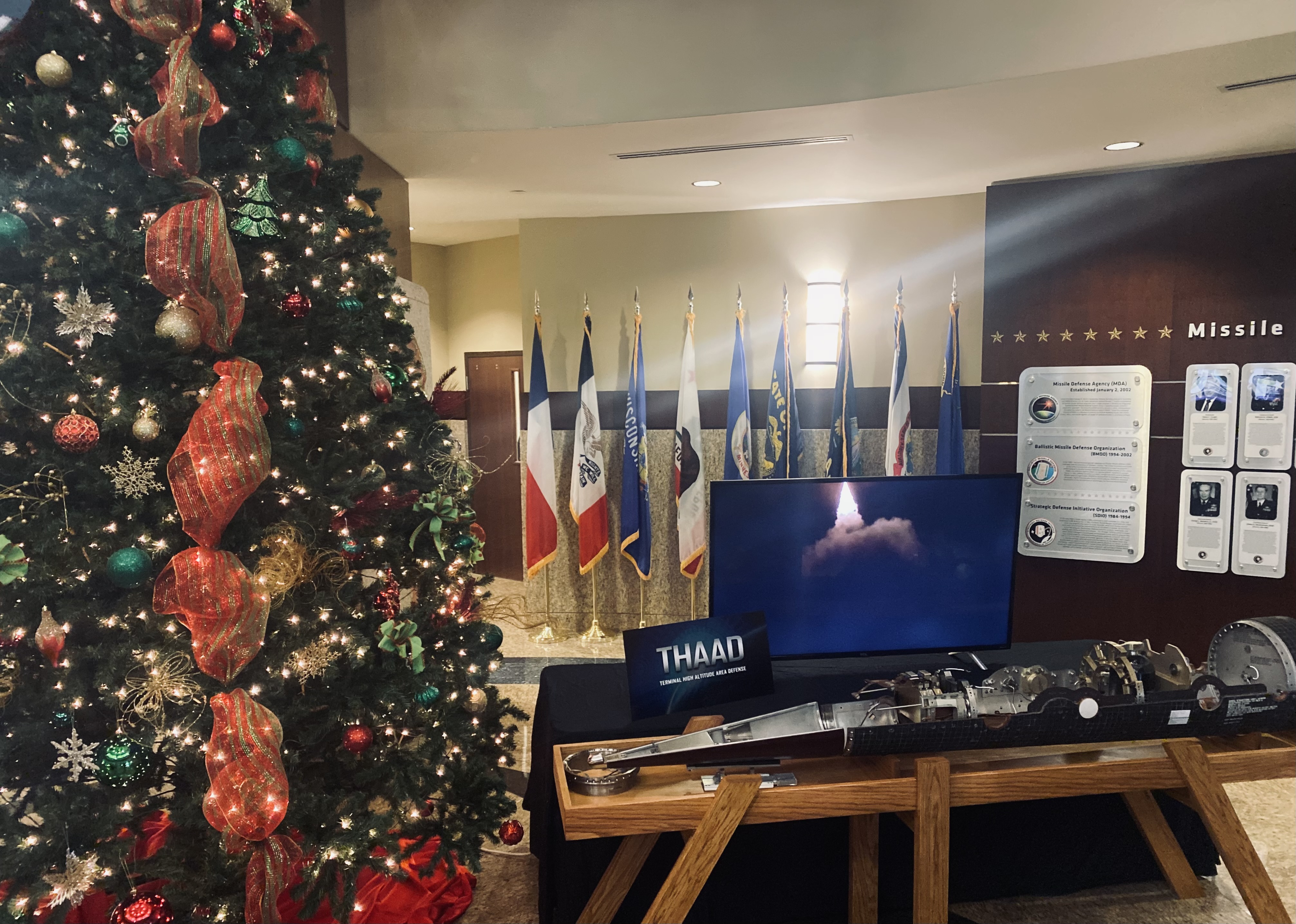
After the classified meeting on Friday, MDA officials quickly briefed Hegseth on replicas of a Sea-Based X-Band Radar (SBX), Models of Exothermic Kill Vehicles, a Next Gen Interceptor, and the Terminal High Altitude Area Defense (THAAD) missile.
The Missile Defense Advocacy Agency says SBX “is designed to detect and establish precise tracking information on ballistic missiles, discriminate missile warheads from decoys and debris, provide data for updating ground-based interceptors in flight, and assess the results of intercept attempts.”
Raytheon has said that Exoatmospheric Kill Vehicles are “designed to intercept hostile ballistic missile targets outside the atmosphere in the midcourse phase of flight.” Lockheed, for their part, describes the Next Gen Interceptor as “a first line of defense, tip-to-tail interceptor within the Missile Defense Agency’s Ground-based Midcourse Defense system.”
The company also describes THAAD as “a highly effective, combat-proven defense against short, medium and intermediate-range ballistic missile threats”
Trump issued an executive order in January aimed at expanding U.S. missile defense capabilities, and in May he announced plans for a “Golden Dome” missile defense system.
“The Department of Defense welcomes President Trump's announcement regarding the Golden Dome for America, a next-generation missile defense shield,” Hegseth said in May.
Outside the MDA building, a group of U.S. service members gathered for a photo with Hegseth in front of a THAAD launcher, and Hegseth gave challenge coins to a group of officers.
Hegseth unveils sign for new Space Command HQ in the Rocket City
Hegseth’s final stop of the day was at the site of Spacecom’s future command headquarters in Huntsville. Leaders from the U.S. military, Alabama’s congressional delegation, and local Huntsville officials gave speeches with a huge empty grassy field and construction equipment as the backdrop.
Trump reestablished Space Command in August 2019, but controversy ensued over the years over whether it should be headquartered in Colorado or Alabama, and it became unclear whether the event on Friday would ever happen.
The Biden-era Defense Department announced in July 2023 that “President Biden notified the Department of Defense that he has selected Colorado Springs as the permanent location of the U.S. Space Command Headquarters.”
Today, following a thorough and deliberate evaluation process, and after consultation with Secretary Austin and weighing the input of senior military leaders, President Biden notified the Department of Defense that he has selected Colorado Springs as the permanent location of the U.S. Space Command Headquarters.
The Government Accountability Office released multiple reports, including one in May, which identified “shortfalls” in the way that Colorado Springs was selected.
Trump announced in September that "I am thrilled to report that the U.S. Space Command headquarters will move to the beautiful locale of a place called Huntsville.” Trump said that Spacecom would play an important role in building the Golden Dome for America missile defense system.

"The air force secretary made the right choice in recommending to me and recommending to the president that this is the place to continue to establish space dominance — right here in Alabama,” Hegseth said during his Friday speech. "It's common sense that this is precisely where Space Command should be. It's common sense that we need to move rapidly and expeditiously, and we will.”
The war secretary declared that "we are deadly serious in committing to cutting every piece of red tape and bureaucracy to get this headquarters established as quickly as humanly possible.”
U.S. Space Command says that it “plans, executes, and integrates military spacepower into multi-domain global operations in order to deter aggression, defend national interests, and when necessary, defeat threats.” SPACECOM argues that its establishment “as the 11th combatant command demonstrates the critical importance America places of space.”
The Defense Department’s 2024 annual report on military and security developments involving China warned about China’s growing capabilities in space.
Spacecom’s own website seemingly acknowledges that it is often confused by laypeople as being synonymous with Space Force, with Spacecom stating that “U.S. Space Force organizes, trains, and equips space professionals and then presents those forces to U.S. Space Command and other Combatant Commands” while “U.S. Space Command actively employs joint forces from the U.S. Army, Marine Corps, Navy, Air Force, and Space Force” to accomplish the command’s mission.
“First it was 'He who controls the skies' — now it's 'He who controls the space domain' understands what the future of warfare will look like, and who controls that dominance,” Hegseth said on Friday. "That's why I'm here today, because the quicker we establish this, the more robust the capabilities are, the more likely we are to deter the next conflict and — if necessary — stand prepared to overwhelmingly defeat our enemies.”
The Facts Inside Our Reporter's Notebook
Links
- Redstone Arsenal
- Marshall Space Flight Center
- Materiel Command
- Aviation and Missile Command
- Space and Missile Defense Command
- Missile and Space Intelligence Center
- Terrorist Explosive Device Analytical Center
- Hazardous Devices School
- Lt. Gen. Francisco Lozano
- air campaign
- to supply
- U.S. assistance in the defense of Israel
- possible invasion
- advanced
- website
- says
- announced
- previously reported
- also reported last week
- announced
- says
- says
- contends
- says
- said
- says
- reported this month
- Lt. Gen. Heath Collins
- states
- previously reported
- prominent signer
- reportedly
- produced
- says
- said
- describes
- describes
- executive order
- announced
- said
- reestablished
- announced
- reports
- announced
- said
- declared
- says
- argues
- annual report
- own website
- said

Top Stories





Trending
Just the News Spotlight
Just News, No Noise