Trump counterterrorism chief: U.S. has eliminated nearly 450 terrorists, warns of ISIS resurgence
Dr. Sebastian Gorka said the president’s travel ban is directed at countries that either lack the capability or willingness to properly vet citizens for entry to the United States after a series of deadly attacks around the world.
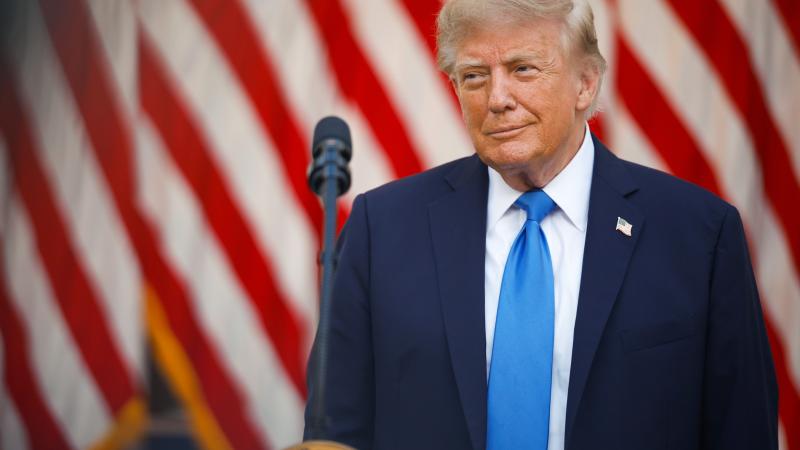
President Donald Trump’s top counterterrorism official says the administration has eliminated nearly 450 terrorists since taking office earlier this year as part of its broader effort to battle resurgent terrorist groups and protect the American homeland.
“As of this morning, we are at 449 jihadis who have been terminated since the President was sworn back in again,” the Senior Director for Counterterrorism, Dr. Sebastian Gorka, told the Just the News, No Noise TV show on Thursday. “That is excluding the Houthi campaign, excluding the cartel drug boats.”
Gorka said the administration has zeroed in on the resurgence of terrorist groups like ISIS in the wake of the Afghanistan withdrawal and lax border enforcement during the Biden administration.
In his first term, “the President declared war on the ISIS caliphate, and within a matter of weeks, the physical caliphate that had been established by the jihadi threat group in Syria in Iraq was gone. However, there are always survivors,” Gorka said.
Biden gave space for overseas Islamic terrorists to regroup
Gorka said because the Biden administration shifted terrorism focus to domestic terrorism, which earned the administration significant criticism, it gave space for Islamic terrorists to recover from the defeat of the caliphate in Syria.
“As a result, a breathing space was afforded jihadis, and they reconciled, reconstituted themselves, especially in Africa,” Gorka said.
The 2021 withdrawal of U.S. forces from Afghanistan also provided breathing room for one of the most deadly branches of ISIS, known as ISIS-K, to rebuild itself in the region. A regional branch of the Islamic State focused on Afghanistan and Pakistan, the Office of the Director of National Intelligence describes it as the “one of ISIS’s most lethal branches.”
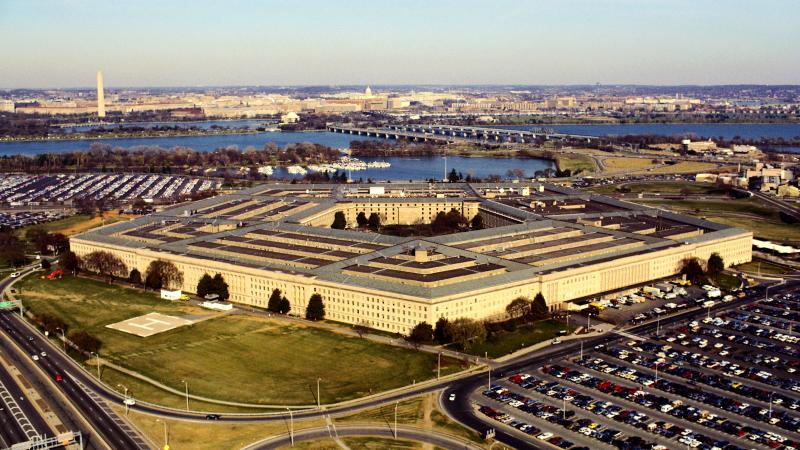
ISIS was linked to the latest attack on American troops in Syria that left three personnel dead and three wounded. The Pentagon on Saturday confirmed that two American soldiers and a civilian translator were killed in an attack as part of ongoing anti-ISIS operations in the country. U.S. officials said they believe the attacker was a former ISIS member who had joined the current ruling party HTS' security apparatus but was recently expelled, Just the News reported.
Additionally, shortly before the 2024 elections last year, U.S. authorities arrested an Afghan national on suspicion of plotting an election day attack in support of the Islamic State in the United States. In addition to terrorism-related charges, Tawhedi was charged with “attempting to provide material support and resources” to ISIS, which is a U.S.-designated terror organization.
UK's MI5: "They’ve resumed their efforts to export terrorism”
Tawhedi’s special immigration status, granted by the Department of Homeland Security in the wake of the Afghanistan withdrawal, caused a stir on Capitol Hill, but the suspect’s radicalization likely occurred after he entered the country, senior officials reportedly said, raising concerns about the Islamic State’s reach and threat to the U.S. homeland, Just the News reported at the time.
Before the arrest in the U.S., the intelligence chief of one of America’s closest allies was also warning the public that the renewed threat of ISIS had become one of his top concerns. “Today’s Islamic State is not the force it was a decade ago, but after a few years of being pinned well back, they’ve resumed their efforts to export terrorism,” British MI5 Director General Ken McCallum told a press conference in London a week earlier.
That same terror group claimed responsibility for the Abbey Gate bombing in Kabul, Afghanistan that targeted U.S. forces and Afghan civilians during the United States evacuation. That August 2021 suicide bombing in the midst of the chaotic withdrawal took the lives of 13 U.S. soldiers and 169 Afghan civilians on the perimeter of the Hamid Karzai International Airport.
“The collapse of Kabul under Biden led to an exploitation of U.S. sovereignty by the regime and by bad actors,” Gorka said, referring to possible threats among the 200,000 Afghan nationals that were allowed to enter the country during Operation Allies Welcome and Operation Enduring Welcome in the wake of the withdrawal.
Gorka: "We will identify them"
“Now, a lot of these people fought with us, shoulder to shoulder. They bled for us. Some of them lost limbs fighting with our forces in Afghanistan and elsewhere. But if these individuals who were clinging to the planes who got into those aircraft during that horrendous fall of Kabul, if some of those people were let in without being properly screened by the last administration, we will identify them and following us law, we will take the requisite action to make sure that they do not pose a threat to anyone here in America,” Gorka said.
The danger was made readily apparent last month, when a suspect, an Afghan national and member of a special forces unit backed by the CIA, carried out a murder attack on members of the National Guard in Washington, DC. President Trump called the attack an "act of terror," and a "crime against humanity." One servicewoman died of her injuries and another was severely wounded.
In light of the recent events, President Trump added several countries to his list of countries whose citizens are banned from entering the United States, including Syria, where the attack on U.S. troops was carried out earlier this week.The travel ban was extended Tuesday to include citizens from Burkina Faso, Mali, Niger, the Palestinian Authority, South Sudan and Syria, according to the White House.
The president signed the initial travel ban of his second administration in June, which barred citizens from Afghanistan, Chad, the Republic of the Congo, Equatorial Guinea, Eritrea, Haiti, Iran, Libya, Myanmar, Somalia, Sudan and Yemen.
No vetting: No asylum
Gorka told Just the News that these travel bans have been specifically targeted at countries that lack the capability or willingness to thoroughly vet potential visitors, asylum seekers, or other immigrants to the United States.
“It's any nation that doesn't have the capacity to vet or guarantee to us that the citizens who are applying to come to America, or those who are coming in, as you know, wanna-be asylum seekers or refugees, sorry, we cannot vet whether they are a threat — therefore there is a moratorium,” Gorka said.
“This is exactly as happened eight years ago with the travel moratorium at the beginning of the first Trump administration, which is based on the Obama White House threat assessment, that there were numerous countries who could not tell us whether the citizens they were sending here were bad malefactors, terrorists or criminals,” he explained.
“So we're just not going to risk it. We have one priority here,” Gorka added. “We believe in the sanctity and the sovereignty of our nation and the protection of our citizens.”
The Facts Inside Our Reporter's Notebook
Links
- âone of ISISâs most lethal branches.â
- confirmed that two American soldiers and a civilian translator were killed
- arrested an Afghan national on suspicion of plotting an election day attack
- special immigration status
- was also warning the public
- member of a special forces unit
- carried out an attack
- called the attack
- added several countries
- signed the initial travel ban
Top Stories


Trending
Just the News Spotlight
Just News, No Noise