U.S. Supreme Court to hear mail-in ballots case Monday
The case, Watson v. RNC, challenges a Mississippi law that allows mail-in ballots to be received up to five days after Election Day, as long as the ballot is postmarked by Election Day. Fourteen states and the District of Columbia also allow mail-in ballots to be received after Election Day.
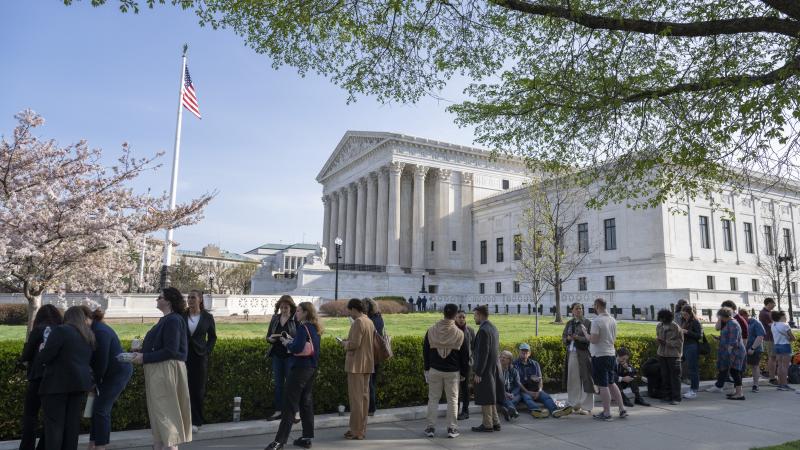
(The Center Square) - The U.S. Supreme Court on Monday will hear arguments in a consequential case to determine at what point states can accept and count mail-in ballots.
The case, Watson v. RNC, challenges a Mississippi law that allows mail-in ballots to be received up to five days after Election Day, as long as the ballot is postmarked by Election Day. Fourteen states and the District of Columbia also allow mail-in ballots to be received after Election Day.
Jason Snead, executive director of the Honest Elections Project, said the case would give an opportunity for mail-in ballot laws to be uniform across the country.
“Federal law clearly states that ballots must be received by Election Day,” Snead told The Center Square. “Despite this, states continue to allow absentee ballots to pour in days or even weeks late.”
In Illinois, mail-in ballots can be received up to 14 days after Election Day. Lawyers for the RNC argued that the federal government sets a date for federal elections and that all ballots need to be available for counting by that date.
Lisa Dixon, executive director at the Center for Election Confidence, said delayed mail-in ballot receipt deadlines became more prominent during the COVID-19 pandemic. She said a ruling in favor of the RNC would still allow states to accept late mail-in ballots for nonfederal elections.
Lawyers for Mississippi have argued that upholding a strict receipt deadline would jeopardize ballots for military and overseas voters. However, Congress’ passage of the Uniformed and Overseas Citizen Voting Act established requirements for states to send absentee ballots 45 days before a federal election.
“Congress has spoken in that area and created a system of law that’s arguably separate from the federal Election Day statutes themselves,” Dixon said.
In December, the U.S. Postal Service altered its postmark policy so that the date reflected is when mail first arrives at a processing facility, not when it is dropped off. Dixon said this aspect of the case could be substantial grounds for a claim of disenfranchised voters.
“There is unfortunately a real risk of disenfranchising voters who drop their ballots off close to Election Day and assume it’s going to be postmarked as normal,” Dixon said. “States haven’t really begun to grapple with that and its impact on voters yet.”
Dixon admitted the court could carve out a distinction between overseas voters and domestic mail-in ballot voters.
“To the extent that the court wants to maintain the status quo, I would also see them being reluctant to kind of disrupt the whole system of U.S. law that governs military voters and overseas voters,” Dixon said.
Regardless of possible exceptions, Snead thinks the court will likely strike down Mississippi’s late receipt deadline for mail-in ballots. He said strict mail-in ballot receipts are popular among the American public.
When asked, 78% of American voters said that requiring ballots to be received by election officials at the end of Election Day makes elections more secure, according to a new poll shared with The Center Square.
The poll was conducted by CRC Research for Honest Elections Project between March 12-17 and included 1,600 likely voters nationwide. Among those surveyed, 90% of likely Republican voters said requiring ballots to be received by election officials by the end of Election Day makes elections more secure. About 77% of Independent voters and 68% of Democrat voters agreed.
Going a step further, the poll found 59% of voters said they would not trust the results of an election that counts ballots received after polls close on Election Day. About 60% of voters said counting ballots received after polls close on Election Day makes it easier to cheat.
“What you want to see is at the end of the voting period, the polls close on Election Day, you know how many votes are cast,” Snead said. “The absolute maximum number of ballots should be set when the polls close.”
While the justices will hear arguments on Monday, they are not likely to issue a decision until June.
Snead does not anticipate the decision timeline will affect upcoming midterm elections. He urged advocacy groups to educate voters on possible mail-in ballot changes, based on the court's decision.
“Federal law is clear: all ballots must be received by Election Day to be counted," Snead said. "The Supreme Court has a prime opportunity to keep it easy to vote and make it harder to cheat by upholding the rule of law and ensuring that ‘Election Day’ means Election Day.”
The Facts Inside Our Reporter's Notebook
Links

Top Stories

Trending
Just the News Spotlight
Just News, No Noise