Facing fires and toxins, citizens and firefighters in New York rally against battery facilities
A report prepared for the Hauppauge Fire Department in Long Island finds that a fire at a proposed facility in the area could spread a toxic cloud over a large area, even entering the ground water. Such an event would result in the evacuation of tens of thousands of residents, and is just one facility proposed in the state.
Long Island, New York, has become a battleground between the communities and developers of grid-scale battery storage facilities.
“I'll be fighting them tooth and nail,” Long Island resident Christina Tisi-Kramer told Just the News.
In January 2025, the world’s largest battery energy storage system (BESS) near Monterey, California, caught fire. The blaze forced the evacuation of more than a thousand people and took several days to put out. The fire left a widespread layer of toxic metals in the area surrounding it, and some businesses continue to be impacted a year later.
Image
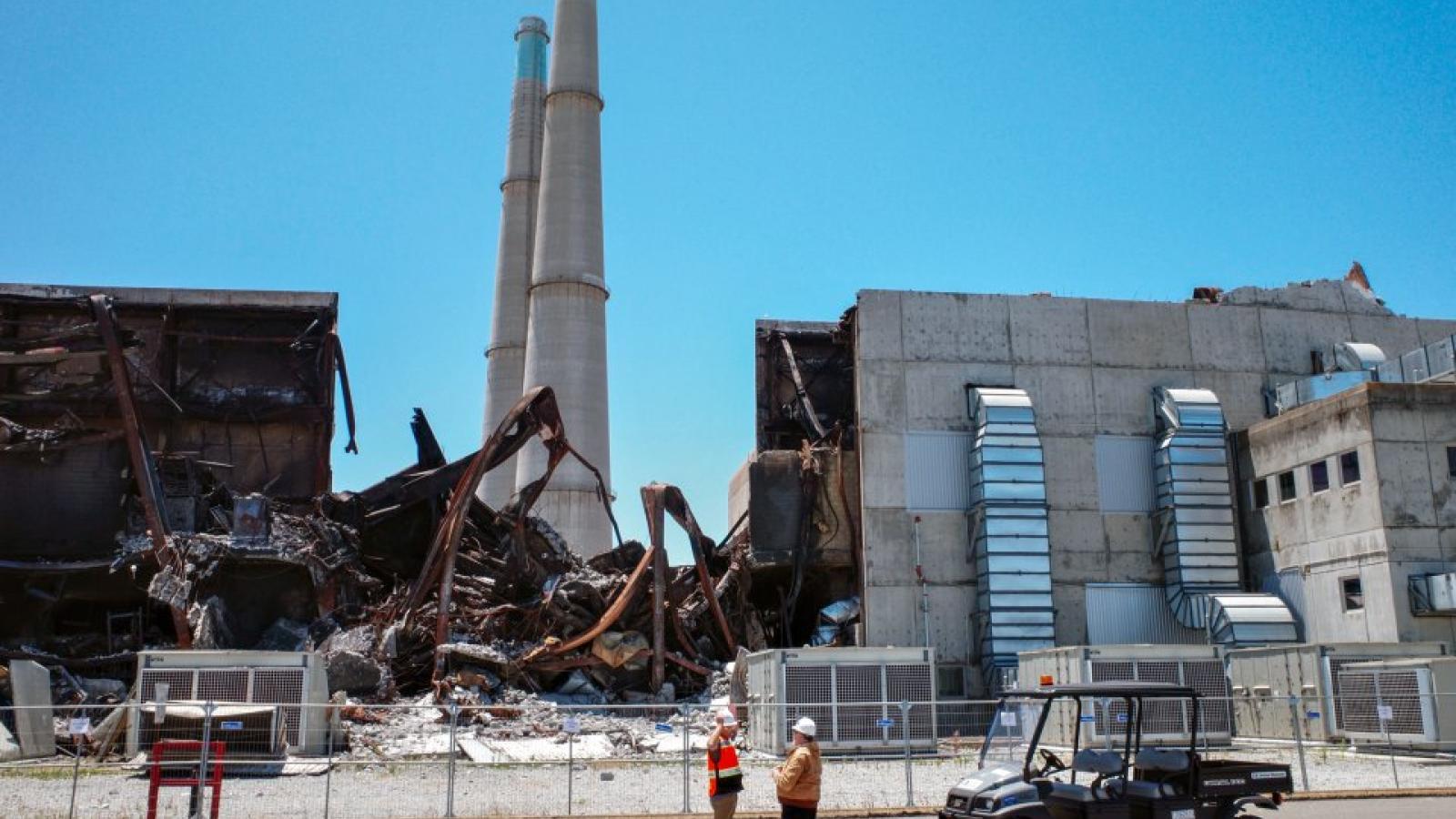
Officials survey the fire damage at the Moss Landing battery facility.
(U.S. Environmental Protection Agency)
Report suggests disastrous outcome
Once welcomed as a green-energy solution, the Moss Landing incident has raised fears about the facilities. As project developers look to the population-dense neighborhoods of Long Island, residents and fire departments are pushing back.
It's not just people in New York who are fighting the facilities. A developer looking to build a BESS in Comfort, Texas, abandoned the project following sustained resistance from residents, fire safety personnel and Kendall County officials.
The Hauppauge Fire Department asked an electrical engineer who lives on Long Island to prepare a report on the risks one proposed facility presents to the area. The report found that a fire at the facility could result in the evacuation of tens of thousands residents and leach toxic metals into the aquifer that supplies drinking water to residents.
Dispatchable emission-free resources
The New York Climate Leadership & Community Protection Act was passed in 2019, and it committed the state to 70% renewable electricity and a 40% emissions drop from 1990 levels — all by 2030. Following that target, the legally binding goal was to reach zero-emissions electricity by 2040, which would then be extended across the entire economy by 2050.
Powering an energy-hungry state like New York with intermittent electricity from wind and solar has long presented a challenge. The state planners realized they’d need what they called "dispatchable emissions-free resources" — DEFR, which is pronounced dee-fer — to stabilize the power supply. These DEFRs would provide backup when the wind wasn’t blowing and the sun wasn’t shining.
The problem is no one has really decided what these were or how they’d work, but BESSs has been one option the state is pursuing aggressively.
“Long-term, catastrophic environmental damage”
The proposed facility in Hauppauge would be located within 3,500 feet of an elementary school in a densely populated area. The fire department has joined in the opposition to the facility, and it asked Richard Ellenbogen, an electrical engineer, to prepare a report on the risks the facility would pose to the surrounding communities.
A fire in a lithium-ion facility, like the one at Moss Landing, could produce “long-term, catastrophic environmental damage” in addition to the “very serious threat to people and structures at the school and” surrounding neighborhoods, Ellenbogen’s report states.
When burning, lithium-ion batteries produce extremely high heat, and are extremely difficult to extinguish.
Eco-manufacturer opposes climate act
Years ago, Richard Ellenbogen, who is president of eco-manufacturer Allied Converters, took a look at New York’s climate act and saw that electricity-generation margins were going to be falling below zero as it pursued a grid powered by intermittent sources free from fossil fuel-powered generation.
“I immediately became a huge critic of it — not because I’m anti-environment as is apparent by what I've done — but because it's not achievable,” he told Just the News.
To avoid blackouts, he installed solar panels and backup generators powered by natural gas at his house, which was featured in a New York Times article in 2008. He said his system today provides about 80% of his power on site, and its carbon footprint is 30%-40% lower than the utility system.
“While everybody else's utility bills are going up, ours are flat lined or going down,” Ellenbogen said.
If something goes wrong
Key Capture Energy and the Long Island Power Authority are developing the 79-megawatt proposed facility. Ellenbogen wasn’t paid for the report he prepared for the Hauppauge Fire Department. Among the problems it identifies is the volatility of lithium.
“It's really volatile, which makes it really great for energy storage, but it makes it really hard to control if something goes wrong,” Ellenbogen said in an interview.
When it comes into contact with water, it generates a reaction that produces temperatures as high as 5,000 degrees Fahrenheit. The batteries can also burst into flames if they enter a state of what’s called thermal runaway under heavy loads.
“These fires spread rapidly within a BESS facility, quickly resulting in a conflagration. In addition to the great heat from them, there is release of toxic gases during the fires,” the report explains.
Following a fire at the facility, the heavy metals and other toxins that are released into the air and water create pollution that is nearly impossible to remediate. Long Island, the report explains, has highly permeable soil and a history of water issues.
These toxins produce a wide range of health effects, including asthma, tremors, cardiomyopathy and cancers.
Dangers increase in high-density population centers
The report also notes that the population density of the area is very different from that of Moss Landing. There were only 1,250 people within the 2.75-mile evacuation zone of the Moss Landing fire.
The Moss Landing facility had a capacity of 750 megawatts. It was many times the size of the proposed Long Island facility, but an evacuation zone around the Long Island facility of just one mile would require the evacuation of 20,000 to 40,000 people, according to the report.
Christina Tisi-Kramer, a resident of Long Island, has been attending public hearings on proposed facilities. She said that it seems there’s another proposal popping up regularly.
“We are exhausted with this entire renewable energy. I don't even call it renewable anymore. I call it alternative energy, this farce,” Tisi-Kramer said.
In nearby Hempstead in January, residents came out to support an extension on a moratorium on BESS facilities. The town board ultimately tabled the measure. In January, Troy, N.Y. enacted a moratorium, and is considering a total ban.
“They're nothing more than energy vending machines. They're energy vending machines for private equity investors. There's nothing good about them, except for that they are making money for their shareholders,” Tisi-Kramer said.
She explained that, because fires can impact a large area, she can’t just limit her concerns to the community in which she lives. A facility anywhere on Long Island becomes a risk for neighboring communities, she said.
“It's affecting communities for miles around them in all directions, particularly in the direction that the wind blows. Our firefighters are not trained to put these fires out,” she said.
Expensive "backroom deals"
Tisi-Kramer said it’s especially frustrating because there are better options for reducing emissions, and the climate act is saddling New Yorkers with higher energy costs.
“We have natural gas. They can build nuclear. We don't have a clean energy problem in New York. [New York Governor] Kathy Hochul and people like her are just capitalizing on the backroom deals. And the residents of Long Island are suffering. We will be strapped with higher energy costs for the rest of our lives. There's nothing good about this,” she said.
Ellenbogen said that the climate act is attempting to regulate away physics, which is impossible, and it’s pitting project developers against communities. The state, he said, needs utility infrastructure, and energy storage is important. However, decisions are being driven by the wrong people.
“They've taken infrastructure planning away from the engineers and turned it over to politicians, climate activists and climate scientists who don't understand what they're doing,” Ellenbogen said.
The end result will be a freeze on all development. Residents are becoming increasingly distrustful of the state government, such as the disputes in Upstate New York over the citing of solar projects. As a result, Ellenbogen said, not in my backyard (NIMBY) activism has become CAVE – citizens against virtually everything.
“There's people who don't want anything anymore because they no longer have faith that the government has a brain,” he said.
Kevin Killough is the energy reporter for Just The News. You can follow him on X for more coverage.
The Facts Inside Our Reporter's Notebook
Videos
Links
- widespread layer of toxic metals
- businesses continue to be impacted
- abandoned the project
- Climate Leadership & Community Protection Act
- fire department has joined in the opposition
- report states
- Allied Converters
- New York Times article
- support an extension
- Troy enacted a moratorium
- disputes in Upstate New York
- citing of solar projects
Other Media
Image
Officials survey the fire damage at the Moss Landing battery facility.
(U.S. Environmental Protection Agency)
Top Stories



Trending
Just the News Spotlight
Just News, No Noise