Not just gasoline: Besides oil, Iran export blockage could also drive up food costs, expert warns
It's not just crude oil and LNG that move through the Strait of Hormuz. One fourth of the world's nitrogen fertilizer supplies come from the Middle East, and that supply is vital to modern global agriculture. The conflict in Iran threatens to drive up those prices, along with other petroleum products.
In response to the U.S. military strikes, Iran is threatening to cut off shipping from the Strait of Hormuz, which is an artery through which 15 million barrels of crude oil per day and 4 million barrels of refined petroleum products, such as diesel, flow.
Whether or not it can pull a full blockade off is doubtful, but the conflict has already managed to greatly disrupt exports moving through the strait. This, according to Wood MacKenzie, represents 15% of the global oil supply flows.
Robert Rapier, a chemical engineer and editor-in-chief of Shale Magazine, told Just the News that the Gulf region is also a major supplier of nitrogen fertilizer, and those supplies will be difficult to get out as a result of shipping halts. Approximately half of the world’s crops depend on nitrogen fertilizers, and one-fourth of the world’s supply comes from the Middle East.
With diesel prices rising, and nitrogen fertilizer shipments disrupted, the conflict may threaten global food supplies and drive up costs.
Near a worst-case scenario
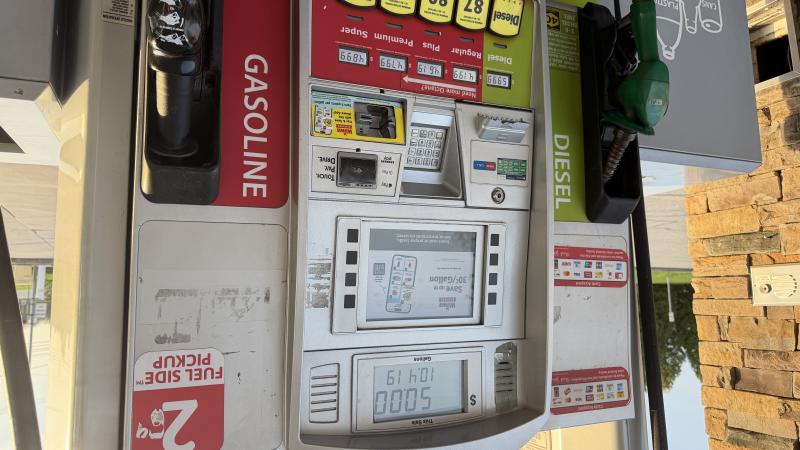
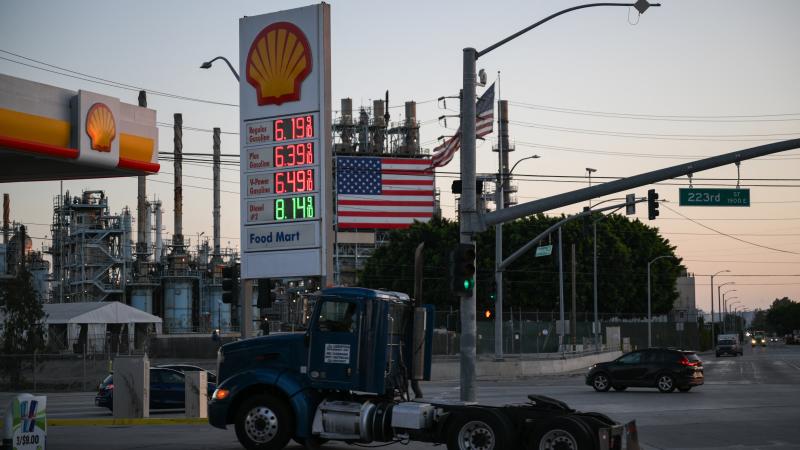
The situation in Iran has driven up the West Texas Intermediate price of crude — the U.S. benchmark — to more than $70 per barrel Monday, according to OilPrice.com. Gasoline prices in the U.S. on Monday were up by $0.10 over where they were a week ago, according to GasBuddy.
“This is near a worst-case scenario, with Iran being involved in military conflict, because of the Strait of Hormuz. The only thing worse would be if Iran and Saudi Arabia start fighting,” Rapier said.
David Blackmon, an analyst with more than 40 years of experience in the oil and gas industry and author of the “Energy Absurdities” Substack, told Just the News that Iran lacks any capability of forming a real blockade at the strait. But it can fire missiles at tanker traffic shipping through the chokepoint and endanger the shipping lane.
Shipping through the strait was effectively halted on Sunday, when the world’s largest maritime mutuals withdrew insurance covering war risk, Bloomberg News reported. The decision will likely discourage shipowners from risking their vessels and cargo in the Strait of Hormuz until the conflict is resolved, or new premiums are negotiated.
This won’t have as large of an impact on the U.S. Most of our oil is imported from Canada. About 444,000 barrels per day come from Saudi Arabia. The country has alternative routes, but Iran may be able to prevent some of those from getting shipped to the U.S.
Especially bad news for China
The larger impact is on China and Iran itself. All of Iran’s oil moves through the strait, and much of it goes to China. Asian markets opened Monday with a modest 7.5% jump, and the Brent price of crude oil — the European benchmark — was at $77.53 Monday afternoon. “I've been gratified by the fact that traders didn't just go crazy when the markets opened in Asia,” Blackmon said.
Blackmon also said this shows there’s no real blockade at the strait. Also, China has considerable reserves at onshore inventories, as well as Iranian tankers at sea to keep its energy needs met for now. Likewise, the global market was oversupplied by 2 million barrels per day before hostilities in Iran began.
“So there’s a cushion,” Blackmon said.
Image
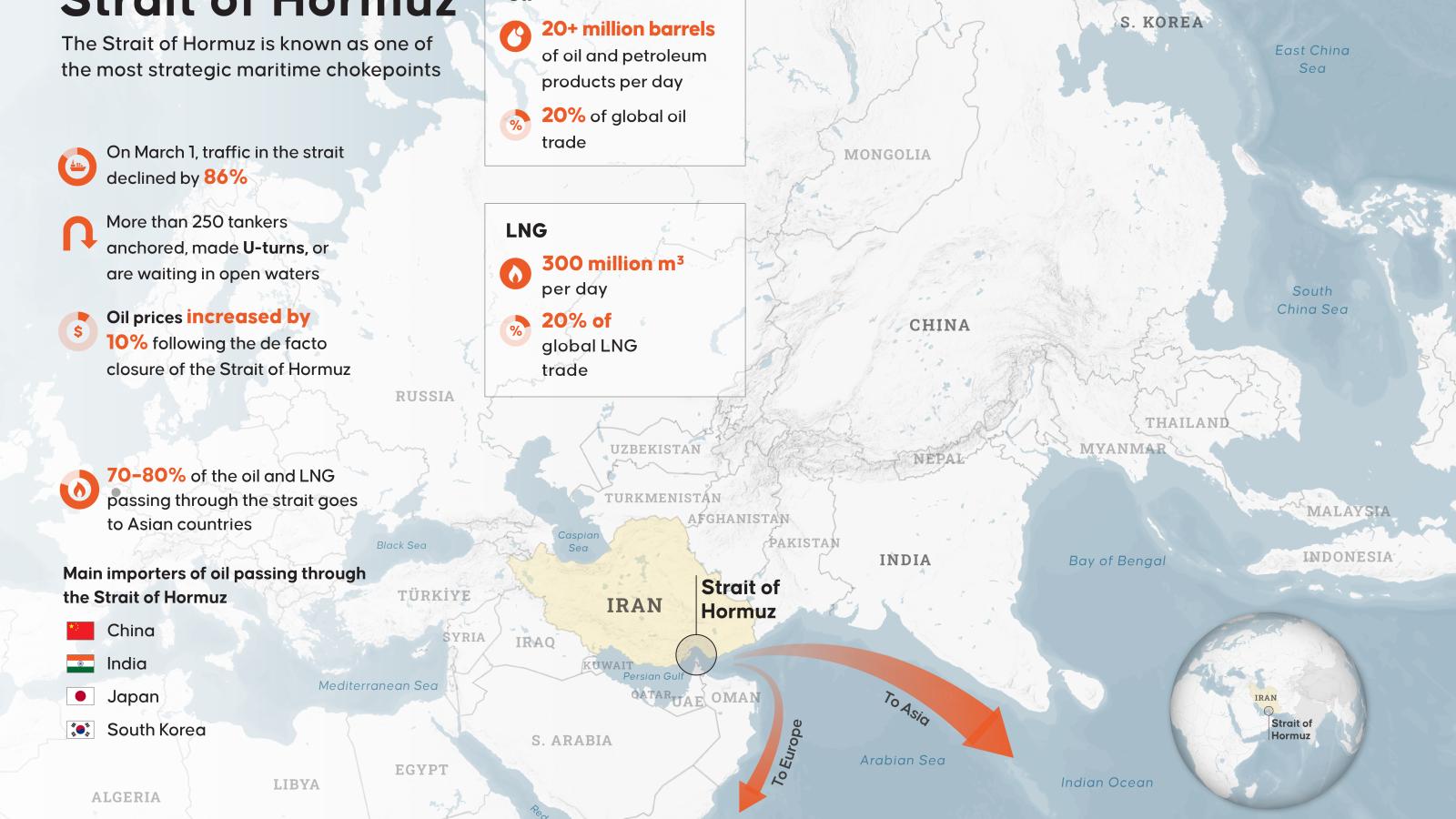
An infographic titled "Strait of Hormuz" created in Ankara, Turkiye on March 2, 2026.
(Getty Images)
For China, the situation in Iran adds to their complicated situation vis-a-vis Venezuela. Prior to the U.S. removing former Venezuelan president Nicolás Maduro, China received about 800,000 barrels per day of sanctioned crude oil from the country, and all that was at discounted prices of about $30 per barrel. Another 2 million barrels per day came from Iran, and that was also at discounted prices.
Blackmon said China will be able to find new sources of crude oil to replace those it’s losing, but it’s going to be at market prices, which will impact its economy. If exports through the Strait of Hormuz are halted for a long period of time, he said, then China could be in real trouble. “China could have a problem just in terms of having enough imports to run their economy,” he said.
$100 per barrel oil possible
Blackmon said it’s hard to predict how the situation will ultimately play out. If insurers negotiate new premiums with shippers within the next week, it could all be a pretty minor impact. “If it goes longer than that, then we could have a pretty significant problem,” he said.
Woods MacKenzie estimates that, even under the best-case scenario where the Iranian regime cooperates with the U.S. to end the conflict, it will take at least a month for exports to move through the Strait of Hormuz. Following the Russian invasion of Ukraine, the loss of 3 million barrels per day drove up prices from $80 per barrel to more than $125. Once the market saw that supplies weren’t going to be impaired by the conflict, the prices dropped again.
In this conflict, 15 million barrels per day are at stake, and Woods MacKenzie forecasts that a price of $100 per barrel is possible. There are some alternative routes to avoid the Strait of Hormuz, and higher prices could incentivize producers to hit maximum outputs.
It’s not an easy thing to ramp up production, however, and even the U.S. would need up to a year to add more than a few hundred thousand barrels per day to its production. If global producers managed to add a couple million barrels per day to the market over the course of several months, Woods Mackenzie notes, it wouldn’t make up for the loss of 15 million barrels per day.
Fertilizer and natural gas
Writing in Forbes, Rapier explained that nitrogen fertilizer is made with natural gas. About 55 to 60 million tons of it is moved through international seaborne trade every year, and the Middle East produces about half of it. Almost all of it transits through the Strait of Hormuz.
“In other words, close to one-quarter of globally traded nitrogen fertilizer — and a meaningful share of total global nitrogen production — moves through that single maritime chokepoint that is now threatened by war,” Rapier wrote.
Qatar, the third-largest exporter of liquefied natural gas in the world, is also impacted. Iran attacked facilities in Ras Laffan in Qatar, which are operated by the state-owned company QatarEnergy. The company announced Monday it was stopping production of LNG. According to Woods Mackenzie, 20% of the global LNG supply transits the Strait of Hormuz, and virtually all of that comes out of Qatar to Asian markets. This could trigger competition for LNG between Europe and Asia, and European storage levels are below seasonal norms.
While Woods MacKenzie predicted spikes in gas prices on Monday, prices were up only slightly over the previous week. The situation will mean more demand for U.S. LNG. The U.S. is the largest exporter of LNG in the world.
Blackmon said that it’s likely the situation will take a while, possibly longer, to settle down. While the initial impacts of gasoline and natural gas prices are fairly modest, it’s anyone’s guess what will happen in the coming weeks.
“I just don't see this resolving quickly. Iran has a big army, and they're a fairly populous country. It just depends on how quickly things resolve over there, but this could be a mess for a while,” Blackmon said.
Kevin Killough is the energy reporter for Just The News. You can follow him on X for more coverage.
The Facts Inside Our Reporter's Notebook
Links
- according to Wood MacKenzie
- Shale Magazine
- half of the worldâs crops
- according to
- OilPrice.com
- according to GasBuddy
- Energy Absurdities
- Bloomberg reported
- Brent price of crude oil
- Woods MacKenzie estimates
- Writing in Forbes
- production of LNG
- prices were up only slightly over the previous week
- follow him on X
Top Stories




Trending
Just the News Spotlight
Just News, No Noise