Oil-rich Texas to build power lines for renewables, and landowners face possible eminent domain
Despite being one of the most prolific oil and gas regions in the world, the state of Texas is proposing to build 200-foot high high-voltage power lines to support renewable energy. The routes will cross private land, and landowners in the Lone Star State are facing the threat of eminent domain.
Texas produces so much oil that if it were an independent country, it would rank in fourth or fifth place in the world’s top oil producers. Yet the state is still looking to build massive high-voltage transmission lines primarily to satisfy the needs of wind, solar and battery facilities.
The lines will cross over tens of thousands of acres of private land. The Texas legislature shrunk the timeline to construct them at breakneck speed, which has made the landowners very conerned, considering they have little time to provide input and are potentially facing eminent domain to make room for the projects.
The power lines are 765 kilovolt lines, which are strung over 200-foot towers requiring corridors 200 to 300 feet wide.
Margaret Byfield, executive director of the American Stewards of Liberty, said that landowners who object to the lines crossing their land are effectively asking for the company to reroute it to other property owners, who also don’t want the lines on their property.
“So it pits neighbor against neighbor. It's just a terrible system,” Byfield told Just the News.
STEPing up power lines
In 2023, the Texas legislature passed House Bill 5066, which created new forecasting rules for electricity demand and required reliability plans to ensure timely planning, identification and approval of needed transmission improvements. It also requires expedited permitting from the Public Utility Commission of Texas.
The Electric Reliability Council of Texas (ERCOT), the state’s grid operator, created the Strategic Transmission Expansion Plan (STEP), which proposes the construction of new 765 power lines. These will, ERCOT says, meet rising demand and the “increasing penetration of intermittent generation” from wind, solar and large-scale battery facilities.
Among the demand drivers are data centers, hydrogen manufacturing and the electrification of oil and gas operations in the Permian Basin.
David Blackmon, an analyst in Texas with more than 40 years of experience in the oil and gas industry and author of the “Energy Absurdities,” told Just the News that the Permian basin is more than capable of supplying its own energy with the energy it produces. The state, however, is reluctant to build natural gas-fired power plants in West Texas.
“They'd much rather put up a bunch of windmills. Apparently, that's more profitable for them, or at least it was with all the incentives from the federal government,” he said.
‘Prettiest pieces of Texas’
Byfield said the path of the proposed power lines will cross pristine land in rural West Texas.
“It's where all the wine country is. It's one of the prettiest pieces of Texas,” she said.
Jan Rose is among the landowners potentially facing eminent domain as a result of STEP. She’s the owner/operator of the Taylor-Rose Ranch in Burnet County, northwest of Austin, and her ranch has been in the family since 1883.
Last June, she received a letter in the mail from Oncor, one of the companies building the projects. She said it was a “nondescript letter.” She thought it was junk mail and tossed it in a pile.
Later, she heard something about a transmission line being proposed for the area and went to look at the letter again. It was an invitation to a public forum on the project, which was happening the following day. Despite the short notice, she attended. She said there were about 500 or 600 people attending the meeting.
“It was total chaos. They were trying to get information from us. They gave us a form to fill out with all of our concerns when we didn't even know what the project was,” Rose told Just the News.
Since then, she’s learned a lot more about the project, including the height of the towers and width of the right-of-way. She said none of that came out of the meeting. Instead, all her neighbors have gotten together to help each other learn about what the project means for their community. Oncor, she said, hasn’t been any help.
“They're not responsive. They don't return our phone calls or our emails with inquiries,” Rose said.
Image
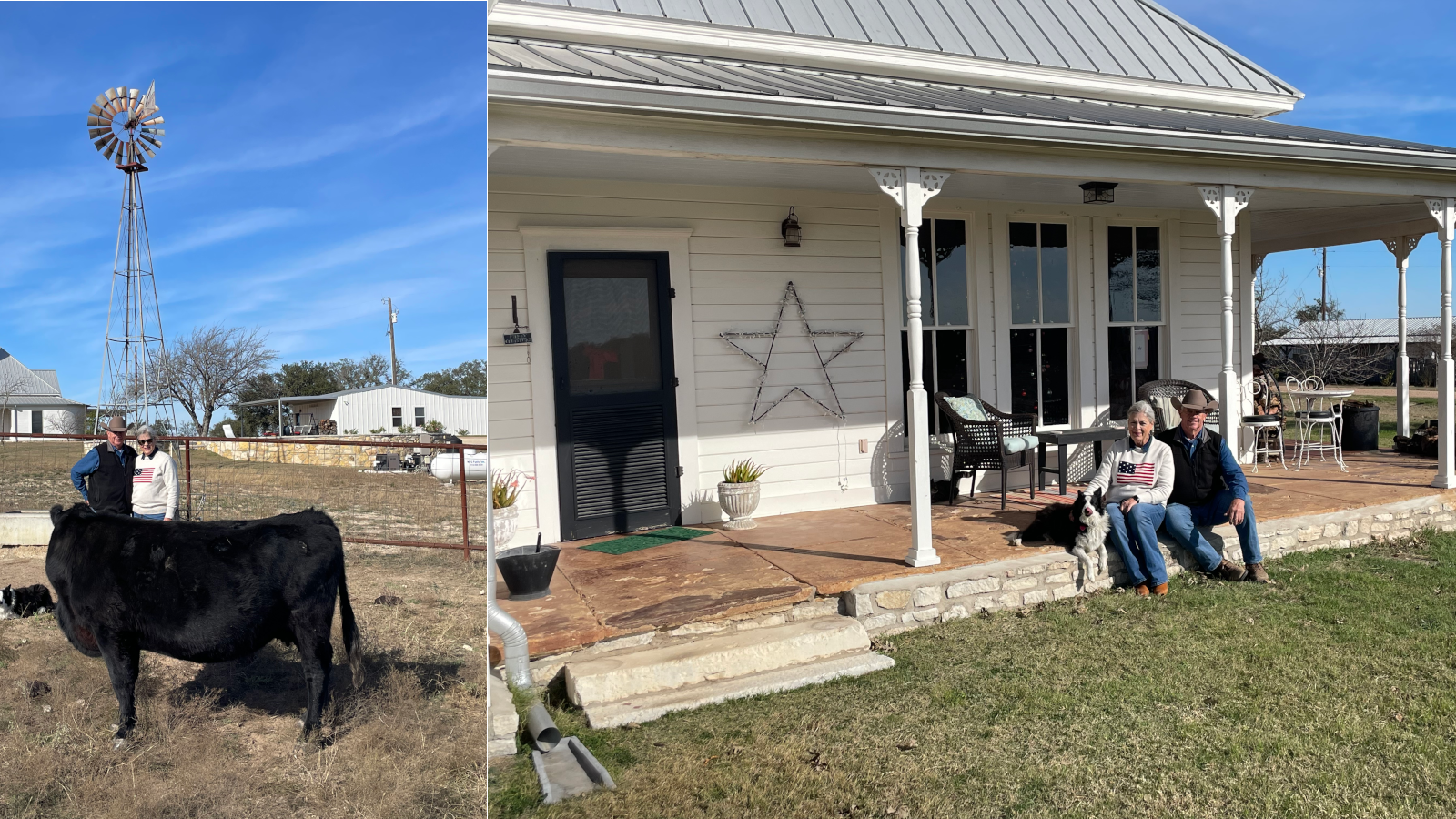
Jan and Austin Rose's ranch has been in their family since 1883. Now, the state is proposing a high voltage transmission line that could potentially cross their land.
(Courtesy Jan Rose)
Oncor says it works with land owners
Andrew Clark, spokesperson for Oncor, told Just the News that public input is an important part of the regulatory process that Oncor follows when developing transmission lines.
"Oncor has responded to thousands of emails, phone calls, letters and other communications from local community members regarding our four 765kV projects," he said.
Clark also said Oncor uses that input to refine the proposed routes that are submitted to the PUC, and the company responds to questions from anyone interested in the projects. The company has also coordinated with federal, state and local agencies throughout the process.
Prior to construction, Clark said, the company worked with landowners to acquire rights for access, called utility easements.
"With an easement, a landowner continues to own and use the property in a manner that does not interfere with Oncor facilities, and Oncor has the right to use the land for construction, operation, and maintenance of power lines," Clark said.
Clark said that Oncor negotiates fair and appropriate compensation with each landowner and Oncor representatives are available during and after construction to address questions, concerns, or problems landowners may have.
When asked about the need for the transmission lines and their short permitting and construction timeline, ERCOT referred Just the News to its website.
Proposed route cuts through history
Rose said the proposed path cuts her cattle operation in two, and it comes within 100 feet of their home, a restored house that was built 120 years ago. It would also come close to their headquarters, their barns, water sources and other historic structures.
Since the company has a right by statute to use eminent domain to take the property, Rose said they’re in the position where they can work with Oncor, which may provide some small concessions. If the Roses choose to fight, however, they risk having their property taken by eminent domain. Rose said it’s a tough choice to make.
If the project is built using their property, she estimates it will lower their ranch’s value by 50%. The land in that area, she said, goes from anywhere from $17,000 to $25,000 per acre.
Engaging with the project developers through the complex legal process requires lawyers. The landowners with whom Just the News spoke said it’s not easy to find one, even for those who can afford it. There are only so many in the state who specialize in these kinds of cases, and almost all of them have taken on other clients.
If an attorney is representing a landowner trying to get the project rerouted, then the attorney can’t represent the neighbors who may have the line rerouted over their land.
Rushed through the process
Burnet County Commissioner Damon Beierle said the Roses aren’t alone. He said he’s been fielding numerous calls from landowners concerned about the project and its impact on all the legacy ranches in the county.
“It'll forever change the landscape and the economics of Burnet County,” Beierle told Just the News.
He attended the public hearing in June, and he said the company provided few answers. Oncor provided maps, timelines and information about the project, but there was no engagement with the landowners.
He said the PUC is supposed to consider a wide range of impacts of a project, but he doesn’t see that they’ve done that. Instead, it’s being rushed through the process.
“I think it's for a reason, so they can get in and get out and get it done,” Beierle said.
Kevin Kennedy, a former highway planner with an engineering background, told Just the News that the proposed routes suggest there’s been little consideration of the impact it may have. One section of the proposed route runs right on top of the North San Gabriel River. Kennedy said the river is untouched and runs crystal clear water. It also has a lot of archeological sites along it.
“You show that to any engineer and environmentalist, and they will wonder what you've been smoking,” Kennedy said.
From the desert to the ocean
Besides the impact on land values and the threat of eminent domain, opponents of the project are concerned about the impact on their electricity rates. The capital cost of the estimated $30 billion project will be borne by the ratepayers of Texas over decades.
State Sen. Kevin Sparks, a Republican, said these added costs to consumers’ bills aren’t necessary.
“I work in the oil and gas industry. We are the most energy-rich region in the lower 48 states. So why in the world would we need to pipe in electricity to the most energy-rich region in the United States? Makes no logical sense,” he told Just the News.
Kennedy said that building a power line from the east part of Texas to the oil-producing western part of the state is a lot like building a pipeline from the desert to the ocean to help make sure the ocean has enough water.
The entire STEP includes two phases and three new 765 power lines, as well as smaller 345-kilovolt power lines. Sparks’ district includes Midland and the Texas panhandle, where one of the sections of the project will cross.
Sparks said he’s been fielding project-related calls and emails from constituents since October, and many of them don’t know what they can do about it.
The Burnet County Commission passed a resolution asking the PUC to consider other routes, minimize impacts from construction, and to work with landowners. The American Stewards of Liberty is encouraging counties to establish “391 commissions,” which require state agencies to coordinate transmission line projects with the members of the commission.
Losing agricultural land to renewables
Texas has some of the highest penetrations of wind, solar and batteries in the country. While electricity rates are currently below the national average in the state, they’re higher than all the neighboring states. Wind and solar farms take up a lot of land, and that requires a lot of transmission lines to connect them to the grid.
Whatever routes transmission projects take in the state, they’re going to impact a lot of land, and much of that will be rural ranch and farmlands.
“We're losing a lot of our farming capacity in Texas anyway. And if we continue to devalue it by putting in wind farms and solar farms and, now, overhead lines that you'll be able to see for miles and miles and miles – you're going to look up in 20 years, and we're not even going to be able to feed the state of Texas, much less United States,” Sparks said.
Kevin Killough is the energy reporter for Just The News. You can follow him on X for more coverage.
The Facts Inside Our Reporter's Notebook
Links
- American Stewards of Liberty
- House Bill 5066
- ERCOT explains
- Energy Absurdities
- Oncor
- borne by the ratepayers of Texas over decades
- entire STEP includes
- one of the sections of the project will cross
- passed a resolution
- encouraging counties
- highest penetrations of wind, solar and batteries
- follow him on X
Other Media
Image
Jan and Austin Rose's ranch has been in their family since 1883. Now, the state is proposing a high voltage transmission line that could potentially cross their land.
(Courtesy Jan Rose)
Top Stories



Trending
Just the News Spotlight
Just News, No Noise