Opposition to data centers turns violent as local concerns merge with hostility toward Big Tech
Big Tech is facing a wave of community opposition to data centers, and some opponents are using violence to advance their cause. Experts say the opposition to data centers has various sources, but whatever the reasons, tech companies will need to find ways to get communities to buy-in.
Big Tech faces a number of challenges with the expansion of data centers, including getting the energy to power them. But if the impacts of renewable energy opposition are any indication, the local opposition to data centers is going to become a formidable opponent to the expansion of artificial intelligence.
Renewable energy requires large amounts of land, and unlike other energy sources, it requires a lot of new acreage in rural areas. Local opposition has been identified as the biggest impediment by Big Wind and Big Solar to the buildout of renewable energy.
Become fanatical, even violent
The opposition to data centers is not only rising rapidly, in some cases it’s become fanatical. An opponent of data centers fired shots into an Indiana councilman’s house and left a note reading “No Data Centers.” The councilman supported a development commission’s decision to approve a rezoning petition allowing for a data center to be developed, PBS reported.
Multiple comments on a CBS story posted on X about the shooting expressed sympathy for the attacker’s opposition. The organizations opposing the data center condemned the violence and said it doesn’t reflect their advocacy.
Image
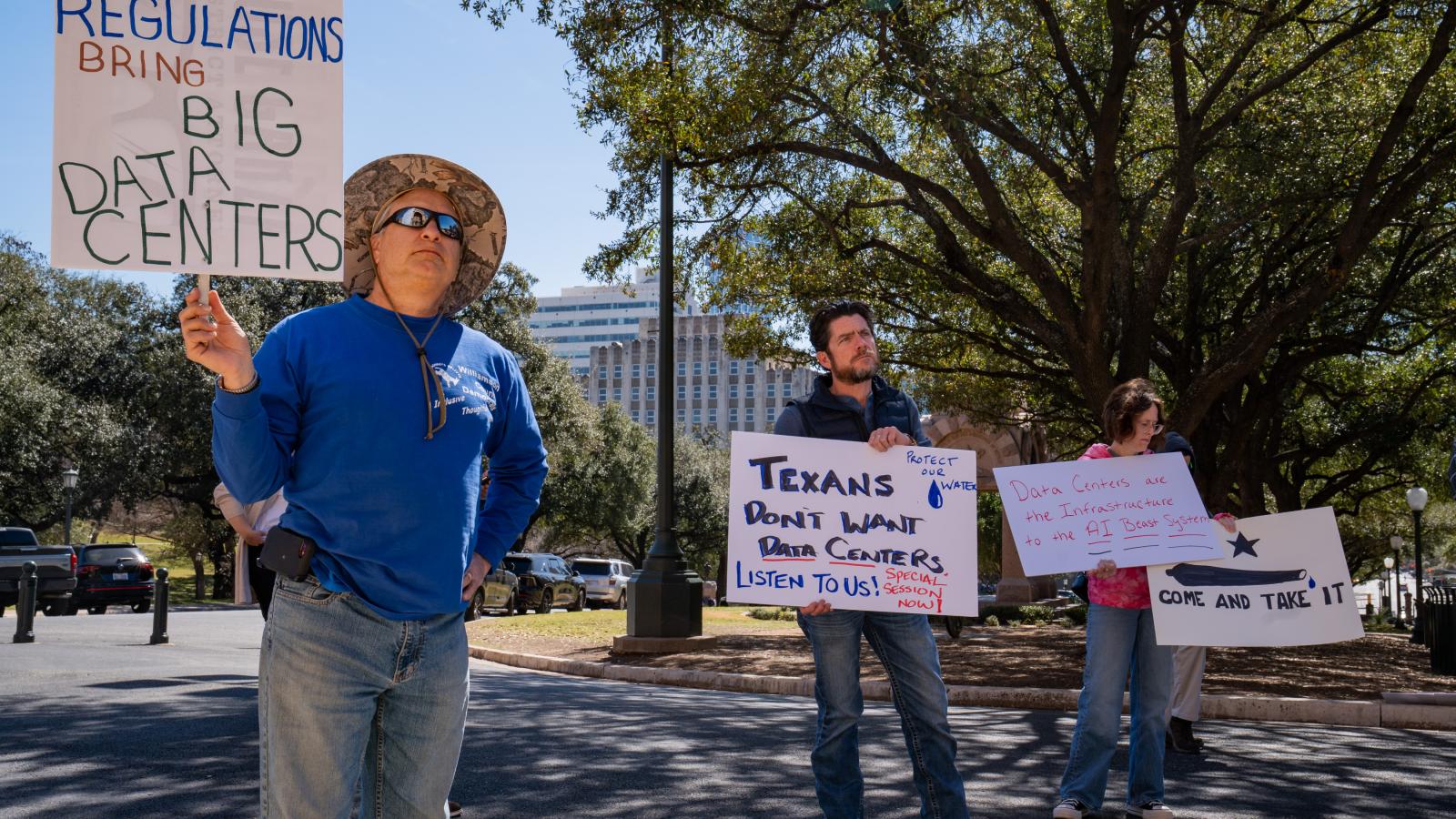
Advocacy groups and community members protest laws surrounding data centers while outside the Texas Capitol in Austin Monday, Feb. 23, 2026.
(Getty Images)
A man accused of throwing a Molotov cocktail at the home of Sam Altman, CEO of OpenAI, had writings claiming artificial intelligence will result in the extinction of the human race, NPR reported.
These extremists are on the fringe of the opposition, and most opponents aren’t using violence to advance their positions. They’re concerned about the impact of data centers on their electricity rates, views, water resources and property values. Some of those concerns aren't supported by the data, but whether or not facts support their case, Big Tech will have to contend with the opposition. Unlike renewable energy, it won’t have quite the backing of governments and subsidies to overwhelm opponents.
Experts tell Just the News that the opposition to data centers is driven by a deep distrust of Big Tech and climate groups. There are also ways that Big Tech can address some of the concerns opponents have and possibly assuage some of these community concerns.
‘Unprecedented’ opposition across U.S.
Energy expert Robert Bryce, who has tracked rejections of renewable energy projects for years, is maintaining a database of data center rejections. Between 2021 and April 7, 2026, according to Bryce’s database, 70 communities rejected or restricted data centers. A week later, Maine enacted a moratorium on new data centers.
Bryce produced a short documentary on the backlash against data centers, where he interviewed opponents of a data center facility planned by Skybox in Round Rock, Texas, which is north of Austin. The opponents in the video tell Bryce they’re worried about the impact of the 60-foot facility on their views in the neighborhood, noise, water use, property values and electricity rates.
“All those issues are in play when it comes to data centers, but then you add in the distrust or even outright hatred of big tech combined with the general public's concerns about AI, and you have a whole then range of issues that are now being used by opponents to fight these data center projects,” Bryce told Just the News.
Bryce said he’s been tracking opposition to alternative energy projects for 16 years, but he’s never seen in that time something similar to the level of opposition he’s seeing to data centers.
“This is unprecedented,” he said.
Climate activists join opposition: "A coordinated national campaign"
The American Energy Institute published a study this month that ties the opposition to networks of activist groups. The study highlights 12 organizations that are actively opposing U.S. data center development, which have collectively received millions from foreign donors.
“These are not isolated protests. They are part of a coordinated national campaign to slow the buildout of the electricity systems required for AI, manufacturing and economic growth. That directly undermines President Trump’s agenda to secure American dominance in artificial intelligence and rebuild the energy systems needed to power it,” Jason Isaac, CEO of the American Energy Institute, said in a statement.
In December, 230 activist organizations, many of which are affiliated with the dozen groups highlighted in the institute’s report, signed a letter demanding that Congress impose a national moratorium on the approval and construction of new data centers. Besides the concerns shared by many communities about data centers, the activist groups are also concerned about climate change.
Because renewable energy is unreliable, it’s not capable of doing much more than providing intermittent fuel savings for the baseload power — mainly natural gas-powered generation — upon which data centers rely. More than half of the power for data centers, the activists complain in their letter, comes from fossil fuels.
“These are not popping up like mushrooms, as everyone is making them out to be." - Gabriella Hoffman, director of energy and conservation for the Independent Women’s Center
According to the institute's study, these groups have local chapters that host anti-data center events in multiple states, and the local groups are supported with funding from national organizations.
The study argues that the opposition to data centers isn’t a spontaneous grassroots movement, but rather a well-funded coordinated campaign by groups and donors pushing a progressive agenda.
It should be noted that proponents of renewable energy made similar claims about the opposition to renewable energy. Anti-fossil fuel activists like Brown University’s J. Timmons Roberts published articles claiming that the opposition was primarily driven by oil companies afraid of competition from alternative energy sources and “climate denial” think tanks. Publications funded by anti-fossil fuel groups, such as ProPublica, also published articles painting opposition to renewable energy as being a front for oil companies’ interest.
Pathways to sustainable development
Whatever its source, the opposition to data centers stretches across the U.S. A Gallup poll released in September found that 80% of the public wants to slow down the development of AI, and 66% of adults have some level of distrust when it comes to AI’s ability to make fair and unbiased decisions.
A YouGov poll published in December found that 77% of Americans believe that AI could pose a threat to humanity. Despite the distrust, the poll also found that 35% of adults, including 51% of GenZers, use AI tools weekly.
Gabriella Hoffman, director of energy and conservation for the Independent Women’s Center, argues that many of the concerns communities have about data centers can be addressed. Hoffman told Just the News that part of what drives the opposition to data centers is a misunderstanding about what they do.
Facilities requiring large space and cooling systems go back to the 1940s, Hoffman explains in a policy paper, and the facilities handle the data for a wide range of technologies people use every day — from online purchases to emails. “These are not popping up like mushrooms, as everyone is making them out to be. And it's similar, in my opinion, to the fear mongering placed on fracking and also nuclear energy as well,” Hoffman said.
Hoffman said that, while some concerns like impacts to electricity rates are not well supported, she doesn’t dismiss all concerns people have about data centers. However, these problems have solutions, Hoffman argues.
Concerns about water usage, for example, can be addressed with closed-loop recycling. Electricity demand can be addressed with more reliable power from nuclear, natural gas, coal and geothermal.
“I think data centers can be built sustainably. We have thousands of them already. It's not as terrible as everyone makes it out to be, and unless people quit their addiction to technology, they’re going to be feeding the demand for AI data centers,” Hoffman said.
Community buy-in needed
Renewable energy has been able to, in many cases, steamroll over local concerns since it enjoyed massive subsidies and support for governments pursuing an energy transition, which has not materialized.
Bryce said that the opposition to data centers provides a path by which people can fight Big Tech, which they’ve wanted to do for some time. Activism over privacy concerns has gained little traction against these big companies, but they are winning at local zoning board hearings.
“People understand they can't fight big tech in the digital world, so they're fighting them in the physical world,” Bryce said.
Hoffman said that Big Tech will have to work on the community buy-in if they’re going to get local boards to permit their projects. Tech companies will likely be on board with a lot of what is needed to address many of the concerns. They’ve always been supportive of industry developing alongside nature preservation, and marrying the two won’t present insurmountable obstacles, Hoffman said.
“We can be judicious and practical with how AI data centers are developed without supporting moratoriums or the kind of NIMBYism [Not In My Back Yard] we're seeing,” Hoffman said.
The Facts Inside Our Reporter's Notebook
Links
- Local opposition has been identified
- PBS reported
- CBS story posted on X
- NPR reported
- database of data center rejections
- Maine enacted a moratorium
- Bryce produced a short documentary
- Skybox
- American Energy Institute published a study
- signed a letter
- published articles
- published articles
- Hoffman explains in a policy paper
- impacts to electricity rates are not well supported
- closed-loop recycling
- steamroll over local concerns
- has not materialized
Other Media
Image
Advocacy groups and community members protest laws surrounding data centers while outside the Texas Capitol in Austin Monday, Feb. 23, 2026.
(Getty Images)


Top Stories



Trending
Just the News Spotlight
Just News, No Noise